THE SATOR SQUARE SONNET
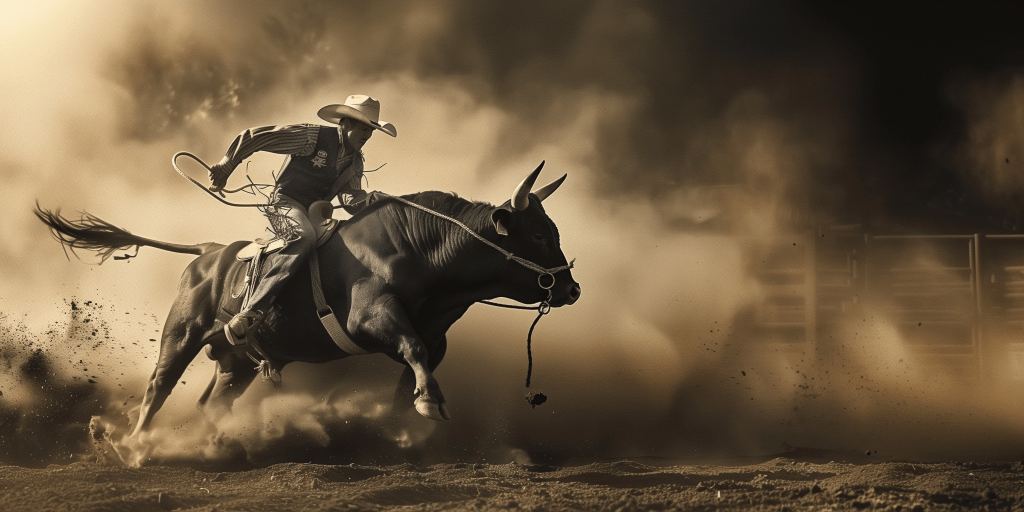
As with the Chiastic Helix Sonnet, this form began not as a theory but as an experience: a memory that lay dormant for years before I recognized in it the architecture of a formal system. To call it a sonnet outright would be misleading. Aside from the fourteen lines we associate with the traditional form, the Shakespearean rhyme scheme is concealed internally, occurring on the seventh word of each line. In this way the sonnet survives not as a visible scaffold but as an embedded mechanism. Where the Chiastic Helix drew its structural logic from an iconic sculpture—its physical torsion informing both the poem’s function and its lineation—this form grew out of the rodeos I attended as a child in rural Kansas. What impressed itself upon me was the simultaneous restriction of time and space: eight seconds allotted for the ride, contained within the strict geometry of a rectangular arena. The sonnet, with its own compressed duration and bounded internal architecture, proved the natural container for that double constraint—a form that had always been, in its way, about what survives eight seconds of maximum pressure.
Seen retrospectively, the event resembles a living sonnet. It possesses a discernible beginning, middle, and end, but more importantly it operates as a pressure system: a deliberately constructed environment designed to subject human bodies to acute tension. Yet unlike the classical sonnet, it does not culminate in adjudication or thesis. It proceeds instead through curvature and recoil. Its ending is provisional, because regardless of victory or failure the bull returns to the gate and another rider steps forward.
Recognizing the arena as a container led me to investigate the craft and culture of bull riding more closely. In doing so, it became apparent that a conventional sonnet, even in its more elastic variations, lacks the spatial and kinetic capacity to account for the violence, torsion, and cyclical motion of the ride itself. The form that emerged therefore reflects the intersection of three long-standing preoccupations. The first is my persistent, perhaps quixotic attempt to construct a truly palindromic poetic structure, inspired by the Sator Square—a recursive linguistic device that has long functioned as a kind of private white whale. The second arises from my professional instincts as a filmmaker and animator, disciplines that encourage attention to motion, balance, and spatial dynamics. The third is more personal: the impulse, common to middle age, to revisit formative environments not as memoir but as systems worthy of renewed analysis.
The resulting poem is not autobiographical. My brother, who appears in the narrative, was never a bull rider; in fact, we were merely children—ten and eleven years old—when we sat in the stands at those rodeos. The poem therefore performs a speculative act: it imagines a life in which we remained within the cultural circuitry of the Midwest rather than departing from it. In that sense the poem does not document experience so much as reconfigure it, transforming an inherited spectacle into a procedural structure that attempts to register the kinetic reality of the ride. It is therefore appropriate to begin not with metaphor but with the arena itself—seen from above, as an engineered space whose geometry quietly governs everything that occurs within it.
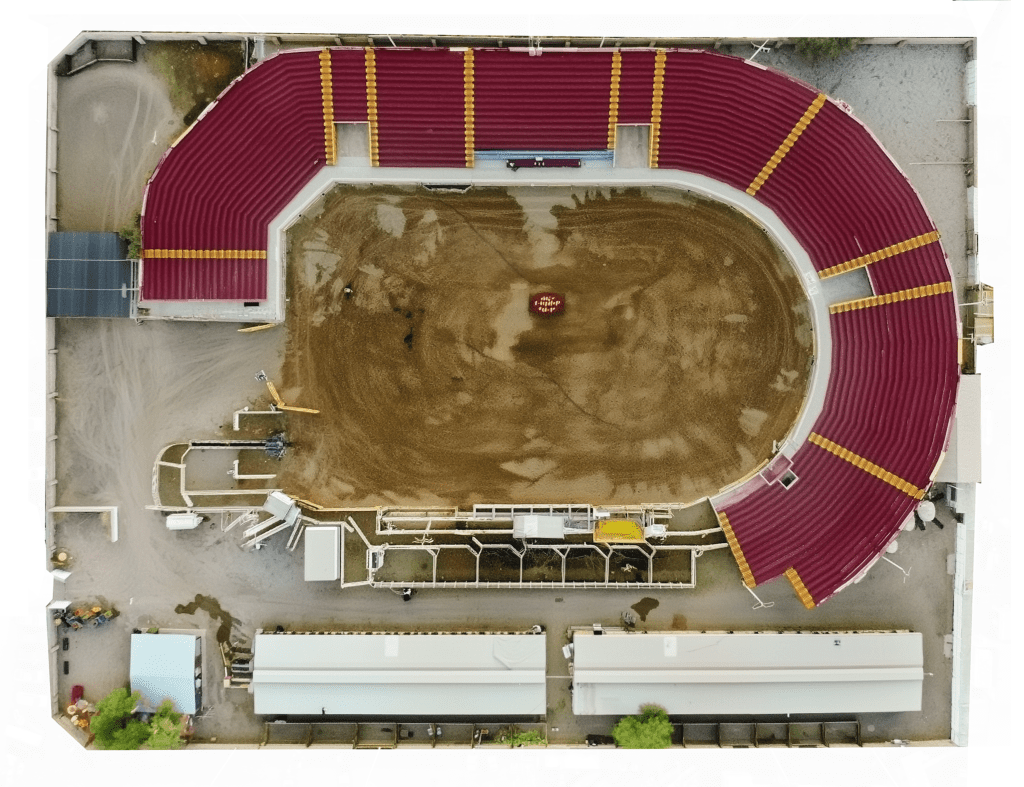
A top-down view of the rodeo arena reveals the geometric logic that later informed the poem’s structure. The arena is formally a rectangle—a contained field governed by rails, gates, and the chute—but the motion within it tends toward circularity. The bull’s torque, the rider’s counterbalance, and the cyclical buck patterns all generate rotational paths within the rectilinear frame. In other words, the arena functions simultaneously as square containment and circular motion, a dual geometry that becomes implicit in the diagrams that follow.
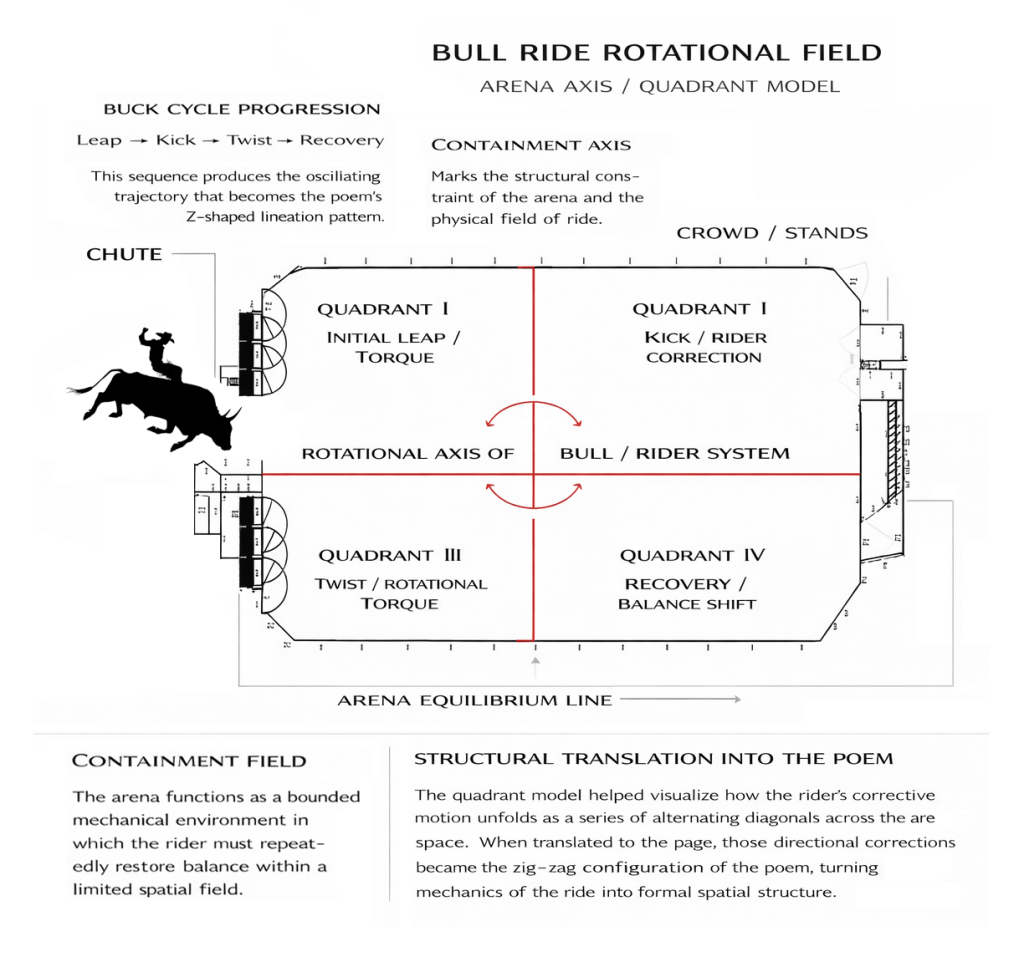
This diagram grows directly out of the arena blueprint shown above. What first caught my attention in that plan was the cross-shaped division of the space, an architectural necessity that inadvertently suggests a conceptual one. The intersecting axes partition the arena into four quadrants, and from this geometry emerged the idea of both a spine and a rotational axis governing the movement of the bull and rider. Without recognizing that underlying cross, it would have been difficult to conceptualize the rider’s passage through successive states of tension and correction. The structure recalls the logic of the Stations of the Cross, in which physical movement through space marks a ritual progression through stages of ordeal. The analogy is not theological so much as structural: the cross organizes experience into sequential moments of pressure.
Within the arena, each quadrant corresponds to a distinct modality of the ride. The first is psychic anticipation at the chute; the second introduces the mechanical violence of the buck; the third becomes a rotational struggle for equilibrium; and the fourth resolves into bodily recovery—or failure—within the limits of the system. What appears chaotic from the stands therefore reveals itself, in plan view, as a sequence of forces unfolding within a constrained field. The arena becomes not merely a container but a diagram of passage, where the cross-shaped axis organizes the oscillating motion of the ride into interpretable phases. In this sense the geometry of the arena quietly anticipates the formal logic of the poem itself, where containment and rotation combine to produce a structured field of pressure.
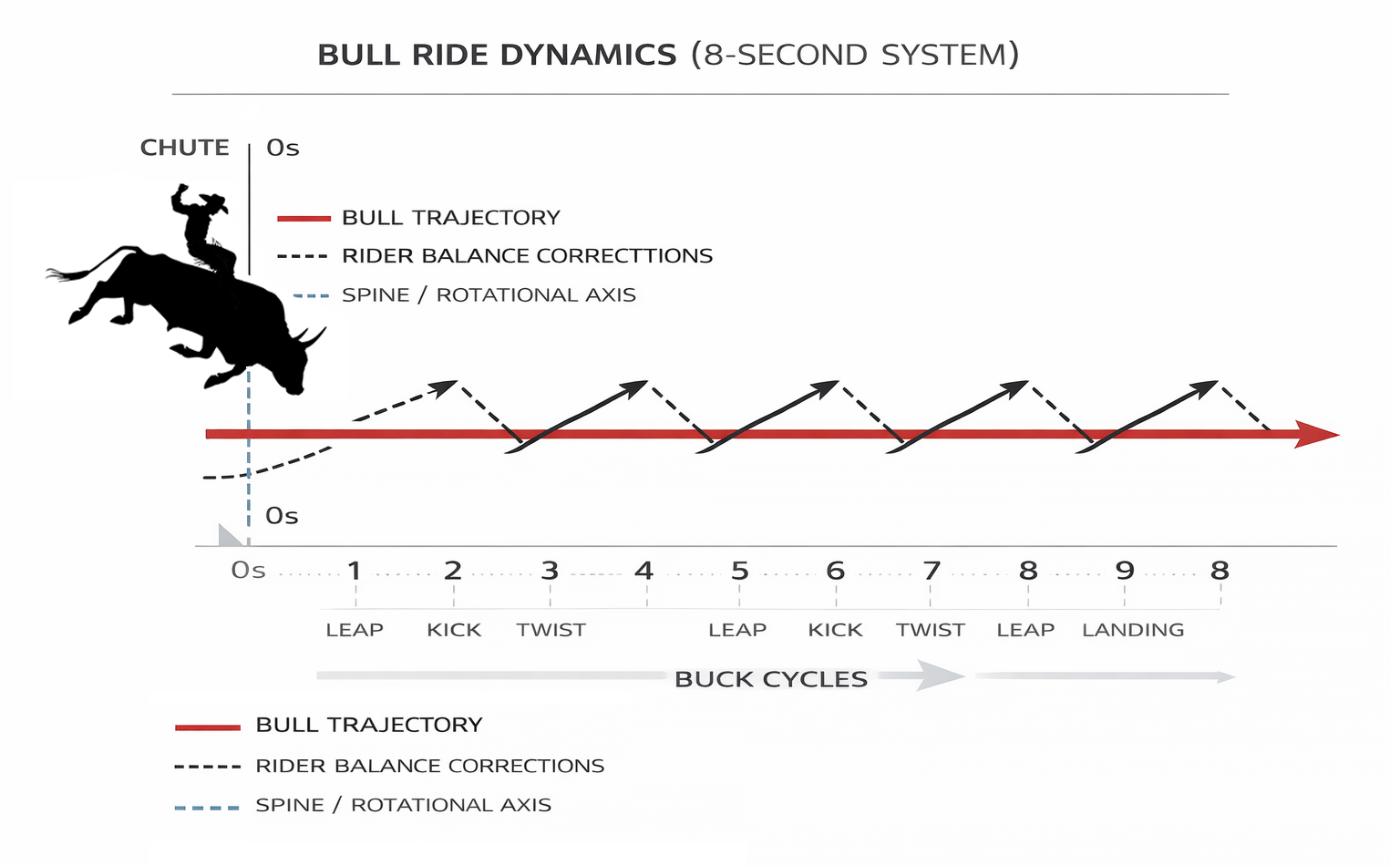
This leads to the next stage of investigation: the actual movement of the bull and rider during the ride itself. By plotting the bull’s forward trajectory and comparing it with the rider’s continuous balance corrections—both operating around the animal’s spinal and rotational axis—a recognizable pattern begins to emerge. What initially appears chaotic resolves into a sequence of alternating displacements and recoveries. Each buck cycle—leap, kick, twist—pushes the rider off equilibrium, while the rider responds with rapid counter-adjustments designed to regain alignment along the bull’s spine.
When these forces are mapped against the bull’s forward motion, the resulting path resembles a series of zig-zag vectors. The bull drives the system forward through bursts of torque, while the rider continually redirects his balance in response to those forces. Over the course of the eight-second ride, this interaction produces a repeating oscillation between displacement and correction. Recognizing this pattern proved foundational to the formal logic of the poem. The zig-zag configuration that emerges in the diagram becomes, in the poem itself, a spatial notation of that struggle for equilibrium—a way of translating the mechanics of the ride into the geometry of the page.
Like the Chiastic Helix Sonnet, this form is also based on torque, but here the motion is contained within the arena of lineation—a series of interconnected boxes that regulate movement while making its pressures visible. Both forms are highly prescribed, mirrored, and recursive systems for examining movement under pressure. The Sator Square Sonnet, which follows in this section, extends that logic into a third dimension: where the Chiastic Helix spirals around a central axis and the Z-configuration oscillates across a forward plane, the Sator Square rotates through all four quadrants simultaneously, meaning sealed inside a closed system readable in every direction. We shall examine the Z-configuration more closely after a brief consideration of the sonnet space re-engineered as filmic reality, since this perspective ultimately determines both the mechanics and the meaning of Eight Seconds in Nowata.
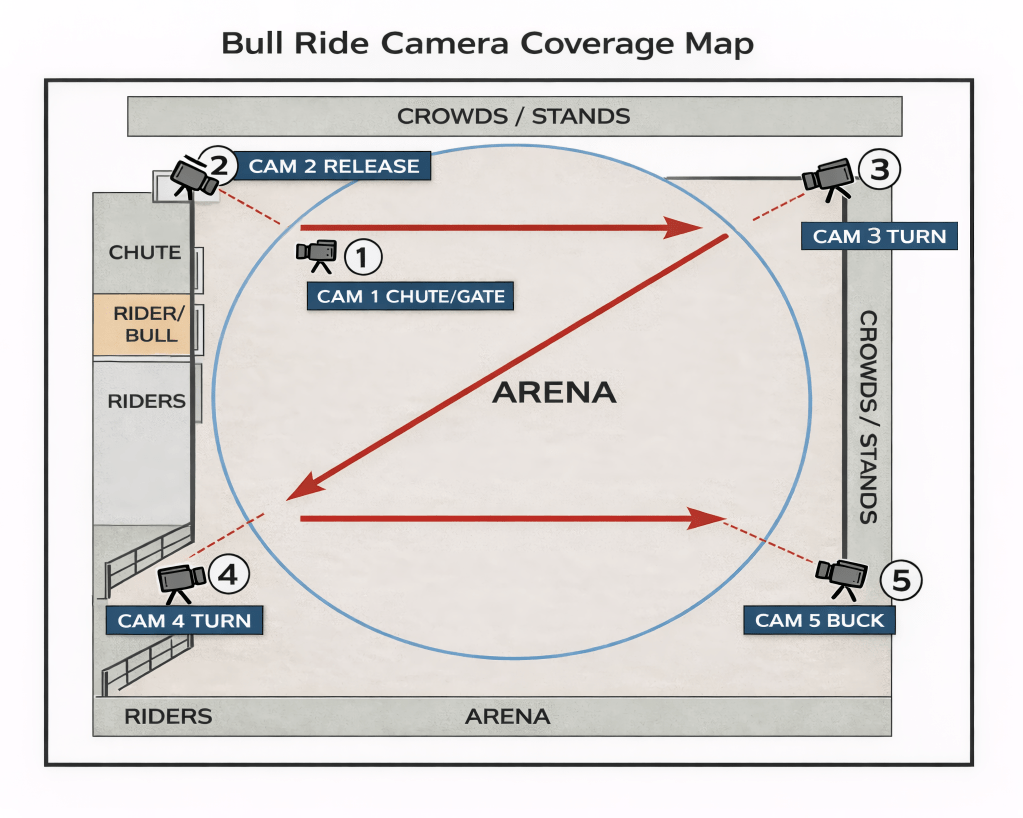
If we apply this same logic to a typical camera setup—say, for storyboarding a rodeo broadcast—it immediately begins to delimit the number and placement of cameras that can meaningfully describe the event. As I have said elsewhere, perhaps ad infinitum, I think primarily as a visual artist and filmmaker. If I cannot see an action clearly—either as an isolated gesture or as part of a sequence—I cannot adequately describe it, since description depends first on orientation. Before any analysis of motion can occur, the field in which that motion unfolds must be established.
In short, all formal arts may be understood as containment systems—music, writing, and the visual or applied arts alike—but film makes this principle especially visible. Aspect ratios function as literal containers for a convergence of disciplines deployed in the service of narrative: cinematography, music, animation, editing, writing, and performance. The figures and elements operating within these frames are subject to tension, since meaningful narrative movement depends upon stakes. A similar dynamic is at work in these visual schematics, which frame and organize the words of the sonnet within a defined structural field.
These principles govern the structure of this poem. If the macrocosmic field is not first understood—if we cannot see the arena, its axes, its constraints—then the granular movements of the rider and bull become unintelligible. The purpose of the graphic, therefore, is not decorative but explanatory. It establishes the spatial logic of the event: what the viewer sees, in what sequence, and why. Once that field is clarified, the poem can begin to operate within it, translating the choreography of the ride into a readable formal system. In this sense, the diagram performs the same function as an establishing shot. It orients the reader to the geometry of the arena so that the subsequent movements—the torque of the bull, the rider’s balance corrections, the zig-zag progression of force—can be understood not as chaos, but as motion unfolding within a defined and intelligible space.
If I were to use this camera map to explain the sequence, I would begin with cameras 3 or 5, which provide the establishing shot. We would then cut to camera 1, covering the chute, the gates, and the waiting riders. At the moment the ride begins, the cut moves to camera 2, which tracks the bull and rider through mid-arena. From there, camera 3 takes over, capturing the oncoming rider, the turn, and the southwest diagonal trajectory toward camera 4. The same principle applies at the next midpoint: camera 4 assumes coverage as the rider advances toward it, turns, and begins the final eastern trajectory toward camera 5. Camera 5 then frames the approaching—and now struggling—rider as he is about to lose his grip, before being bucked from the bull just prior to the eight-second whistle. The shot lingers on the bull, either following its movement toward the exit (camera right) or tracking it as it circles back toward the gate.
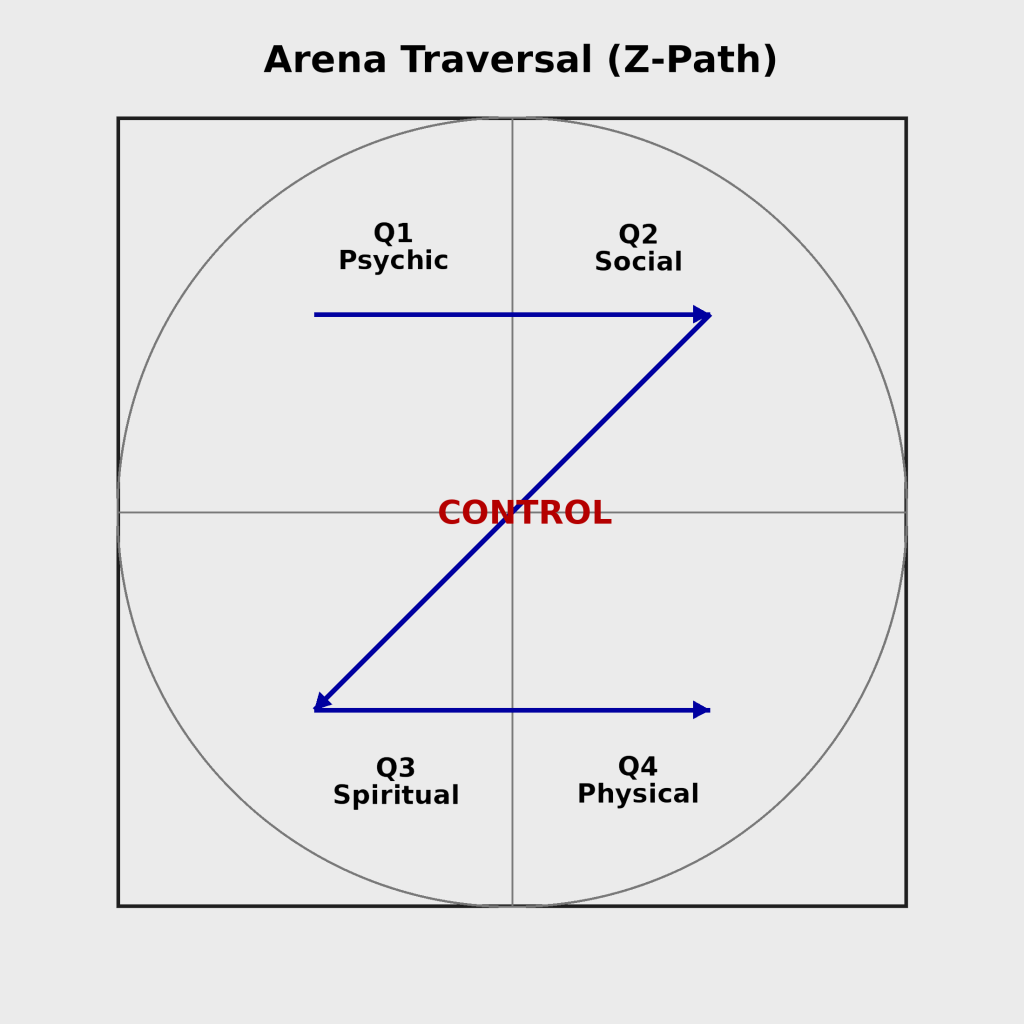
The diagram proposes the arena not merely as a physical enclosure but as a partitioned field of pressures. When the circular riding space is overlaid with orthogonal axes, the arena becomes divided into four conceptual quadrants, each representing a distinct modality of experience through which the rider moves during the ride. These quadrants—psychic, social, spiritual, and physical—are not literal geographic zones within the dirt ring so much as shifting states that arise as the rider traverses the space. The cross that divides the arena therefore functions less as a cartographic device than as a structural armature, revealing how the ride unfolds as a sequence of transformations across multiple domains of pressure. What begins internally, as fear and anticipatory tension within the rider, gradually becomes externalized as spectacle before the watching crowd, while simultaneously escalating into ritualized bodily struggle with the animal itself. Within this framework, the rider’s movement across the arena can be understood as a traversal through these four modalities, producing the Z-shaped trajectory illustrated in the diagram. Each diagonal shift corresponds to a transition between pressure fields: from psychic anticipation to social visibility, from ritualized preparation to raw physical confrontation. The arena thus operates as a contained system in which internal states and external forces become spatially legible. The partitioning of the arena into quadrants transforms the ride into something not unlike a sequence of ritual stations—moments through which the rider must pass as the ride progresses from anticipation to instability and finally toward resolution or failure. In this sense, the arena’s geometry does not merely host the event; it reveals the structural grammar through which the event unfolds.
This quadrant logic maps directly onto the poem’s spatial architecture. The Z-configuration that traces the rider’s path through the arena reappears in the poem as a typographic trajectory—the eye moving across the page in the same pattern of diagonal displacement and recovery that the rider’s body traces in the dirt. The Sator Square Sonnet, which governs the poem’s terminal and initial word sequences, enforces that same quadrant structure at the lexical level: each corner of the square anchors a rhyme position, and the poem’s rotational reading paths replicate the arena’s four-field geometry in miniature. The ride and the form are the same diagram, drawn at different scales.
That grammar has a precedent. The SATOR square operates on the same principle: a bounded field subdivided by axes, meaning distributed across quadrants rather than advancing in a single direction, readable through rotation rather than linear progression. What the arena does spatially—partitioning experience into zones that the body must traverse under pressure—the SATOR square does lexically, sealing its five words inside a closed system where every path through the grid returns to origin. The rider’s Z-shaped trajectory through the arena and the square’s rotational reading paths are the same structural argument made in two different materials.
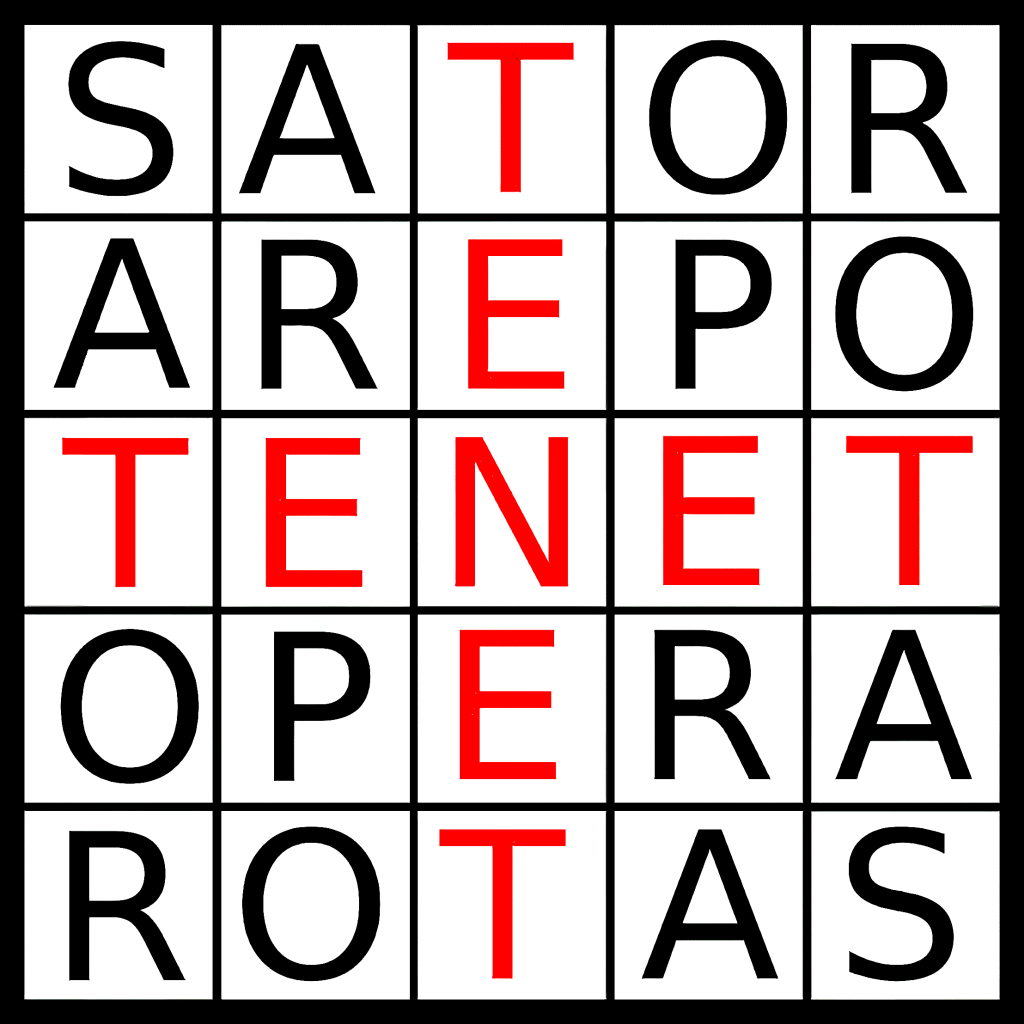
Now that we have the overarching documentation of the riders, their movement through the arena, and the way that movement maps onto the poem’s quadrants and structural logic, we must return to the earlier graphic that partitioned the space itself: the Sator Square. That partitioning is what will eventually generate the rotational axis; yet the axis cannot be established until the spines are first constructed. Why? Because the spines define the outer borders of the container—they are the poem’s semantic palindromes, the enclosing limits within which all motion occurs. Once these are in place, the axis can be understood as a secondary palindromic structure: one palindrome read forward in literal sequence, the other derived more loosely from the governing architecture. “Loosely” here is essential, since the rotational spine never needs to reverse within the body of the poem itself; its reciprocity is structural rather than procedural. The most critical step in this process, therefore, is the creation of the semantic palindromes that form the spines. For this reason, I have returned to the perfection of the Sator Square, whose bidirectional symmetry offers a model of containment, rotation, and structural inevitability.
The Sator Square’s five words—SATOR, AREPO, TENET, OPERA, ROTAS—do not merely read the same forwards and backwards; they generate the same meaning through every axis of the grid simultaneously. Horizontal, vertical, forward, reverse: the square is indifferent to direction because it has sealed its semantic content inside a structure that rotation cannot destabilize. That is the quality the poem’s envelope spines must approximate, though at the level of phrase rather than individual word. Where the Sator Square achieves its palindromic perfection through the inherent reversibility of its five terms, the poem must construct that reversibility through syntactic and semantic engineering—building sentences whose meaning survives inversion, whose words can anchor both ends of the container without collapsing into nonsense when read against their own grain. The spines are not decorative borders; they are the load-bearing walls of the form.
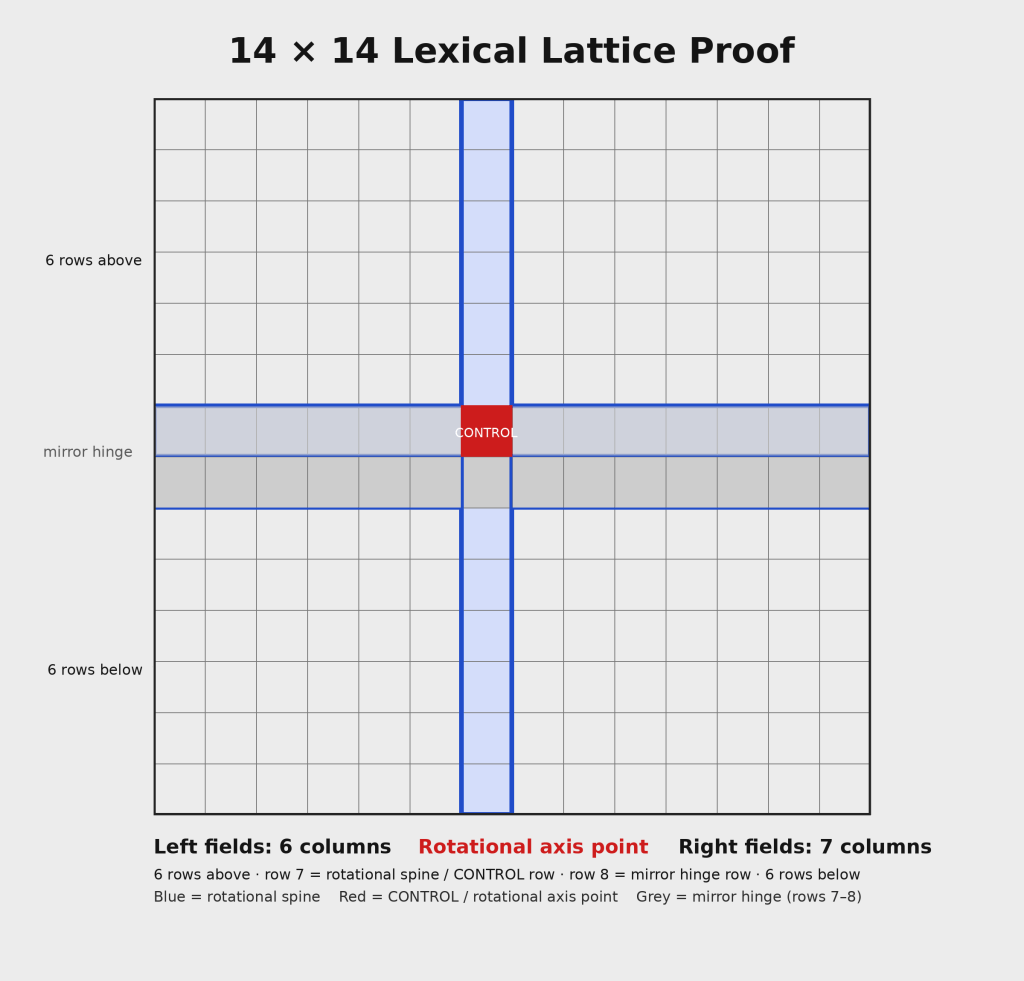
My central takeaway from the Sator Square is its lattice logic—the way letters are fixed within a grid that both contains and generates movement. In this form, however, the lattice operates at the level of words rather than letters. Moreover, the lattice cannot achieve perfect symmetry, since only odd-numbered sequences produce evenly divisible sides. This diagram therefore serves a dual purpose: it prescribes the exact number of words required while also establishing the orientation of the axis and the mirror hinge. The poem thus begins to function like a kind of crossword construction. We first establish the upper and lower semantic-palindrome spines, then set their vertical counterparts, completing the enclosing box. From that containment, the cross-shaped rotational axis emerges. Absolute semantic clarity along the axis is required only in its forward movement, since the reverse reading is never presented as a verse in the poem. Unlike the lower spine-envelope, which is reiterated and must therefore sustain intelligible meaning in both directions, the axis functions primarily as a structural engine. It needs to hold formally rather than lyrically. In this sense, a degree of looseness becomes an advantage: the construction of a semantic palindrome is already exacting enough without imposing the additional burden of full poetic coherence in both orientations.
The significance of the downward axis is twofold. First, although it remains concealed within the body of the poem as a Shakespearean sonnet structure, it reasserts itself in forward sequence at the poem’s midpoint—the mirror hinge. At that moment, the latent architecture becomes legible as recurrence rather than reversal. Yet the ABABCDCDEFEFGG rhyme scheme governing this vertical descent does not appear visibly along the horizontal axis. The most important word in the entire poem is the rotational axis itself: control. The quadrants are defined by it, and the whole poem turns upon it. That word must therefore be chosen with the utmost care. Here, control is the adhesive force that holds the entire structure together: thesis, antithesis, and caudate at once.
Constructing the lattice is the most labor-intensive stage of any invented sonnet form built around embedded spines or semantic palindromes. Among the three most demanding structures produced here—the Sator Square Sonnet, the Chiastic Helix Sonnet, and the Ghost Caudate Sonnet, ranked in descending order of complexity—the lattice work in each case far exceeded the difficulty of writing the poem itself. Once the armature was correctly configured, the verse followed with something closer to the logic of a crossword than the freedom of composition: the constraints had already made most of the decisions. The hope, however, is that these forms ultimately exceed their own mechanics—that the architecture disappears into the language the way a skeleton disappears into a body, present everywhere and visible nowhere.
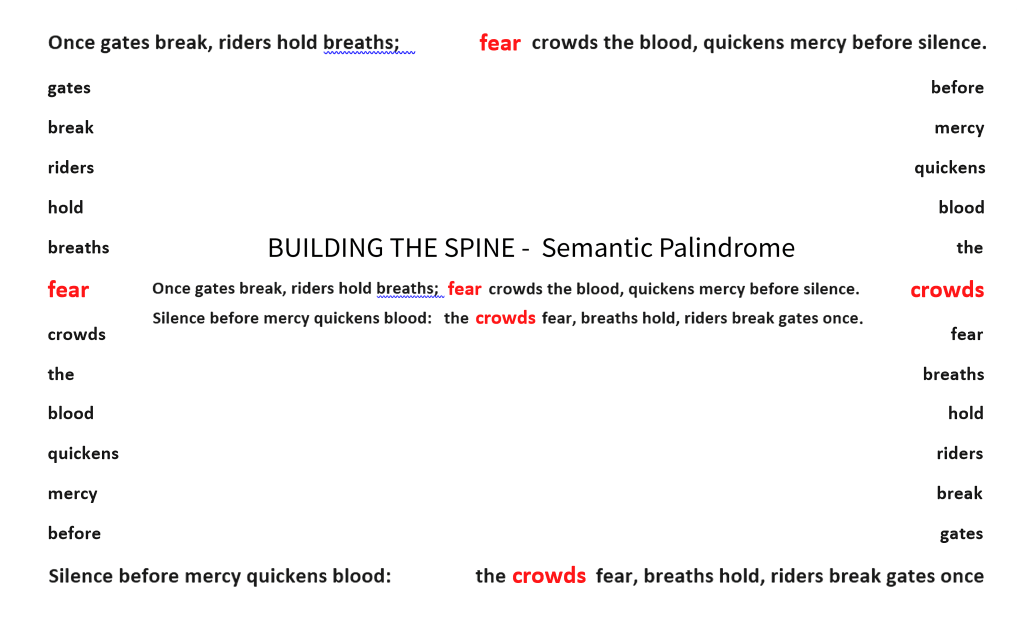
The upper envelope spine is first established in its primary, legible orientation across the opening line of the poem, read left to right in normal order. This same sequence is then reiterated vertically as the column of initial words, again proceeding downward in the same forward order. It appears a third time in reverse orientation, recovered by reading upward through the column of terminal words, beginning at the final line of the poem and moving backward toward the terminal word of the first line. Thus, the upper envelope spine manifests in three directional states:
1. Horizontally, in forward order across the first line.
2. Vertically downward, in forward order through the initial-word column.
3. Vertically upward, in reverse order through the terminal-word column, read from the poem’s end.
The lower envelope spine is constructed as a semantic palindrome of the upper, completing the enclosure by reversing the meaning-sequence while preserving structural equivalence. It reads normally from left to right in its primary horizontal manifestation and likewise appears in three directional states:
1. Horizontally, in forward order as the semantic palindrome of the upper envelope, appearing at the bottom of the poem in verse 14.
2. Vertically upward, in reverse order through the left initial-word column, beginning with the initial word of the final line (silence) and proceeding backward toward the initial word of the first line.
3. Vertically downward, in forward order along the right boundary through the sequence of terminal words, functioning as the structural counterpart to the upper envelope spine’s descent through the initial-word column.
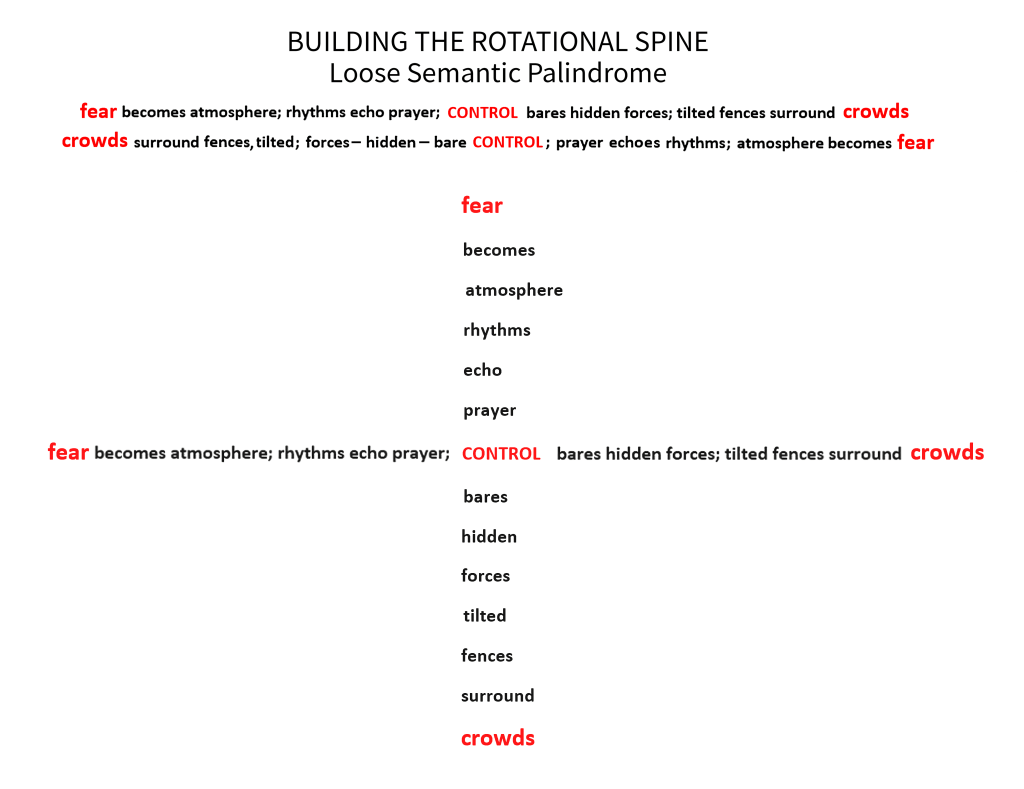
Through these parallel reiterations, both envelope spines establish the poem as a fully enclosed container governed by reciprocal semantic palindromes.
The rotational axis cannot be constructed until the envelope spines are fully established, since the axis depends upon two shared hinge-words: fear and crowds. These words are generated by the completed lattice of the spines and therefore cannot be determined in advance. In its legible state, the axis is read only once, from left to right, in the near-middle of the poem. Its vertical descent is structurally embedded within the poem’s center, where it is concealed inside a rhyming Shakespearean sonnet form. Because this downward movement is never presented in a readable sequence, its return does not need to function as a strict semantic palindrome. The axis operates as a hidden engine rather than as a displayed verse.
At the core of this structure lies the governing word of the rotational axis: control. The completed spines make this word inevitable. It serves as both thesis and thematic fulcrum—the point around which the poem’s pressures, movements, and quadrants revolve. Anyone wishing to replicate this method must therefore give careful consideration to the selection of the primary rotational-axis word, since it becomes the cynosure of the entire architecture, determining not only the poem’s structural coherence but its conceptual gravity. The pivot word must be capable of bearing simultaneous pressure from all four quadrants without collapsing into abstraction or narrowing into mere theme. It must function as noun, condition, and verdict at once—something the poem circles rather than states, arrives at rather than announces, and leaves rotating rather than resolved.
In Eight Seconds in Nowata, control names what the rider seeks, what the bull refuses, what the crowd measures, and what the form itself enacts: a word that means differently in every quadrant and identically at the center. A weaker selection—one that names only a mood, or indexes only a single pressure—will cause the rotational architecture to sag, the quadrants losing their tension against each other because the center can no longer hold them in productive opposition. The pivot word is not chosen after the poem is written; it is discovered in the process of recognizing what the subject is actually about, beneath its surface events. When the right word is found, the quadrants arrange themselves around it with a logic that feels less like invention than excavation—the structure always having been latent in the material, waiting for the center to be named. This is also why it cannot be a verb. Verbs direct; they push the argument forward in time. The pivot word holds rather than moves, organizes rather than propels. It must be the kind of word that a system can rotate around—stable at the center, differently pressurized at each of its four faces, generating meaning through position rather than through action.
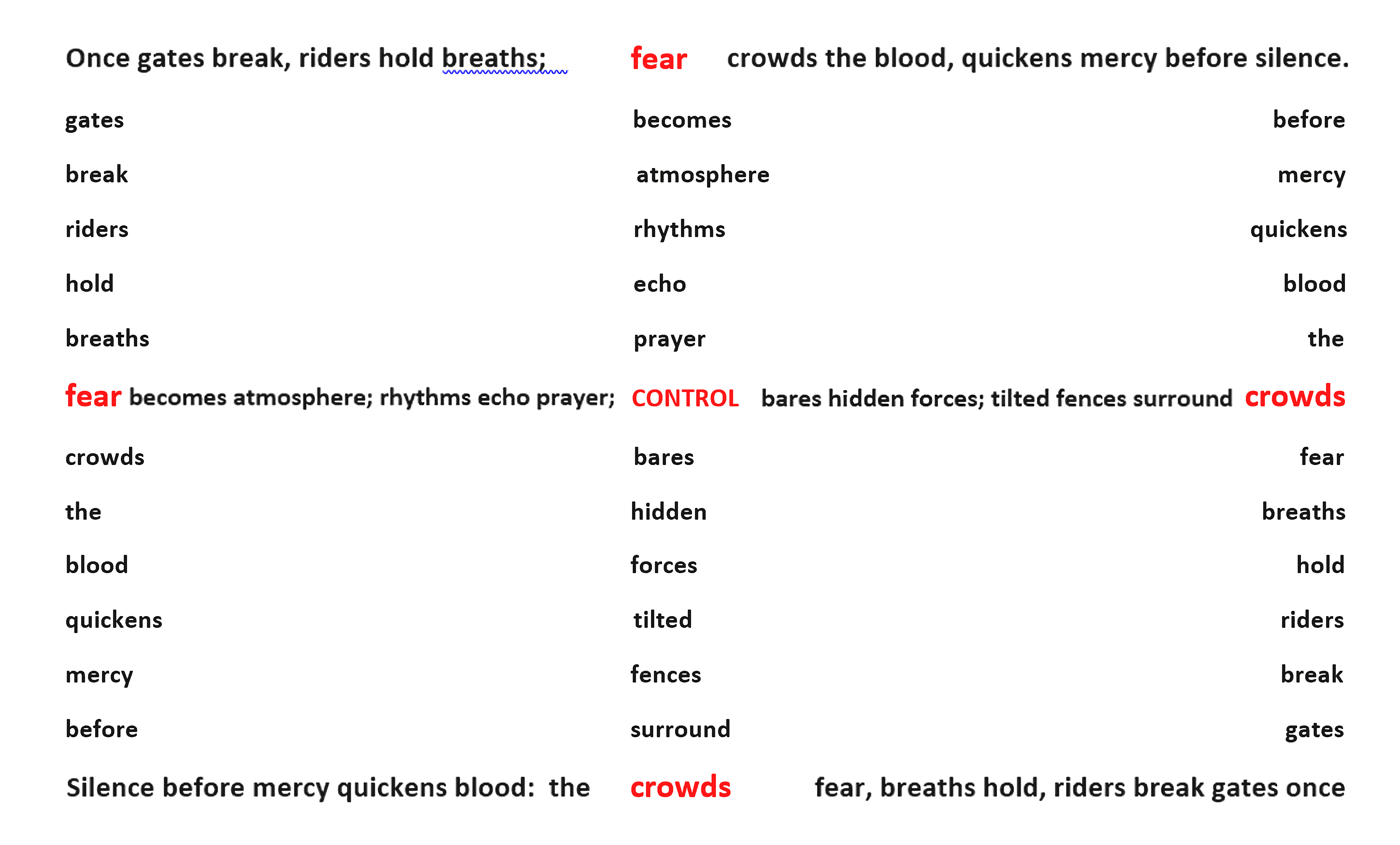
Now that the canvas has been semantically stretched, the structure itself demands attention before any quadrant is filled. Proceeding without fully internalizing the armature risks reverse engineering—inefficient at best, structurally dangerous if the enclosure is not already secure. The white space carries as much weight as the words that will occupy it, and this is the moment to determine how pressure accumulates, transforms, and resolves across the four fields: the initial state, the evolutionary movement, the terminal condition. The transformation must be embedded invisibly within the spatial progression itself, development arriving through cumulative rotational pressure rather than a single rhetorical pivot, each quadrant carrying a distinct mode of conflict or thematic function. When the armature is correctly conceived, the subsequent act of writing becomes less an invention than a fulfilment of structural necessity.
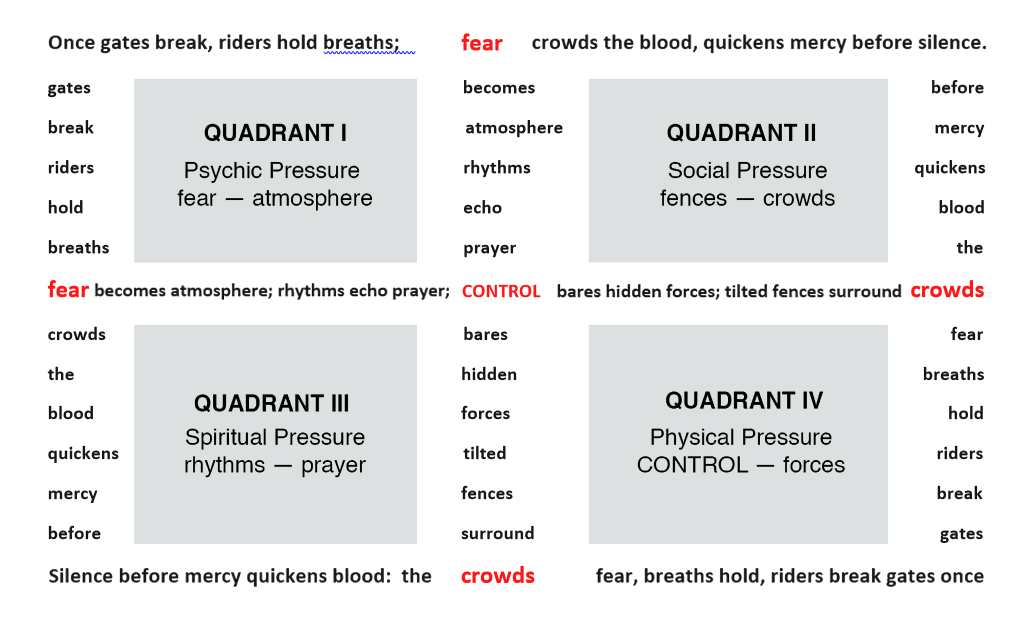
This schematic represents the final stage of preparation before writing begins. The progression through the structure is akin to a set of stations of the cross: the characters must be tracked through the Z-shaped spatial logic of the form, from the psychic to the physical, while accounting for the competing pressures of the social and the spiritual. The inward terrain is as decisive as the visible one—how the rider adapts to fear, to the atmospheric conditions of the arena, to the anticipatory tension that precedes action. The spiritual pressures require equal definition: whether the riders pray, and to what—higher power, ritual, or a magnified version of the self. These questions determine the tonal and conceptual trajectory of the quadrants, shaping how pressure accumulates and transforms as the poem advances through its prescribed lattice. With the architecture firmly established, the poet moves from lattice to meaning, from a holistic vision of the poem to a functional framework, and finally to a series of interdependent moments that progress toward an inexorable terminus.
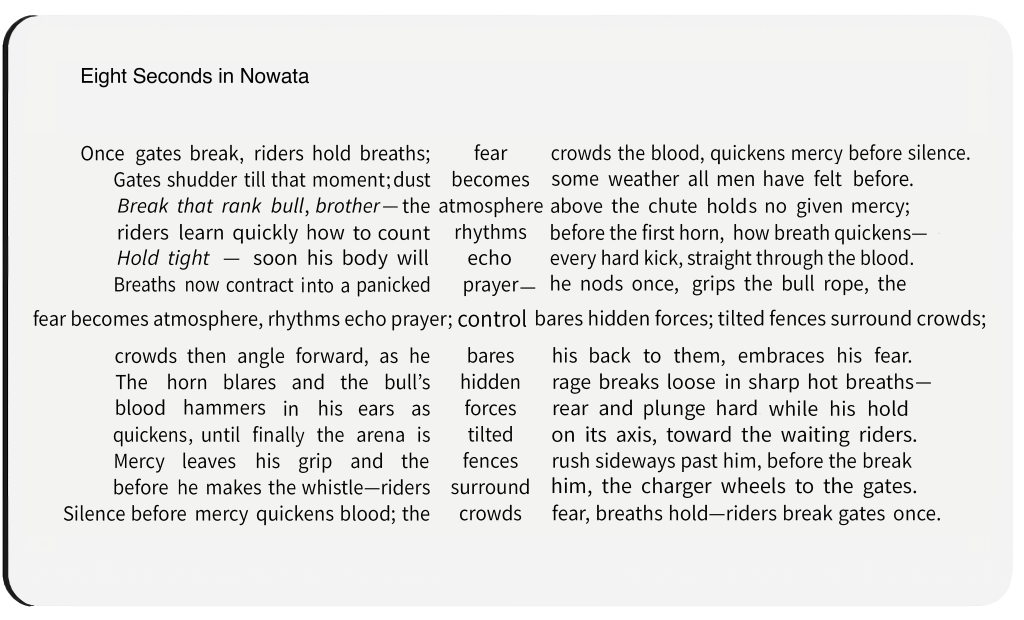
This final lineated arrangement makes the demarcation of structural zones clearly visible; however, one cannot meaningfully analyze the individual quadrants until the poem is first apprehended as an integrated whole. Even then, it is important not to become overly fixated on reading the quadrants as fully autonomous poems. Although it is possible—and I will demonstrate later—to construct looser interpretive pathways that allow such readings, the governing logic of the form does not require strict semantic independence at the quadrant level. Just as the reverse orientation of the rotational axis is never presented in a legible forward sequence—and therefore does not bear the full burden of semantic palindrome—the quadrants may selectively incorporate or omit axial vocabulary in order to maintain local coherence, structural fidelity taking precedence over rigid lexical symmetry.
Lineation here is as critical as it was in the Chiastic Helix Sonnet. The poem assumes a rectangular disposition, modeled in part on the physical geometry of the arena itself. This space is inherently bifurcated: multiple events unfold within a single evening, and the structure must accommodate simultaneous pressures and overlapping temporalities. The resulting layout therefore functions not merely as a visual arrangement but as a spatial dramaturgy, guiding the reader through zones of intensifying experience. The structural logic of the form may be understood through several overlapping precedents derived from the Sator Square. At the most visible level, the poem establishes a square containment system, whose borders are defined by reciprocal semantic-palindrome spines. Within this enclosure emerges a cruciform axis, analogous both to the central TENET hinge of the Sator grid and to the concealed Pater Noster cross configuration, in which meaning is organized around intersecting vertical and horizontal orders. This arrangement also recalls the classical quincunx pattern, a five-point spatial logic that generates four quadrants around a governing center.
In this poem, the quadrants function as stations of experiential pressure—psychic, social, spiritual, and physical—through which the character’s trajectory acquires rotational inevitability. The square provides containment; the cross provides motion; and the governing axial word operates as the poem’s structural cynosure, binding lattice, progression, and thematic force into a single architectonic system. As we will discuss later, the ‘invisible’ verses one can extract from each quadrant act as hidden caudates, much like the Ghost Caudate (or Triple Form Sonnet), but there is no codified formula for extracting them; they are looser in aggregate, and therefore more sensory than specific.
Quadrant I

Once gates break, riders hold breaths;
Gates shudder till that moment.
Break that rank bull, brother—
riders learn quickly how to count rhythms.
Hold tight now— soon his body will echo
breaths, now contract into a panicked prayer;
fear becomes atmosphere, rhythms echo prayer.
Quadrant II

Fear crowds the blood, quickens mercy before silence—
dust becomes some weather all men have felt before:
the atmosphere above the chute holds no given mercy.
Before the horn, how breath quickens—
every hard kick, straight through the blood.
He nods once, grips the bull rope.
Control bares hidden forces; tilted fences surround crowds.
Quadrant III

Fear becomes atmosphere, rhythms echo prayer;
crowds then angle forward,
the horn blares and the bull's
blood hammers in his ears,
quickens—until finally the arena is tilted.
Mercy leaves his grip
before he can make the whistle—
silence before mercy quickens blood
Quadrant IV

He bares his back to them, embraces his fear.
The bull's hidden rage breaks loose in sharp hot breaths
forces rear and plunge hard, while his hold
is tilted on its axis, toward the waiting riders,
the fences rush sideways past him, before the break
riders surround him, the charger wheels to the gates.
The crowds fear, breaths hold—riders break gates once.
The quadrant-verses are derived from the lineated form by a process that is not rigidly mechanical. At times the axiomatic vocabulary of the rotational spine is borrowed directly; at others those words are set aside to preserve local clarity or tonal continuity. That freedom is not arbitrary: if an axial word is omitted in one quadrant, it must be structurally recovered elsewhere. Lexical pressures may shift location, but they cannot be entirely evaded. This step is optional and diagnostic rather than essential—the quadrants remain largely invisible within the finished architecture, and the exercise exists primarily to stress-test the form, ensuring the lattice can sustain multiple interpretive pathways without collapsing its governing logic. The following diagram shows how these distilled quadrant-verses rotate around the central thematic axis—CONTROL—and how pressure accumulates, migrates, and resolves through the poem’s prescribed spatial movement.
What the quadrant-verses also reveal, read in sequence, is the poem’s emotional logic stripped of its formal concealment. The palindromic spines and the hidden Shakespearean descent are structural obligations; the quadrant-verses are the argument those obligations were built to carry. Read this way, the progression is legible as a phenomenology of the ride itself: fear becoming atmosphere in Quadrant I, atmosphere hardening into social spectacle in Quadrant II, spectacle dissolving back into the body’s private reckoning in Quadrant III, and the body finally relinquishing what it could not hold in Quadrant IV. The architecture does not generate that arc—it was always latent in the subject—but the form makes it visible as inevitability rather than accident.
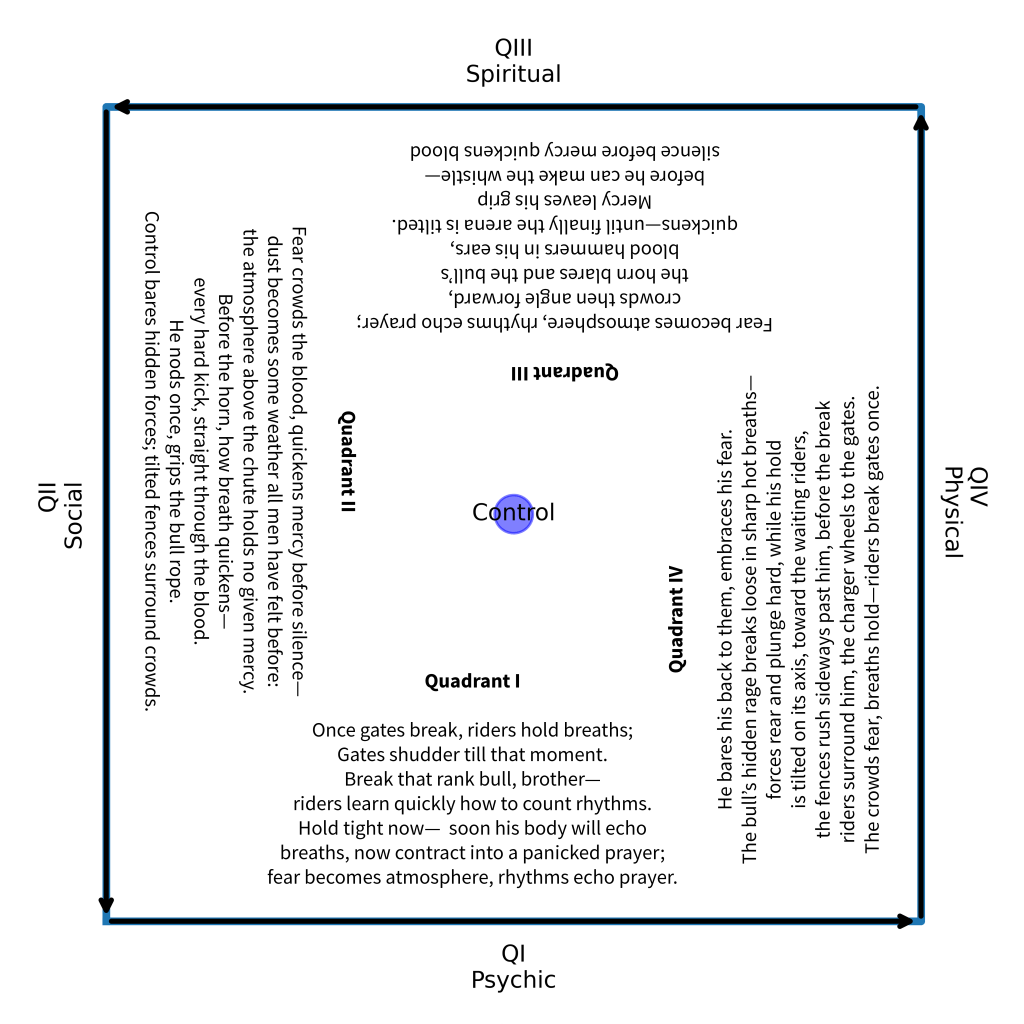
Here is a visualization of how the mini-poems rotate around the pivot word, making the poem’s progression more immediately legible in spatial terms. These schematics are neither arbitrary nor strictly necessary for composition; rather, they function as expository instruments, clarifying the internal mechanics of the Sator Square Sonnet. They allow the poet—and, at a later stage, the critic—to perceive how pressure is distributed, transferred, and intensified across the quadrants.
What becomes most evident in this diagram is the circular logic underlying the poem’s apparent zig-zag movement. Again (and worth repeating): the structure advances directionally—psychic to social, social to spiritual, spiritual to physical—yet it also operates as a recursive loop, continually returning to the central condition named at the axis: control. Each rider must pass through a comparable sequence of emotional and conceptual stations, though the tempo and emphasis of that passage will vary from individual to individual. In this sense, the form accommodates both shared ritual progression and personal contingency. Each station through which the rider passes—fear shading into atmosphere, atmosphere into action, action into its own reckoning—accumulates rather than merely sequences, the rotational design ensuring these experiences build toward a moment of irreversible consequence. The rider’s task, structurally as well as narratively, is to negotiate these converging pressures—to master fear sufficiently to endure the ride, and, ideally, to remain mounted beyond the decisive eight-second threshold.
What the diagram makes visible, finally, is that the poem’s form and the ride’s structure are not analogues of each other—they are the same event rendered in two registers. The Z-trajectory through the quadrants, the recursive return to the axis, the accumulation of pressure across stations that do not release but compound: these are the mechanics of bull riding described in the language of poetic architecture. The rider negotiates the arena; the poem negotiates the page; the governing condition in both cases is the same word sitting at the center of the structure, holding everything in rotation around itself.
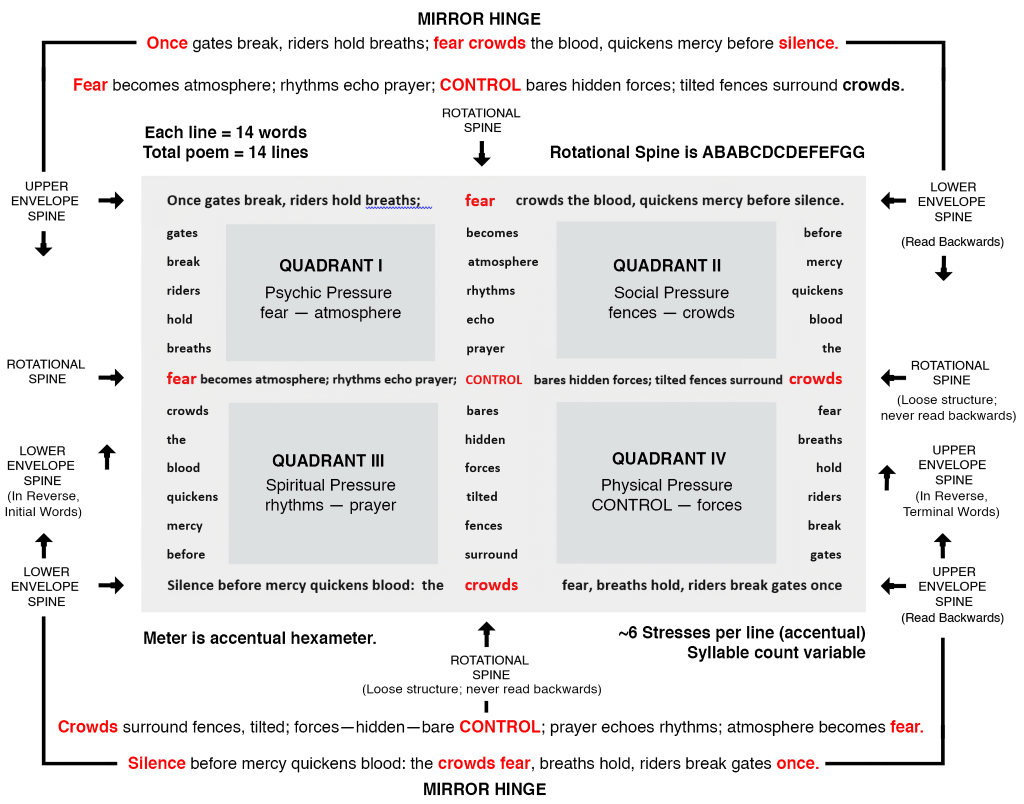
Lastly, we arrive at the complete schematic, the armature in its fully realized state. Seen in this unified form, it functions almost as a Rosetta Stone for anyone wishing to reconstruct the mechanics of the Sator Square Sonnet. What had previously appeared as a sequence of isolated procedures—establishing envelope spines, determining the rotational axis, distributing pressure across quadrants, calibrating lineation—now reveals itself as a single operating system. The diagram becomes less an illustration than a methodological map, a kind of poetic recipe book whose steps may be followed, adapted, and re-applied across different narrative or thematic terrains.
At the core of this structure lies the governing word of the rotational axis: control. The completed spines make this word inevitable. It serves as both thesis and thematic fulcrum—the point around which the poem’s pressures, movements, and quadrants revolve. Anyone wishing to replicate this method must therefore give careful consideration to the selection of the primary rotational-axis word, since it becomes the cynosure of the entire architecture, determining not only the poem’s structural coherence but its conceptual gravity. The pivot word must be capable of bearing simultaneous pressure from all four quadrants without collapsing into abstraction or narrowing into mere theme. It must function as noun, condition, and verdict at once—something the poem circles rather than states, arrives at rather than announces, and leaves rotating rather than resolved. In Eight Seconds in Nowata, control names what the rider seeks, what the bull refuses, what the crowd measures, and what the form itself enacts: a word that means differently in every quadrant and identically at the center. A weaker selection—one that names only a mood, or indexes only a single pressure—will cause the rotational architecture to sag, the quadrants losing their tension against each other because the center can no longer hold them in productive opposition. It is not chosen after the poem is written; it is discovered in the process of recognizing what the subject is actually about, beneath its surface events. When the right word is found, the quadrants arrange themselves around it with a logic that feels less like invention than excavation—the structure always having been latent in the material, waiting for the center to be named.
The pivot word also determines the poem’s relationship to time. Because it sits at the structural center rather than the terminal position, it does not conclude the argument—it anchors it, and the argument rotates around it for the duration of the poem without ever consuming it. This is what distinguishes it from a volta or a closing image: those devices discharge their energy at a single moment; the pivot word holds its charge across every line, present in every quadrant simultaneously, accruing pressure rather than releasing it. The ride ends; the word remains.
Because the system is architectonic rather than ornamental, it can be applied wherever a subject demands structured escalation within bounded space. The most suitable narratives are those in which individuals must pass through predictable yet intensely felt phases of experience: rites of passage, contests of endurance, moral ordeals, initiatory trials, or any situation in which internal and external pressures converge within a fixed temporal or spatial frame. Such subjects benefit from the form’s ability to render simultaneity—psychic fear alongside social scrutiny, spiritual invocation alongside physical exertion—while preserving the sense that all movement ultimately resolves around a single governing condition.
Thus, the question of relevance becomes one of pressure and inevitability. What stories unfold within containers? What experiences recur in cycles even as they appear to move forward? What human actions are measured against thresholds—of time, courage, faith, or control? Wherever a narrative requires both ritual repetition and irreversible outcome, this system offers a disciplined means of shaping the material. The schematic does not dictate content, but it does demand that the chosen subject possess enough structural gravity to sustain rotation, recursion, and return.
The bull ride qualifies on every count: it is timed, witnessed, ritualized, and physically absolute. Eight seconds either hold or they don’t. The form’s quadrants, spines, and rotational axis exist precisely to register that binary—to build a container whose architecture is as unforgiving as the event it houses, where the difference between holding and failing is encoded in the structure itself, not announced in the conclusion.
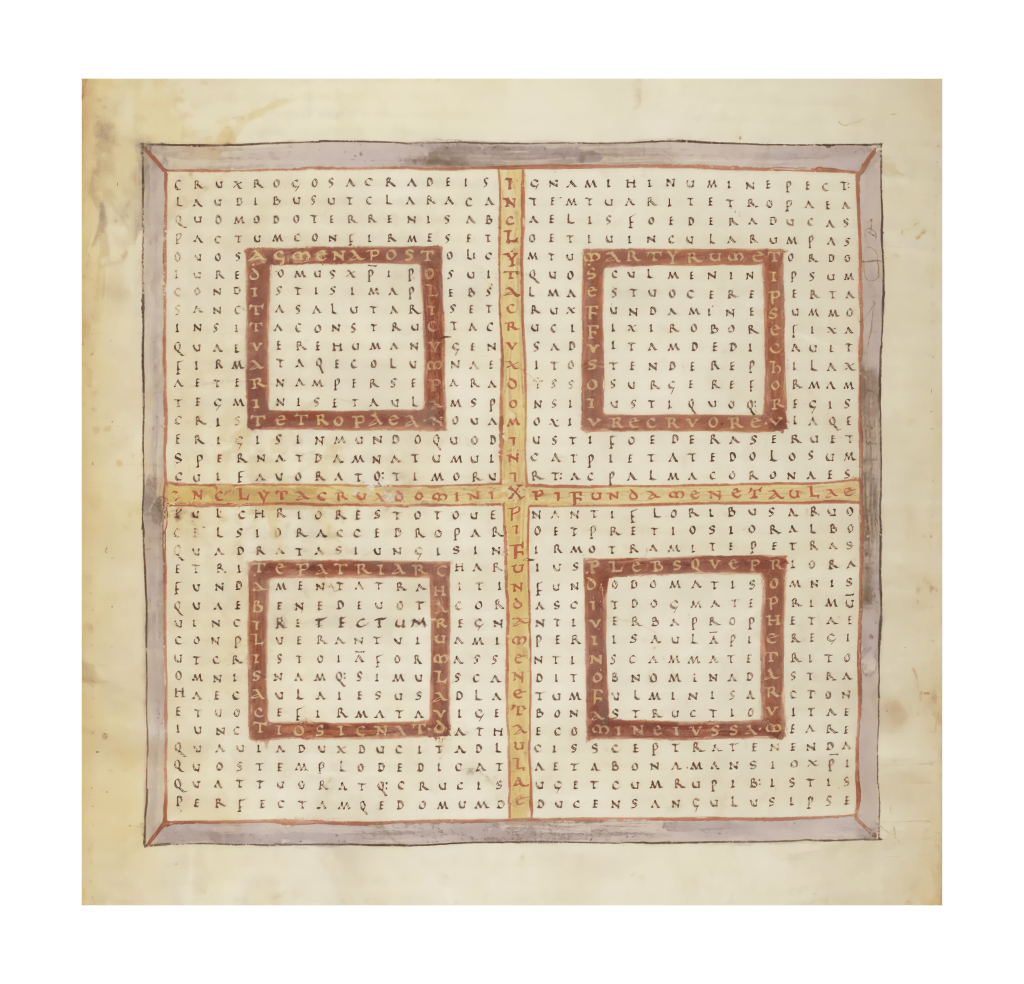
Final thoughts: By the early medieval period, pattern poetry reached a remarkable level of structural refinement in the figure poems of Rabanus Maurus, especially in the above image of the cycle De laudibus sanctae crucis (In Praise of the Holy Cross). In these works, the page becomes a tightly organized lattice in which letters operate simultaneously as continuous text and as elements within a larger geometric design. Crosses, grids, and nested configurations create multiple possible reading routes, inviting the reader to experience the poem as a unified visual-theological system rather than a purely linear composition.
I discuss these structures in greater detail in the SONNET FORMS section; here, however, I place the example immediately after my schematic to demonstrate the strikingly identical architecture—a correspondence I only recognized later and therefore present retrospectively at the end. The principal generative influence for Eight Seconds in Nowata was the Sator Square, which clearly belongs within this broader lineage. Together, such works show how recursive patterning can operate across several simultaneous scales—lexical, graphic, and symbolic—anticipating later developments in fully architectonic poetics.
Click here for all high-resolution Sator Square Sonnet assets.

