RASPUTIN AND THE DOUBLE FORM SONNET
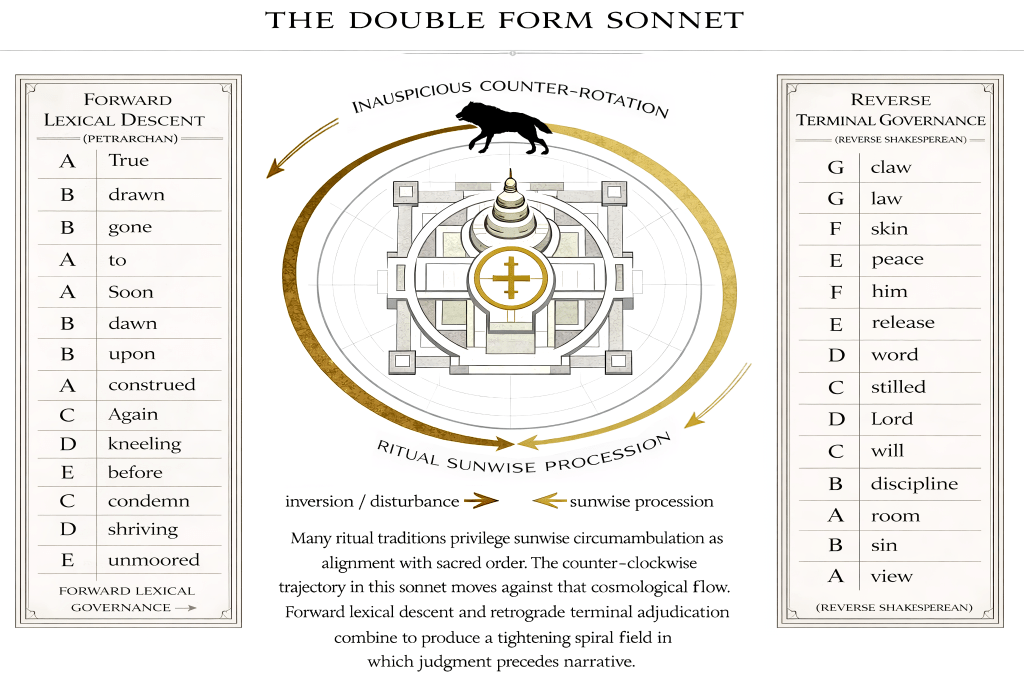
As with many of the invented forms in this collection, the Double Form Sonnet emerged through recursive experimentation—a circular process of drafting, inversion, and structural re-evaluation—rather than through any linear procedural design. Early iterations were driven primarily by thematic inquiry into charismatic authority and ritualized power, drawn from personal experience within Pentecostal Christianity. At that stage, the poems remained formally conventional, even when rhetorically ambitious. Only later did more radical manipulations of inherited structures become possible. One such experiment involved inverting the Shakespearean sonnet while preserving its terminal rhyme governance. Although this produced a compelling directional disturbance, the deeper formal logic remained elusive. The decisive breakthrough occurred when memories from undergraduate training resurfaced: performance art exercises governed by spatial grids and strict temporal containment, alongside concurrent studies in sacred architectural procession. Through the convergence of these embodied and architectural experiences, the operational principle of the Double Form Sonnet finally clarified.
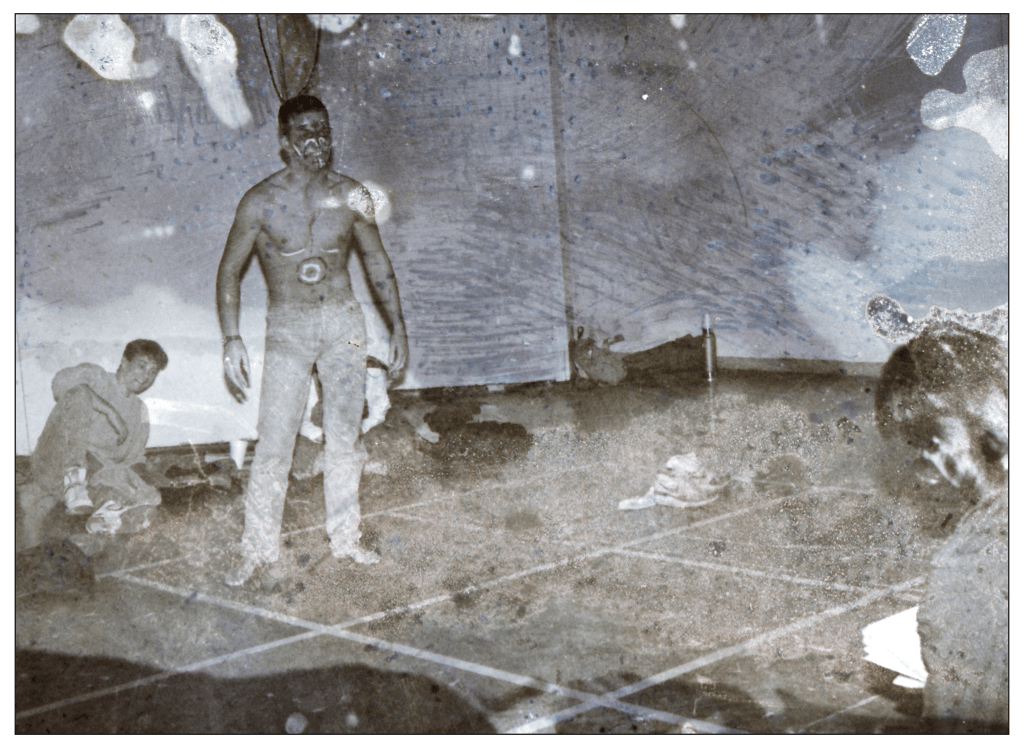
In the performance module that proved formative, students were required to enter an illuminated square within an eight-by-eight lattice and generate unscripted narrative movement within a fixed thirty-second interval. I progressed counterclockwise across the grid, beginning in the northeast corner and concluding in the northwest quadrant. Each timed transition intensified the action: agitation increased, gestures became more animalistic, and with each interval I removed an article of clothing until the performance culminated in a deliberately savage state.
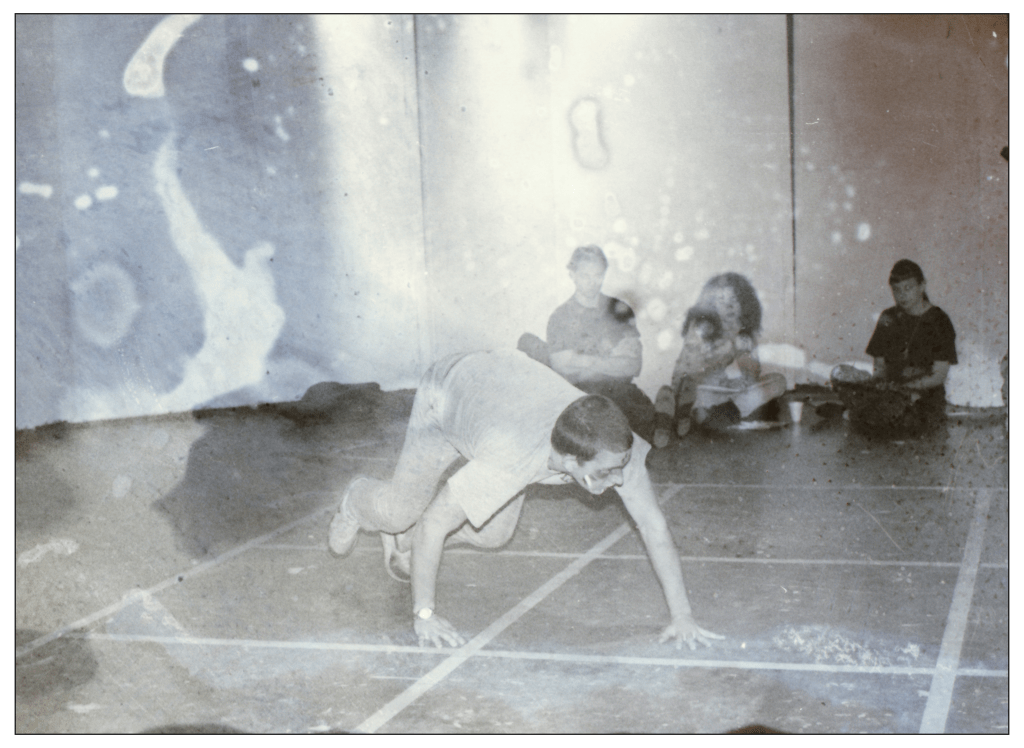
Opposite me, another performer advanced in parallel along the reverse axis, adopting the role of a detached observer—a clinician or researcher—whose neutrality amplified the ritual dimension of the encounter. These improvisations revealed the aesthetic force of constrained sequencing: transformation occurred through regulated movement across partitioned space, the structural pressure doing what explanation could not. In retrospect, the Double Form Sonnet reenacts this spatial dramaturgy. Its concealed Petrarchan descent charts forward progression, while the inverted Shakespearean terminal sequence administers retrograde judgment. The poem stages brutality as procedural inevitability—a ritualized passage through a tightening field of structural pressure.
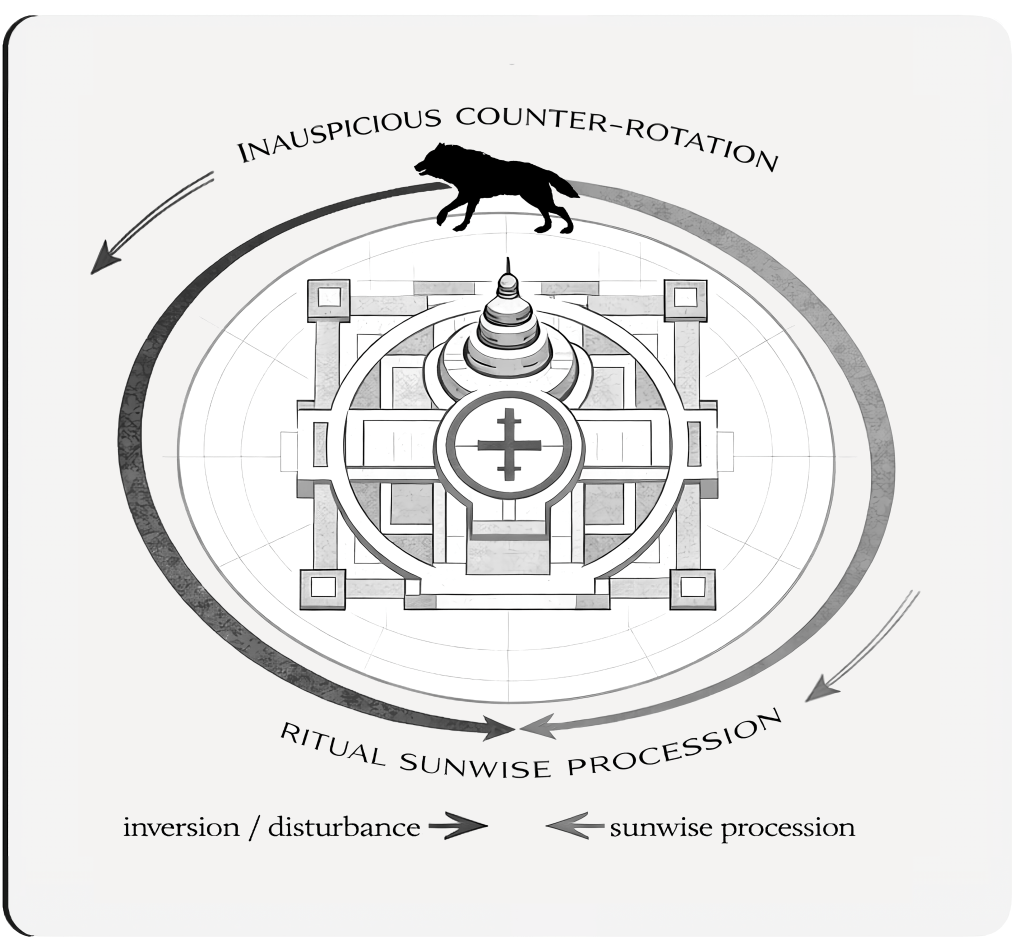
Meanwhile, concurrent art history courses—including an elective in Indian Art and Architecture that began with Chaitya halls and the Gupta period—were depositing a parallel set of spatial intuitions. From the first lecture I was struck by the consistency of their spatial logic: elongated processional halls terminating in an apsidal shrine, within which a stupa functioned as the sacred cynosure. Around this central mass extended a clearly defined ambulatory path, establishing ritual movement as a governing architectural principle. Worshippers circumambulated clockwise—aligning themselves with solar motion and auspicious cosmological order—while counter-clockwise movement, though not formally prohibited, was widely regarded as destabilizing or inauspicious. What struck me even then was how this rotational grammar of devotion appeared to recur, consciously or unconsciously, in sacred architectures far removed in geography and doctrine.
Symbolically, the stupa participates in a broader family of axial sacred forms across South and Southeast Asia. Early aniconic traditions frequently centered worship around vertical or mound-like markers understood as condensations of generative or cosmic force. Over centuries these were formalized architecturally into reliquary monuments and eventually into governing ground plans for monastic complexes. In certain Buddhist contexts this axial logic was extended further through mandalic organization, including swastika-derived spatial diagrams that mapped ritual movement onto cosmological geometry.
Whether read as emblem, orientation device, or metaphysical diagram, such forms articulate the same underlying principle: sacred space is structured through rotational procession around a stabilized center—an architectural enactment of the axis mundi comparable in symbolic function to the omphalos at Delphi or later cruciform Christian plans. What persists across all these traditions is the understanding that the center does not move—that its fixity is precisely what makes the procession around it meaningful, the stable axis against which the rotating body measures its own passage. The wolf who circles rather than charges, the sonnet whose terminal rhymes run backward against the forward pull of the narrative—both derive their force from the same structural logic: a fixed center, a constrained field, and a direction that works against the grain of sacred order.
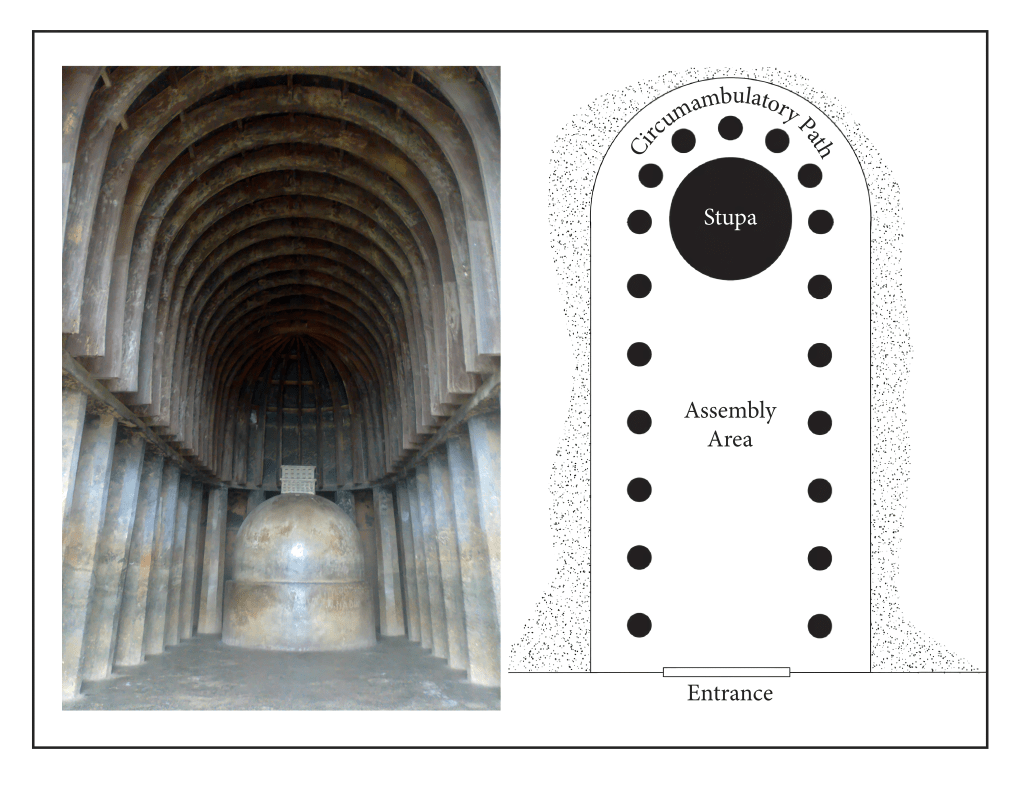
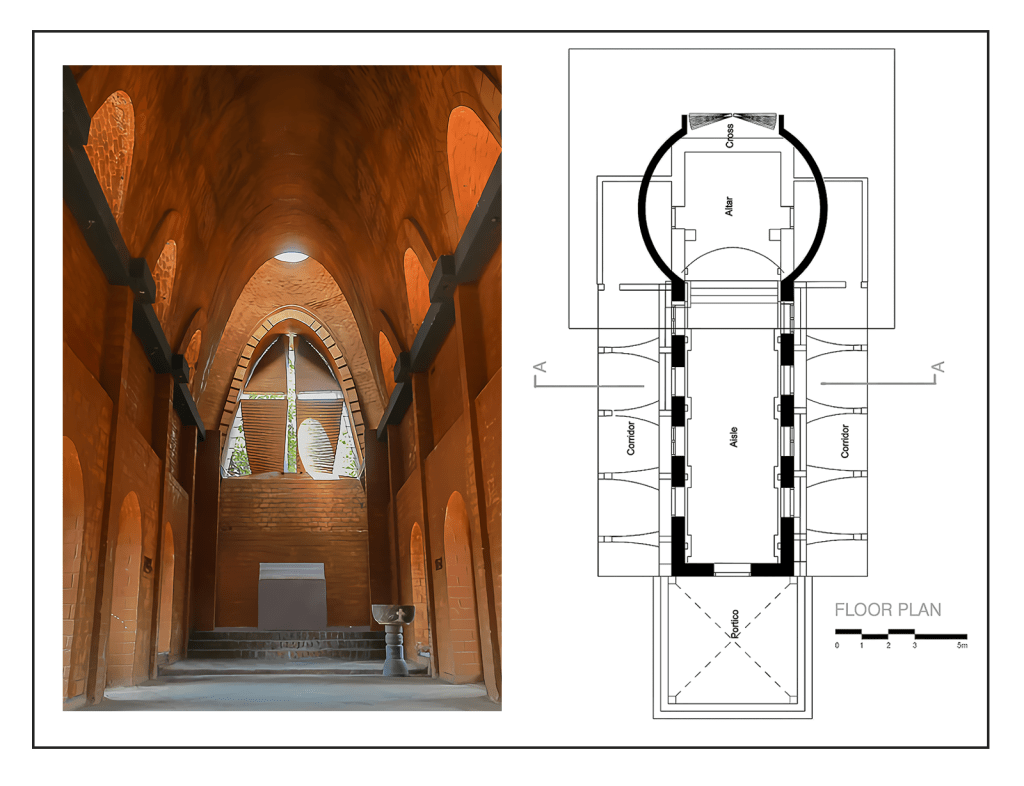
Upon further investigation, it became clear that one need not leave India to observe analogous spatial strategies within Christian architecture itself. Catholic and Orthodox churches in regions such as Goa and Kerala frequently preserve apsidal sanctuaries, strong axial nave progression, and in some cases residual or implied ambulatory circulation zones that echo the processional logic of the Chaitya hall. The Syrian-influenced Orthodox church illustrated here presents a particularly striking parallel. Although doctrinally distinct, its spatial hierarchy similarly organizes worship around a sacred focal point—the altar standing where the stupa stood—while maintaining a geometry that encourages directional movement, ritual orientation, and processional awareness. In both structures, architecture operates as choreography: belief is given spatial form, and devotion becomes patterned movement around a consecrated axis.
What I was unable to perceive at the time was the connection between these spiritual frameworks and the real-time performances I was staging with my classmates. Only now, nearly four decades later, do those experiences resolve into a coherent structural intuition. The broader implication is that much of Western art unfolds within circumscribed geometries—most commonly the square and rectangle, and more occasionally the circle—forms that impose compression upon language, image, and the human body within staged environments. The pressures exerted by these shapes across media are, in essential structure, the same. This recognition proved decisive in shaping the poem’s architecture: the initial lexical governance was altered to follow a vertical Petrarchan descent, embedding a concealed retrograde motion within the sonnet’s forward narrative surface.
It was during this phase that the figure at the poem’s center underwent a transformation. The charismatic Southern pastor who had initially animated the drafts gradually gave way to Rasputin—an unorthodox visionary whose authority derived precisely from his willingness to enter the public sphere against expectation and direction. His name is ubiquitous, his legend improbably persistent, and his death already archetypal; I therefore resisted dramatizing events that history had sufficiently mythologized. Instead, he—the wolf—would circle the narrative field of his own life, even as he is himself encircled by equally predatory boyars. The Double Form Sonnet accommodates this strategy because it begins structurally with the couplet. By refusing the conventional terminal rhyme-pair closure, the poem grants Rasputin a forceful entrance yet denies him a ceremonious exit: he arrives rhetorically amplified and departs within a diminishing acoustic field.
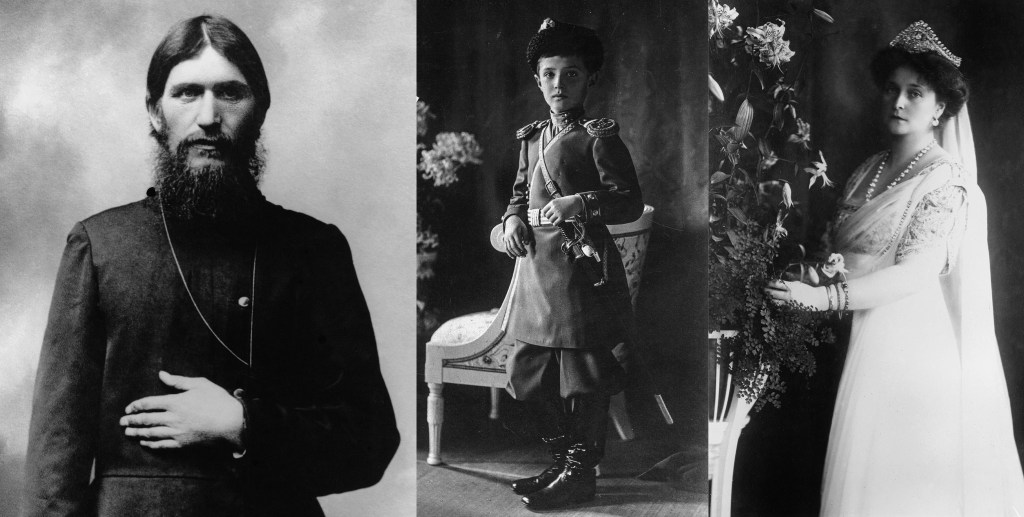
Studying the historical photographs sharpened my imaginative entry into the poem’s dramatic field. However mediated Rasputin’s story may be in biography or film, the intensity of his documented gaze alters one’s sense of proximity; the figure ceases to be merely legendary and becomes spatially present. This visualization helped clarify several moments of structural doubleness within the sonnet. Because the young tsarevich Alexei’s hemophilia was the condition that first drew Rasputin into the tsarina’s orbit, the line Soon the empress sends her women after him; / dawn to dark, where blood finds no release— was designed to operate as both historical reference and suggestive ambiguity. On one level, it evokes the pathology that made Rasputin indispensable at court; on another, it hints at the eroticized mythology surrounding his influence over aristocratic women. Such lexical bifurcation is central to the poem’s engine, allowing narrative pressure to accumulate without explicit exposition.
  The Wolf

True peasant-dark, that Siberian claw—
drawn out of birch and ice into their law,
gone soft with silk but animal, the skin,
to Petersburg, his hunger dressed as peace.
Soon the empress sends her women after him;
dawn to dark, where blood finds no release—
upon her boy, he breathes his mudded word
construed as covenant—the bleeding stilled.
Again he feeds; again she calls him Lord,
kneeling as the boyars measure out his will—
before the feast must turn to discipline—
condemn him to the ice-locked room,
shriving every rank and matted sin;
unmoored into the gloaming, out of view.
The structural turn occurs just beyond the octave, where the boyars enter the poem’s jurisdictional space. Their presence introduces a second register of doubleness: they appear to be gauging Rasputin’s resolve—measuring his “will” in the sense of psychological force—yet the same word gestures toward the legal instrument of a death warrant already forming in secret. The assassination sequence is rendered in muted, almost archetypal terms, the poem’s primary interest lying in completing the retrograde circuit the form demands: Rasputin traversing the full rotational path of the sonnet’s concealed architecture, circumambulating his own life as the field closes around him.
The retrograde motion depicted above is produced by running two competing rhyme architectures simultaneously through the same fourteen lines. The terminal words follow an inverted Shakespearean sequence—its familiar ABAB CDCD EFEF GG reversed into GG FEFE DCDC BABA—while the initial words of each line descend through a Petrarchan ABBA ABBA CDECDE pattern. These two systems move in opposing directions through the same poem, the terminal sequence pulling backward while the lexical descent pulls forward, generating the tightening counter-rotational field the wolf traverses on his way out of view.
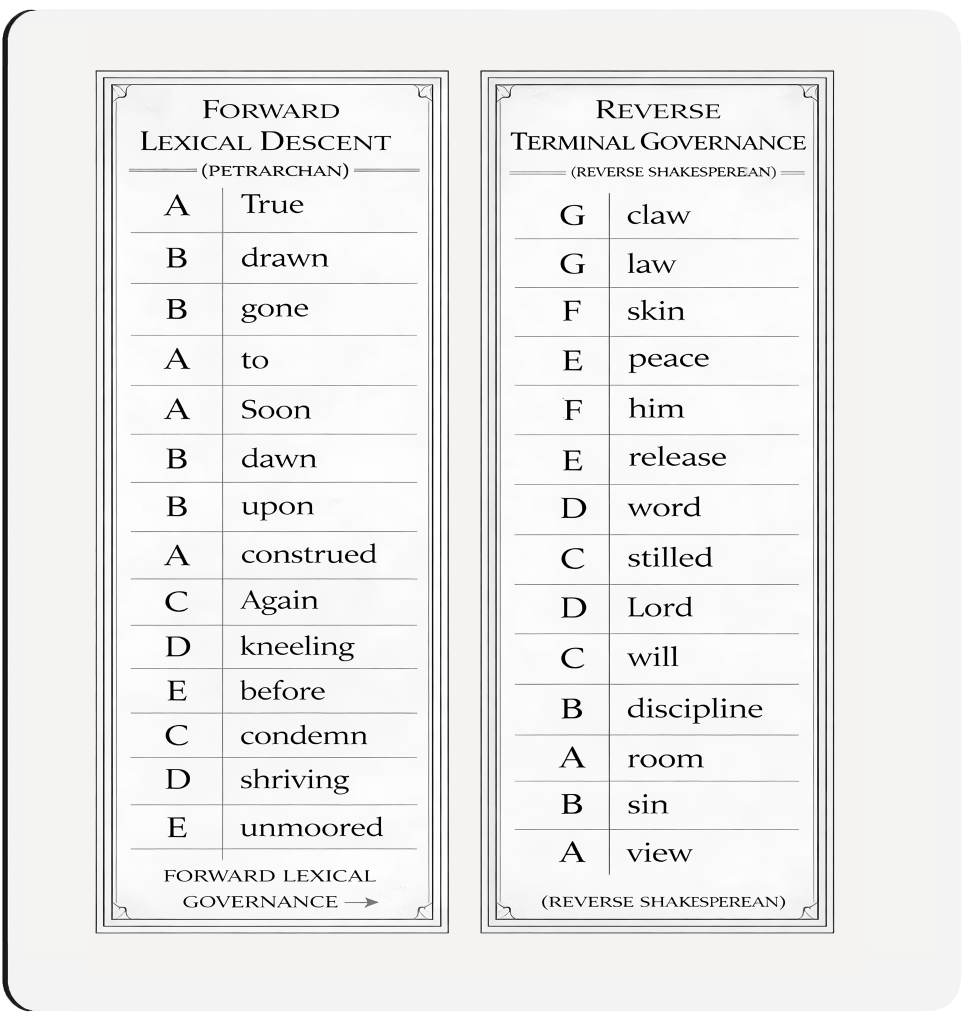
Across all the work on this page, the governing practice is visual construction—building devices that make a poem’s movement legible before or during composition: lexical lattices, fixed camera framings, architectural schematics, supplementary images drawn from photography and fine art. These visual frameworks stabilize both the poem’s internal logic and the spatial progression of characters and forces as they move through constrained environments.
Click here for all high-resolution Double Form Sonnet assets.
 jaznoblog