PART I: THE ACUPUNCTURIST
The Ghost Blazon is covered in structural detail under INVENTIONS, and its lineage within the Blazon tradition is addressed in the SONNETS section under FORMS. What follows is a companion piece—not a formal analysis, but a record of how the form and this particular poem arrived at one another, and what the photographs assembled here are doing inside that architecture. The Ghost Blazon is an invented form, built on the foundations of the classical Blazon and the Anti-Blazon. Where the traditional Blazon catalogs the beloved’s body part by part—from crown to foot, each station its own stanza, desire organized into taxonomy—the Ghost Blazon maintains the catalogue while running a second, silent inventory beneath it. The two systems occupy the same lines simultaneously, each complete, each invisible to the other, and most of the poems in this collection that employ the form run three layers deep.
The earliest version of The Acupuncturist had nothing to do with Cambodia. In the mid-2000s I contracted Bell’s Palsy, and my treatment brought me to a Korean acupuncturist whose methods were, to put it plainly, painful. She connected electrodes to the needles and slowly increased the amperage without apparent awareness of the excruciating sensation this produced. There was something procedural about her indifference—not cruelty exactly, but a clinical remove that made the sessions feel less like healing and more like endurance. What followed was a multi-part sonnet cycle built around that encounter. It was a largely emotionless affair—a formal exercise—and I eventually left it on the editing room floor.
Years later I moved to Singapore, where I have lived since, and began traveling extensively throughout Southeast Asia—lecturing, exploring, absorbing. In 2011 I flew to Siem Reap for Chinese New Year, spent several days at Angkor Wat, then took a boat down the Tonlé Sap River to Phnom Penh to see the Royal Palace, the Killing Fields at Choeung Ek, and Tuol Sleng. I rode for the duration of my stay on the back of my driver’s rickety motorbike, which thankfully broke down every twenty miles, allowing me to interface with the locals deep within the countryside of Prasat Beng Mealea. The Killing Fields was disturbing in a way that registers primarily in the imagination—walking around empty pits, my guide recounting what happened in each one, standing before the Memorial Stupa at Choeung Ek with its floors of stacked skulls and the piles of clothing visible beneath. He had survived the regime, and allowed me to photograph him during our time together, though out of respect I do not show his face; you will encounter his image later in the Joining Valley composite.
Nothing prepared me for Tuol Sleng—S-21, also known as Cyanide Hill. The former high school converted into a security prison processed somewhere between fourteen and twenty thousand prisoners between 1975 and 1979. Fewer than a dozen survived. Beyond the instruments of torture still present in the cells, and the remaining objects in the classrooms themselves, what haunts Tuol Sleng are the photographs. Like the Nazis, the Khmer Rouge were meticulous in archiving their malevolence. There are not only hundreds of intake portraits of victims throughout the complex—numbered, pinned to their clothing—but photographs of the guards as well, nearly all of them adolescents. The guards’ faces carry a different kind of haunting: not the stillness of the condemned, but something more sinister and harder to name. What struck me in particular was this: out of hundreds of portraits, you occasionally encounter someone smiling—as if posing for a school photograph. These were people who were either fully aware that torture was imminent, or who had already been tortured before the picture was taken. I carried those images back with me, and they have never left.
It wasn’t until recently that I thought to connect what I had witnessed to the abandoned poem. The question arrived suddenly: what if, instead of a Korean acupuncturist, the woman at the center of the poem was a survivor of the Khmer Rouge? The poem became a blazon—ascending from the sole of the foot to the eyes—with each anatomical station corresponding to a point in her journey through the regime: the forced evacuation from Phnom Penh, the collective labor in the rice fields, the starvation rations, the restraint and violence, the proximity of mass death, and finally the survival of all of it. The ghost inventory running beneath the acupuncture blazon is her past. The practice she now performs is her attempt to metabolize it—to work the knot to light. In the poem it is intimated that she learned the craft by working on herself, in stolen hours, in the dark of a Khmer Rouge collective. This study of the Ghost Blazon is not primarily a structural analysis—that work is done elsewhere on this site. It is instead a record of the two storylines that comprise the form: the healer’s ascending inventory, and the history her hands carry—first-person research grounded in the acupuncture clinic that produced the original drafts, and the visits to Cambodia that transformed them.
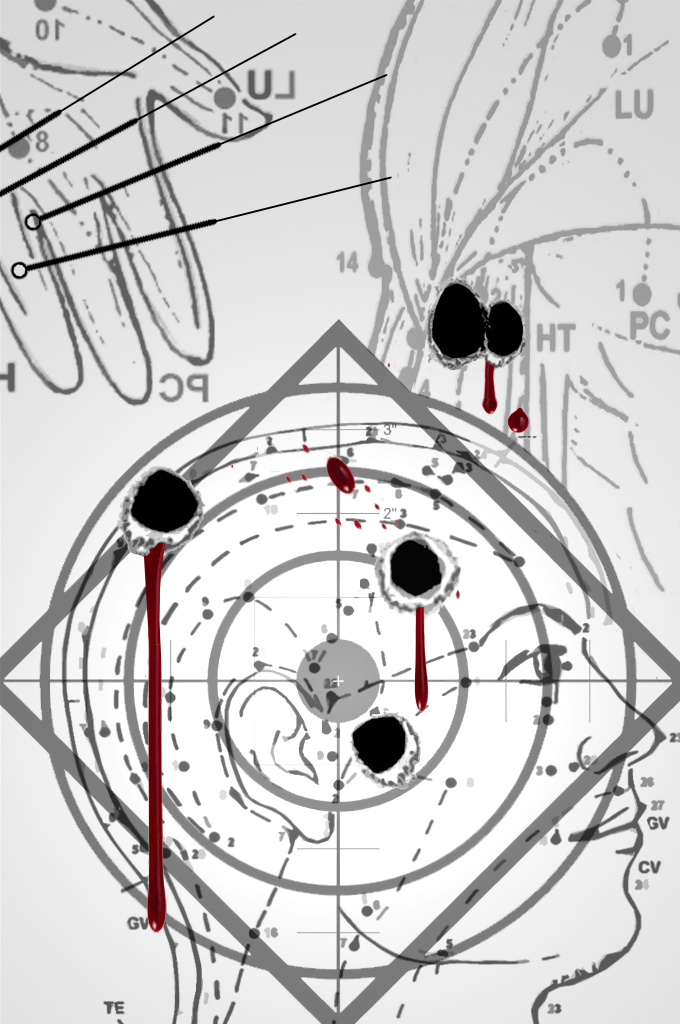
The image at the top of this post is an illustration made for the poem in its original incarnation, completed in 2004. In several respects it remains relevant in its symbolism—a meridian chart pierced by bullet wounds, the needles belonging simultaneously to the healer’s kit and to the instrument of penetration. But the true weight of this material is carried more honestly by the journalistic photographs than by either the illustration or the poem itself. The photographs are what the poem is describing; the poem is what the photographs cannot say.
I have since returned to Cambodia, traveling as far as Battambang to visit the Killing Caves of Phnom Sampov, and back again to Siem Reap and Phnom Penh. The research is not only photographic—it is the act of moving through the country and absorbing what it holds. The genocide remains something the culture is still actively processing: Pol Pot studied in Paris on a French government scholarship, developed a taste for French literature, and later taught it in Phnom Penh before turning his education against the very class of people it represented. The entire Khmer Rouge inner circle was Paris-educated, and Cambodia is still in the process of rediscovering much of the lost culture, from classical dance to the culinary arts.
On my most recent visit to Phnom Penh I attended a public talk organized by a German NGO—both countries still working to properly diagnose what happened within their borders, some strange comfort in that shared incomprehension. Spalding Gray observed something similar in Swimming to Cambodia: that this kind of organized evil is not the property of any one country but a human capacity that alights indiscriminately—Rwanda, Myanmar, Turkey, Bosnia. Prince Norodom Sihanouk only aligned with the Khmer Rouge after being deposed in 1970, the preceding years having seen Kissinger and Nixon’s Operation Menu carpet-bomb Cambodia in the name of destroying the Ho Chi Minh Trail, driving rural Cambodians toward the Khmer Rouge as the only force appearing to fight on their behalf. The bombing created the vacuum; the photographs that follow exist within that recognition.
Gushing Spring
I begin where the body meets the floor,
the sole unseals its mouth against the skin.
This ache admits the point where healing pours,
the way dry ground admits the rain within.
Great Surge
Between the bones, I work the knot to light,
and feel it climb, reduced to simple need.
What holds in muscle moves itself at night,
a pressure worked through fiber into heat.
Three Mile Point
Below the knee, the muscle learns the number:
one bowl of rice, then work until compelled.
The body holds the rise of hunger,
how far the fields extend when breathing fails.
Joining Valley
The hand goes slack. The trade is learned by feel:
to hold, release—remain upright and still.

Inner Gate
At the wrist, the passage seals the chest.
The heart kicks hard against a closing wall.
Air comes too late, the mouth compressed.
I do not move. That stillness is the rule.
Great Sun
The temple bears descending fire
a brightness set in force, a binding law.
What heat selects, it lifts onto the pyre;
what heat rejects is left exposed and raw.
Hall of Impression
Between the brows, the pressure slips—I grasp
not faces, but the burn that faces leave:
a sky that falls, a field erased to ash,
the look that means the future has been seized.
Bright Eyes
Beside the eye, the signal tempers sight.
The nerve is charged, obedient to light.
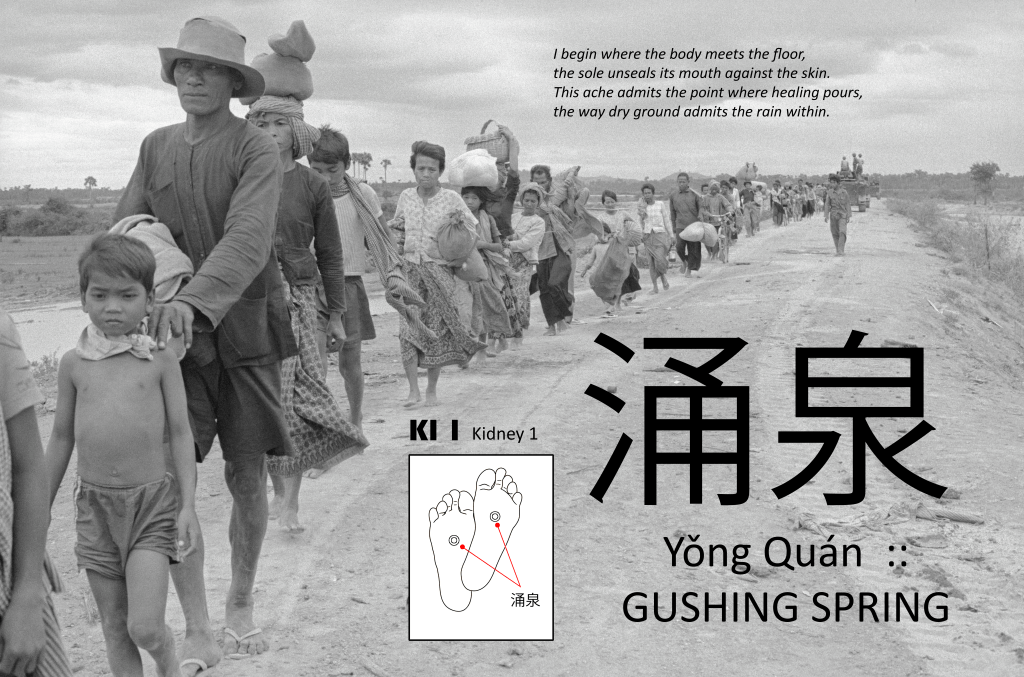
The blazon opens at Kidney 1—Yǒng Quán, Gushing Spring—on the sole of the foot: the body’s lowest point, its first contact with the ground it is being forced across. The forced evacuation of Phnom Penh began on April 17, 1975, the day the Khmer Rouge entered the city. Within hours, the entire urban population—hospital patients, the elderly, the newborn—was ordered into the surrounding countryside. The march stretched for days. The poem begins precisely there: I begin where the body meets the floor, / the sole unseals its mouth against the skin. A road made of compacted earth, and the body pressing against it learning what the ground requires.
The photograph shows this column in motion—the man’s hand on the child’s shoulder, bare feet on the dirt road, the line receding toward the horizon where a military vehicle is visible. What reads as documentary accident is in fact the image’s authority: these are people mid-step, mid-life, mid-sentence, interrupted, and the camera caught them without permission to compose. Kidney 1 is the point where the meridian system first meets the world, and the acupuncture logic and the historical logic arrive there simultaneously—the body beginning its forced curriculum.
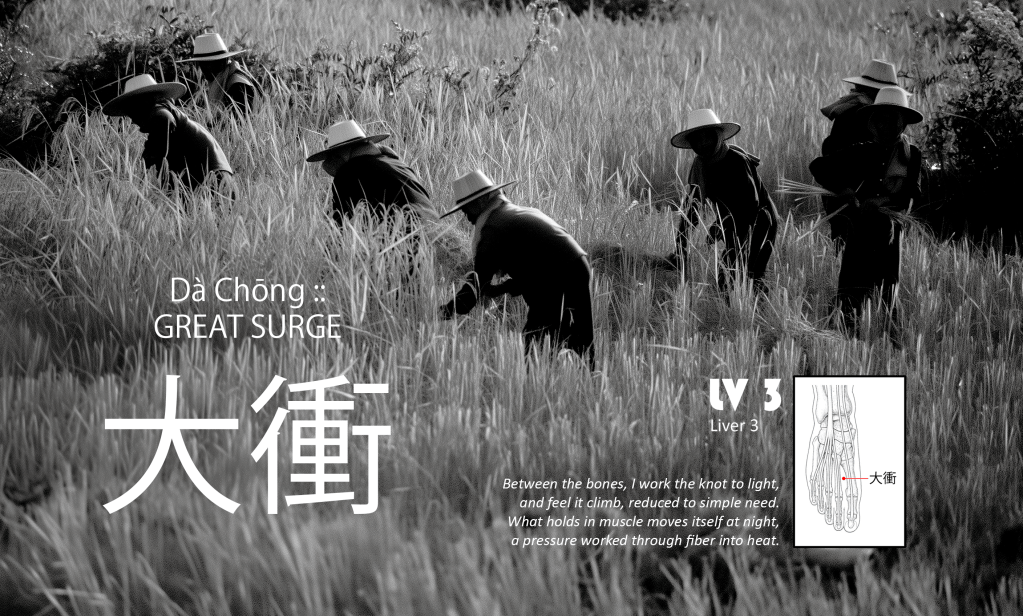
Liver 3—Dà Chōng, Great Surge—sits between the first and second metatarsal bones on the top of the foot: a major release point, the place where pressure accumulated in the body’s lower circuit finds its outlet. The poem works both registers simultaneously: Between the bones, I work the knot to light, / and feel it climb, reduced to simple need. / What holds in muscle moves itself at night, / a pressure worked through fiber into heat. Fiber carries two meanings here—the connective tissue worked to exhaustion under forced labor, and the rice stalks processed under the Khmer Rouge’s agricultural program, which was simultaneously a program of deliberate starvation.
In stolen hours, on her own body, in the dark of a collective, she is teaching herself acupuncture—taking what the regime intended as pure reduction and making it a curriculum. The photograph shows the collective harvest, multiple figures in black bent into the grain until the field fills the entire frame and the bodies and the rice stalks become indistinguishable, both worked to the same exhaustion, both the material the station names.
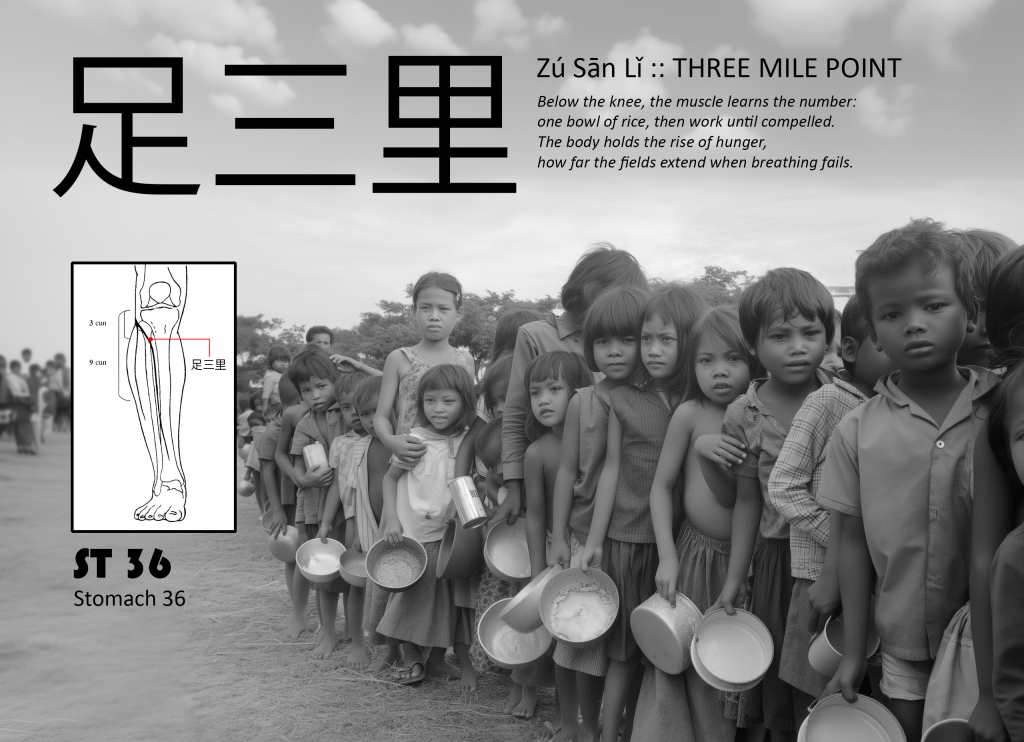
Stomach 36—Zú Sān Lǐ, Three Mile Point—sits below the knee, lateral to the tibia: the meridian system’s primary endurance station, the point that governs how far a body can travel before it exhausts its reserves. The name derives from a claim about its clinical effect—that stimulating it could extend a soldier’s march by three miles beyond the point of collapse. The poem holds this against the collective’s rationing: Below the knee, the muscle learns the number: / one bowl of rice, then work until compelled. / The body holds the rise of hunger, / how far the fields extend when breathing fails.
The photograph shows children in a ration queue, each holding a bowl—tin, aluminum, different sizes, held at the angles of people who have been holding them a long time. The girl second from left carries a slight smile directed at the camera—a flicker of response in the middle of waiting that documentary photography catches and nothing else can reproduce. The bare legs and feet visible throughout the frame place ST 36 in the image directly: below the knee, the body learning its minimum by crossing the distance daily until it knows the number the way it knows its own name.
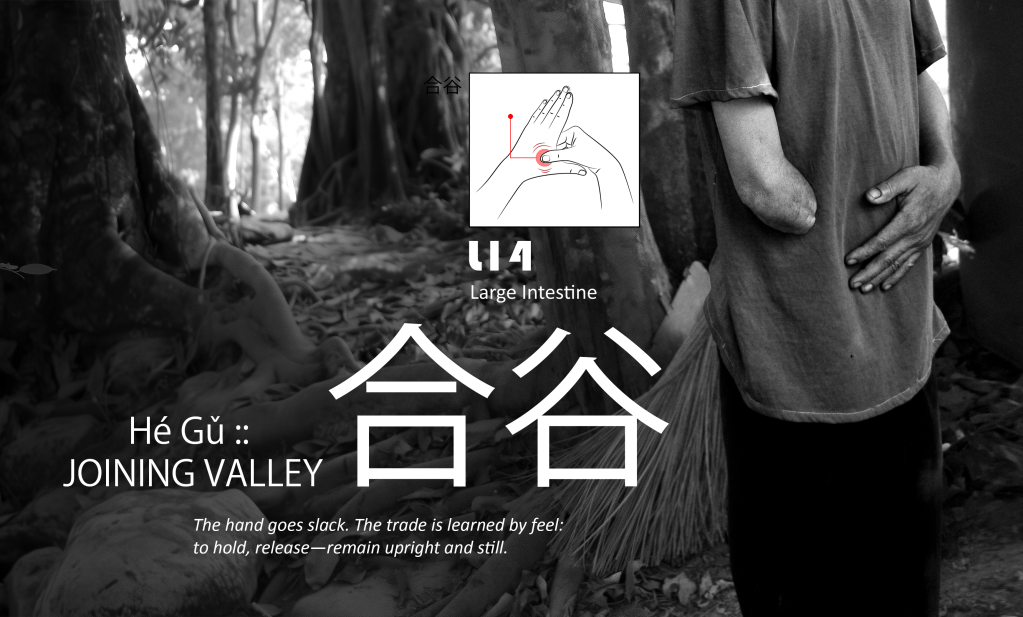
Large Intestine 4—Hé Gǔ, Joining Valley—is located in the webbing between the thumb and forefinger: the hand’s primary point, the place where grip originates and where the acupuncturist’s needle makes its most direct demand. In traditional Chinese medicine it is among the most frequently needled points in the body, governing pain, immune response, and the face—the hands carrying the whole system’s distress upward to the surface. The two verses form a couplet: The hand goes slack. The trade is learned by feel: / to hold, release—remain upright and still. Both the clinical protocol and the survival rule of the collective are present in the same sentence. She learned the trade by practicing it on herself and on fellow prisoners in the hours the guards were not watching. To move, to show knowledge of what was being done, was to be marked. The stillness functions as the most demanding form of available power.
The photograph is my own—taken at Choeung Ek during my first visit to Cambodia in 2011. My guide survived the regime and allowed me to photograph him; out of respect I do not show his face. What the image shows is his truncated arm—one hand absent, one remaining—resting against his side in the grounds of the memorial, the broom beside him, the roots of Choeung Ek’s trees spreading through the leaf litter behind him. Those roots push through soil that still yields bone fragments and clothing after heavy rain, the ground at Choeung Ek not yet finished with what it holds. The hand that remains carries Hé Gǔ intact, and the hand that is absent marks what the trade cost—the valley between them holding everything the station names. He had been working at the memorial for years, tending the grounds where his own history was buried, the broom the instrument of a different kind of practice than the one the poem describes but governed by the same logic: to hold, to remain upright, to stay. I first encountered this point in my own acupuncturist’s office, where she located it matter-of-factly, said it would aid in digestion, then looked up and added: Go make happy.
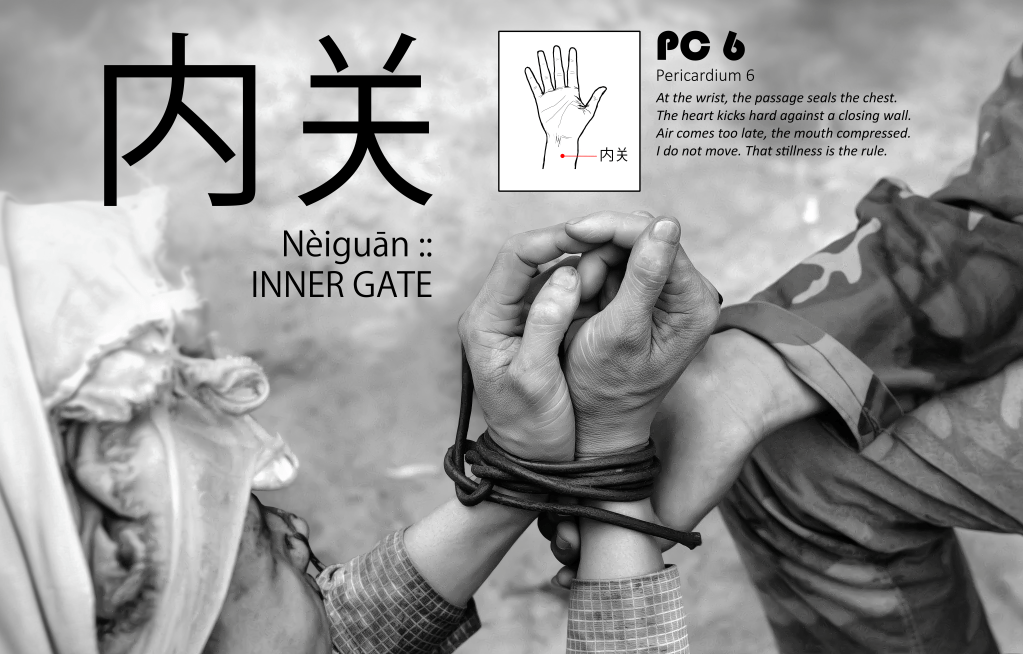
Pericardium 6—Nèiguān, Inner Gate—is located on the inner wrist, two cun above the wrist crease, between the two flexor tendons: the gateway to the pericardium, the fibrous sac that encloses and protects the heart. When this point is under compression, the poem registers it as systemic shutdown: At the wrist, the passage seals the chest. / The heart kicks hard against a closing wall. / Air comes too late, the mouth compressed. / I do not move. That stillness is the rule. The final line operates as doctrine rather than description—a protocol issued from inside the condition it names, the speaker not reporting on her state but administering the rule that keeps her alive inside it.
The photograph shows bound wrists—rope rather than handcuffs, the knots specific and irregular in the way that only actual rope under actual tension carries. The hands are palm-up, the inner wrist surface fully visible and under precisely the constraint the poem names, while the military sleeve at the right edge of the frame establishes the power dynamic without requiring a face—the diagram marking the point, the photograph showing the point under restraint.
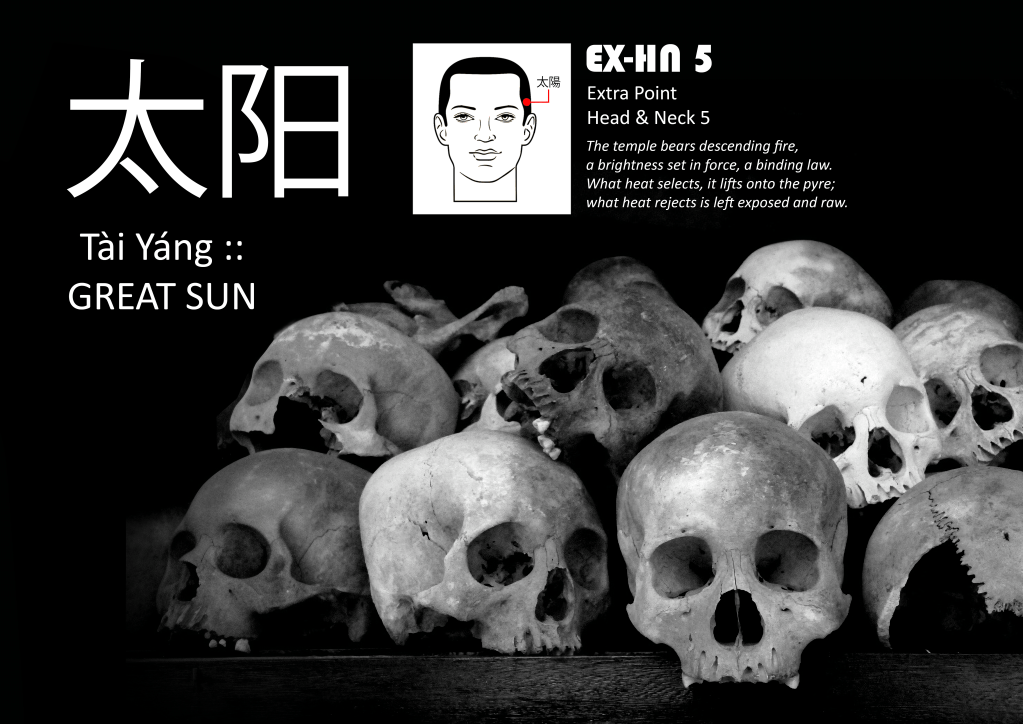
Taiyang—EX-HN 5, Great Sun—is an extra point outside the fourteen primary meridians, located at the temple: the thinnest bone in the cranium, directly over the middle meningeal artery, the skull’s most exposed surface. The poem does not soften what happened at this station: The temple bears descending fire / a brightness set in force, a binding law. / What heat selects, it lifts onto the pyre; / what heat rejects is left exposed and raw. She is the mechanism of this sortition—the instrument, working under a binding law she did not write, the temperature deciding and her hands executing the decision.
Inside the Choeung Ek Memorial Stupa, the skulls are arranged on shelves, each bearing the specific damage of its particular death, no two identical in their fracture lines, their soil staining, their idiosyncratic deterioration—the individuation that confirms these are not reproductions but people, each one the record of a specific force applied at a specific angle. What the fire selected was lifted onto the pyre; what it rejected was left here, arranged on wooden shelves in the dark of the stupa, exposed and raw.
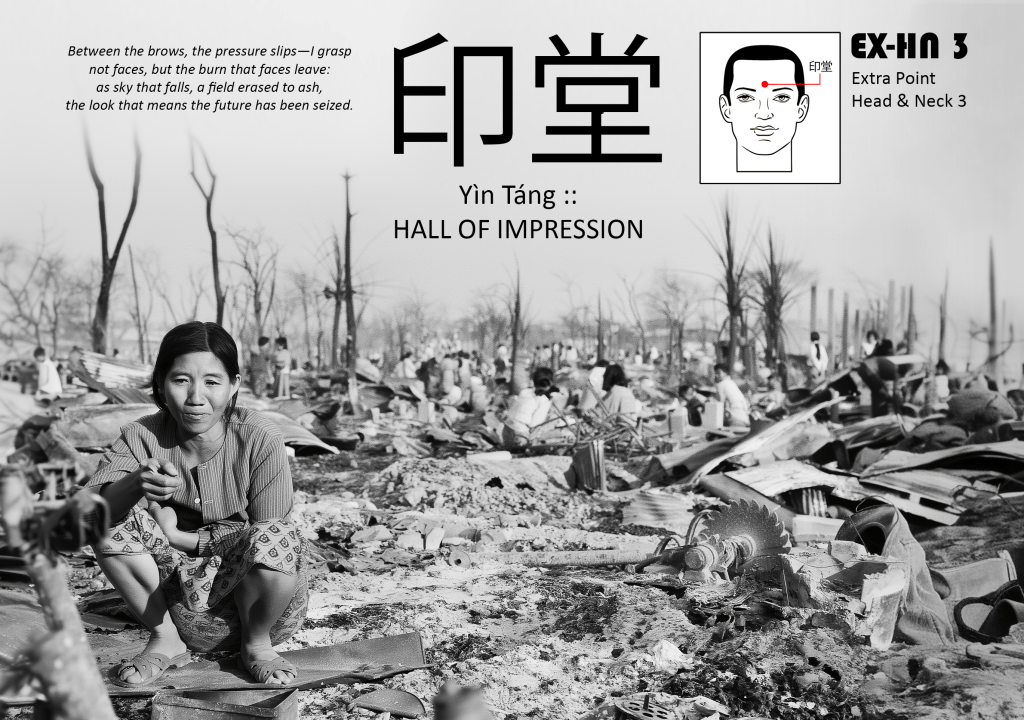
EX-HN 3—Yìn Táng, Hall of Impression—sits in the glabella, the midpoint between the eyebrows: the third eye station, the place where perception is said to be concentrated and refined. At this station the blazon arrives at aerial bombardment—the Vietnamese forces closing in, liberation arriving as additional destruction: Between the brows, the pressure slips—I grasp / not faces, but the burn that faces leave: / a sky that falls, a field erased to ash, / the look that means the future has been seized. The diagnostic gaze trained on the collective is now processing the collective’s end, reading not the living but the thermal residue the dead left behind.
The photograph shows a woman sitting in a field of ash and wreckage—a destroyed neighborhood, the saw blade in the foreground right, the burned tree skeletons receding toward a sky that is enormous and flat. She is simply present in what was her neighborhood, holding something small in her hands, her face already having processed what the eyes are still looking at—not dread, but the specific recognition of a future that has been seized and is already in motion again.
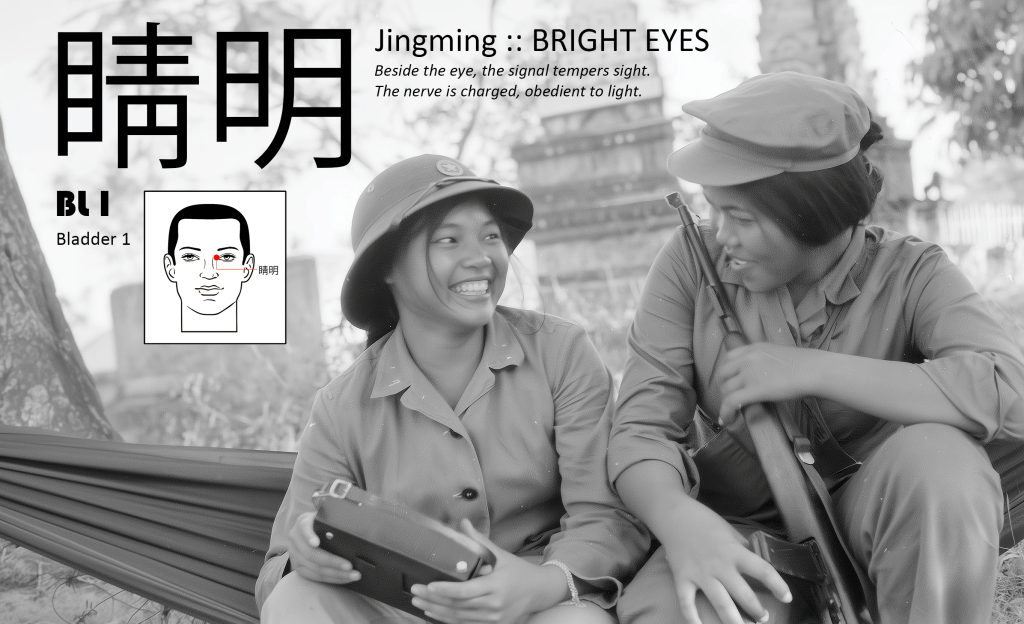
Bladder 1—Jīngmíng, Bright Eyes—is located at the inner corner of the eye, the medial canthus: the terminal station of the ascending blazon, the place where the classical form traditionally concentrated the beloved’s power over the speaker, and where that convention is here inverted entirely. The poem closes in two lines: Beside the eye, the signal tempers sight. / The nerve is charged, obedient to light. The eyes that close the blazon have processed everything the preceding stations catalogued—not deadened by it but calibrated by it, brought to a precision that only this scale of survival produces.
The photograph shows a Cambodian and a Vietnamese woman soldier sitting together in a hammock, laughing, rifles between them, the stupa of Angkor Wat visible through trees behind them—the liberation made visible in the fact of their proximity. The eyes are oriented outward, receiving, having moved through everything the ascending blazon catalogued below them—the blazon closing not on the wound but on the capacity to see what produced it, still looking. That the two women are laughing is the station’s last word: the nerve charged, obedient, and still alive to what the light brings in—the body having survived its full inventory, the eyes open, the signal clean.
A note on the photographs: all images used here are either my own—taken during personal visits to Cambodia in 2011 and subsequently—or fall under fair use as documentary and educational material. The era-specific photographs were taken by war journalists and are not in the public domain. Should this research ever be developed into a commercial publication, formal licensing will be secured for all remaining images. The Joining Valley and Great Sun composites use photographs taken by me personally. For now, I do not monetize my writing or this blog, and the use of these images is strictly non-commercial, in keeping with the educational and documentary intent of the research they support.
PART II: THE ENIGMA
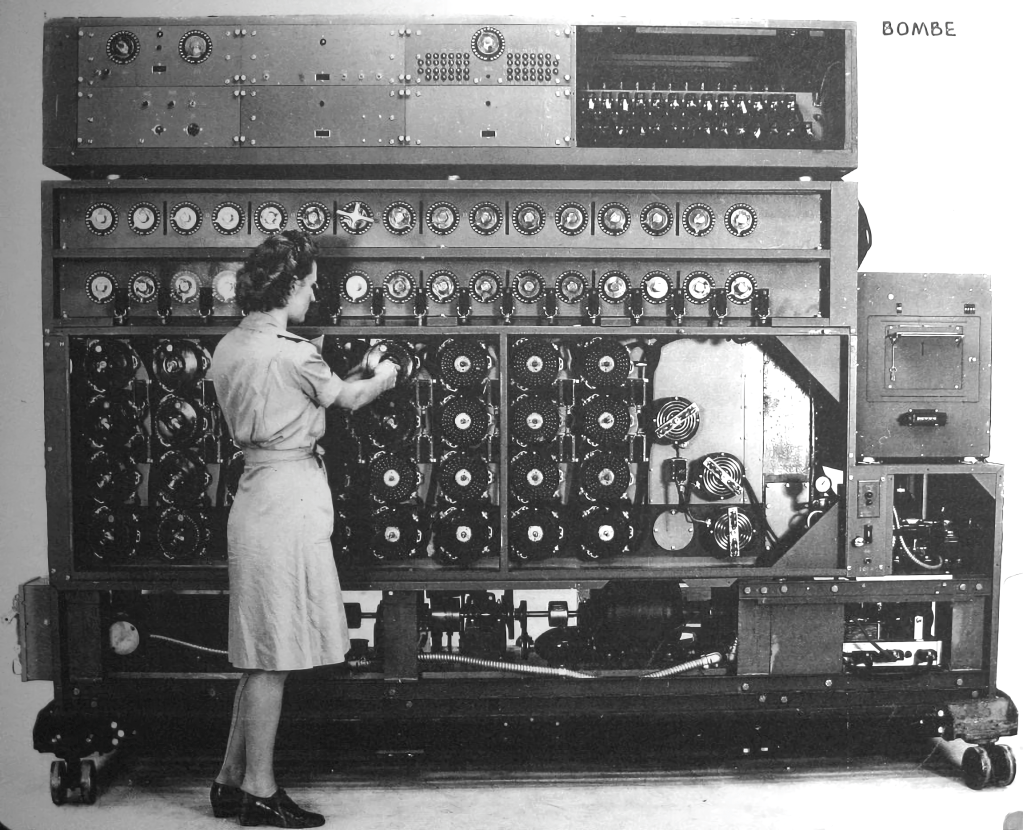
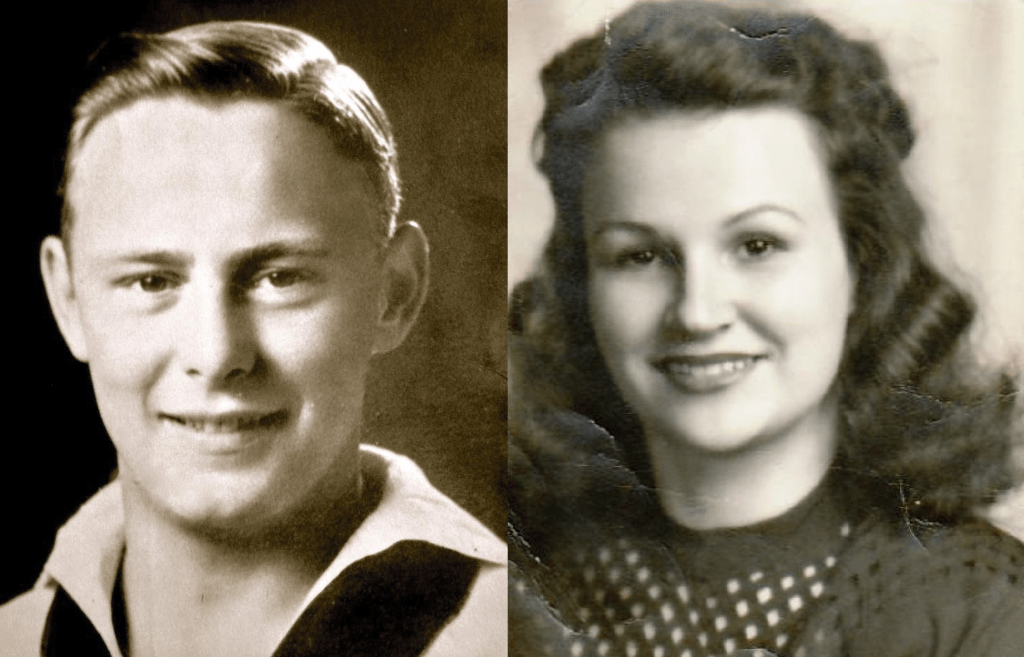
As with The Acupuncturist, this poem has been analyzed in structural detail in the Ghost Blazon section of INVENTIONS. What follows is the companion record: not the architecture of the form but the two main inventories the form is running simultaneously, and the biographical ground they share. The dominant operative levels are the Bombe machine—the electromechanical device used by British codebreakers to crack the German Enigma cipher—and Verla Francoeur, my grandmother, who operated one of these machines as a WAVE, beginning her service in Baltimore and completing it in Washington D.C. At first reading the poem functions as allegory, the machine’s anatomy standing in for something larger about secrecy and signal. But it is also a blazon—the beloved in this case not the machine but the woman who ran it, whose earliest and most purposeful work was conducted in silence, under oath of death, in a language she had spoken since childhood.
Verla spoke perfect Wehrmacht German—an inheritance from her Apostolic Illinois farming community, where German was the domestic tongue and the faith was its own sealed country. The military recruiting system apparently did not consider the irony of asking a woman to feed the enemy’s language into a machine designed to destroy it. She never spoke about her service. The oath held well into her dotage, though eventually it was no longer a state secret. What the family received was not the work but its residue: the signal that the explication describes as the Lorcian duende—the dark current that rose in her sons and ran through the family as atmosphere rather than as speech. Without any of this context, the poem reads as an addict’s poem. Because of the Cohen homage in its final line, it could even be construed as a meditation on his period of creative and moral escapades at the Chelsea Hotel. That layer was not top of mind when the poem was written. It arrived later, forensically, as the blazon’s second inventory surfaced in retrospect.
Verla had been expelled from her community before the war found her—twice over: first for enlisting, which the Apostolic fellowship read as an alignment with violence their pacifism could not absorb, and second for a Catholic boyfriend whose faith placed him outside the boundaries of a world where doctrine and bloodline were the same country. That man died in the D-Day invasion while Verla sat at the Bombe in Washington, running German transmissions through the machine on the other end of the same operation.
The Enigma
For Verla Francoeur

Something wakes inside a numbered lock.
The hands move over banks of wire and tooth;
each breath a calculation, each slow knock
a pulse, a breach the cipher opens through:
the cold thing at the center turns and turns—
a dark fidelity, a mouth that takes
what enters there, gives nothing back, but churns
the husk to signal till the body shakes—
a secret comes up through the floor in waves:
the vessel holds it, shows the way a jaw
unhinges in the dark, the way it splays
a signal turning red, the panel raw
as punctures driven into skin.
But that is where the light gets in.
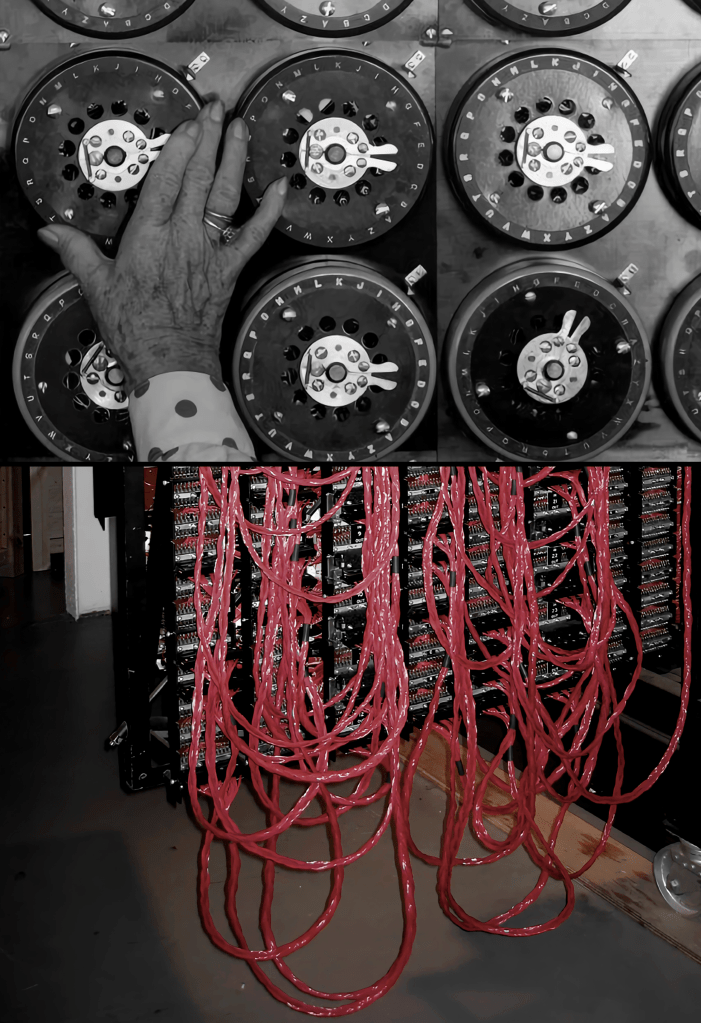
The poem’s first word is not turns or clicks or opens but wakes—which gives the Bombe machine latency and appetite before it gives it mechanics. The numbered lock holds two inventories simultaneously: the lock on the machine’s housing, the device summoned into operation; and the lock Verla built around her interior life and maintained for decades after the institutional reason for it had legally expired—the poems, the paintings, the mystic streak, the signal that had nowhere legitimate to go. The rotor drums visible in the machine’s open housing are the teeth of the poem’s second line—literal, mechanical, set in banks, the wire threading between them in a configuration that, when the housing is opened, reads less like circuitry than like anatomy, the machine and the organism sharing the same vocabulary, neither one conceding to the other’s register. Each breath a calculation, each slow knock / a pulse, a breach the cipher opens through: the knock implies resistance; the breach is its violent answer. An earlier draft used door rather than breach, which smuggled in a threshold logic the poem refuses—entry from outside, traversal, before-and-after. In a closed system, pressure builds and the membrane ruptures. Breach carries that rupture while staying inside the poem’s physiological register alongside churns and unhinges and splays.
It is worth noting that Verla was not alone at the machine. The WAVE program brought thousands of women into cryptographic work precisely because the oath structure suited them—they were considered more reliably discreet than their male counterparts, more capable of sustained repetitive operation, more willing to disappear into the institution without demanding recognition. The Bombe required a particular combination of physical dexterity and procedural patience: the operator set the machine, monitored the drum rotation, watched for the compression bar to release on a hit, then reset and ran the next menu. The work was relentless, classified, and for decades officially denied. Verla carried it the way she carried everything else the faith had trained her to carry—inwardly, without complaint, the signal held under compression until the body finally gave it back in forms nobody recognized as hers.
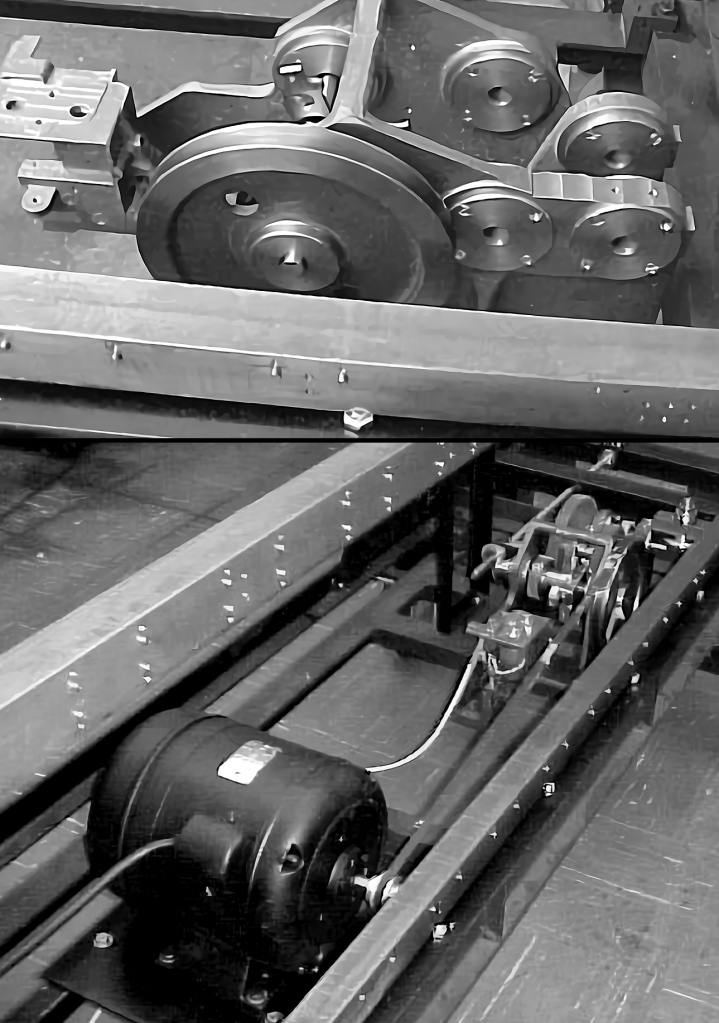
the cold thing at the center turns and turns— / a dark fidelity, a mouth that takes / what enters there, gives nothing back, but churns / the husk to signal till the body shakes—
The cold thing is the Bombe’s rotating drum assembly, the mechanism that cycles through possible Enigma settings with the blind, tireless fidelity of a machine that has no relationship to its contents beyond the processing of them. Internally, the drums are driven by pulleys and a gearbox—the mechanism that allows each rotor to step independently, running through letter combinations at a rate no human cryptanalyst could approach. Dark fidelity is a compressed ethical indictment: mechanical precision faithful to input regardless of what that input is, and the specific moral condition of a woman who spent years feeding the enemy’s language into a machine under an oath that made disclosure equivalent to execution. The mouth that takes and gives nothing back maps the Bombe’s operating principle onto the form of concealment Verla practiced across her life: whatever entered was processed into something unrecognizable as its source, never returned. The husk to signal till the body shakes runs across three registers simultaneously: the Bombe at full operational capacity; the threshing crews of her Illinois agricultural childhood, the communal harvest labor she left behind for the war effort; and across two young women processed through a military hiring system that required their degradation as the price of admission. The body that shakes is the machine under load, the woman being processed, and the woman doing the processing.
The Bombe did not decode messages—it eliminated possibilities. Each run narrowed the field of potential Enigma settings until only one remained—the setting the German operator had used that morning, valid until midnight, when the wheel positions reset and the work began again. The machine produced not meaning but the conditions under which meaning could be extracted elsewhere, by other hands. Verla’s role was to run the elimination, day after day, the husk of each failed setting discarded, the signal emerging only after everything that was not the signal had been burned away—the threshing crews of her Illinois childhood performing the same operation on the grain, the faith performing it on the spirit, Verla now performing it on the enemy’s language in a basement in Washington.
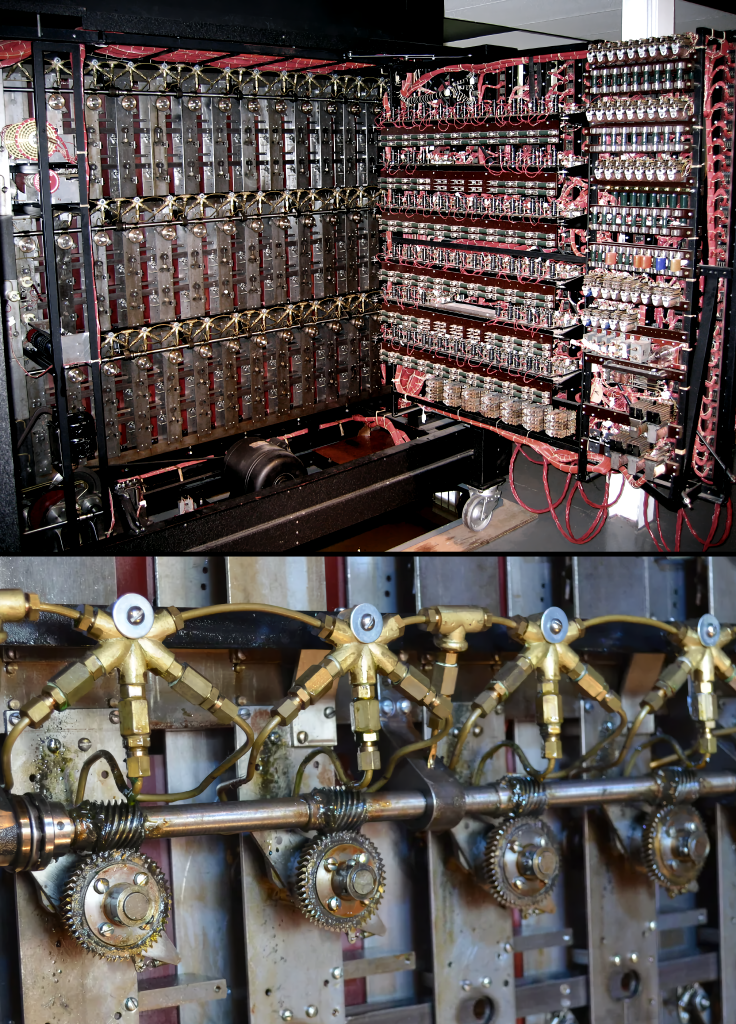
a secret comes up through the floor in waves: / the vessel holds it, shows the way a jaw / unhinges in the dark, the way it splays
The sestet abandons interior process for emergence—not decoded cleanly but rising almost geologically from suppressed depth, surfacing in waves because there is no legitimate channel, the oath having closed them all. The vessel is the Bombe’s seven-foot steel cabinet and the body that has become expert in concealment, holding what cannot be transmitted until the conditions of transmission are accidentally met. The jaw unhinges in the dark as the Bombe’s compression bar releases on a hit, the machine’s single moment of disclosure, the rotor set dropping free to expose the day’s Enigma settings. Once the Bombe’s housing is opened, the backplane reveals itself as a mechanical maw: the sharp teeth of the contact points arranged along the board in rows, the wires hanging from them like arteries, the whole apparatus bearing more secrets than its exterior suggests. The jaw is the machine’s actual configuration when opened, biological in its geometry without having borrowed it from biology—and also the mouth that finally opens under conditions where darkness provides the only available permission, the dislocation required to take in something too large for the ordinary aperture.
The poems Verla left behind were found after her death—not during her lifetime, not shared, not offered—found, the way the Bombe’s output was found: as the result of a process that ran without witnesses, in conditions nobody thought to monitor, producing material that required other hands to read. The secret that comes up through the floor in waves is the poem itself, surfacing decades after the machine was decommissioned and the oath had long since expired, in a form nobody in the family had the key to decode until the decoding was no longer for her benefit but theirs. She had also painted throughout her life—work she shared openly while she was living—the visible transmission running alongside the hidden one, the family receiving the paintings and missing the poems entirely, the instrument for one present and for the other absent. The sealed transmission was not hers alone: Don Jr. on a nuclear sub in the Bering Straits, Jerry in Da Nang, John on the DMZ, Robert in Latin America, Don Sr. on the Indianapolis, Jeremy’s missions in Afghanistan and Iraq and later work at NORAD—each of them carrying what could not be spoken in the same way Verla carried it, the silence moving through the family not as absence but as atmosphere.
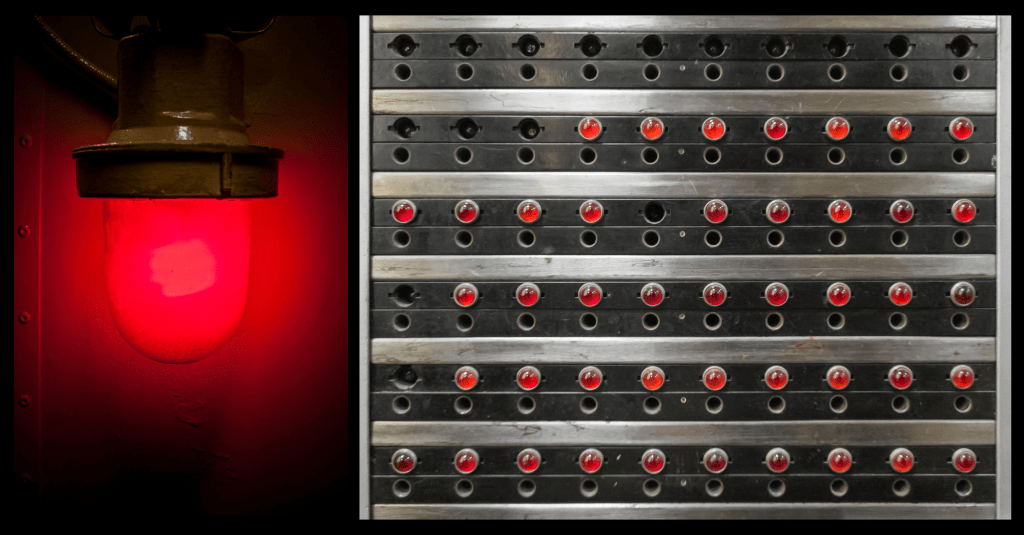
a signal turning red, the panel raw
The jaw’s unhinging produces not a word but a signal—decoded transmission hitting the output panel, red as alarm, the moment classified material becomes legible and dangerous. On the body’s side of the blazon, the vein surfaces under pressure, carrying its own version of the same warning. When the compression bar dropped on a hit, the electrical circuit completed and the indicator lamp lit—the operators called it a stop, the machine communicating through the interruption of its own process rather than through language. The stop did not mean the message was decoded; it meant the conditions for decoding had been established. Other hands took the setting and ran it through the Typex machine to recover the plaintext—the Bombe operator never saw the message, only the conditions under which it could be recovered by someone else, in another room, at another machine. Verla ran the elimination daily, the husk of each failed setting discarded, the signal turning red the end of her part in the process and the beginning of a part she was not permitted to witness.
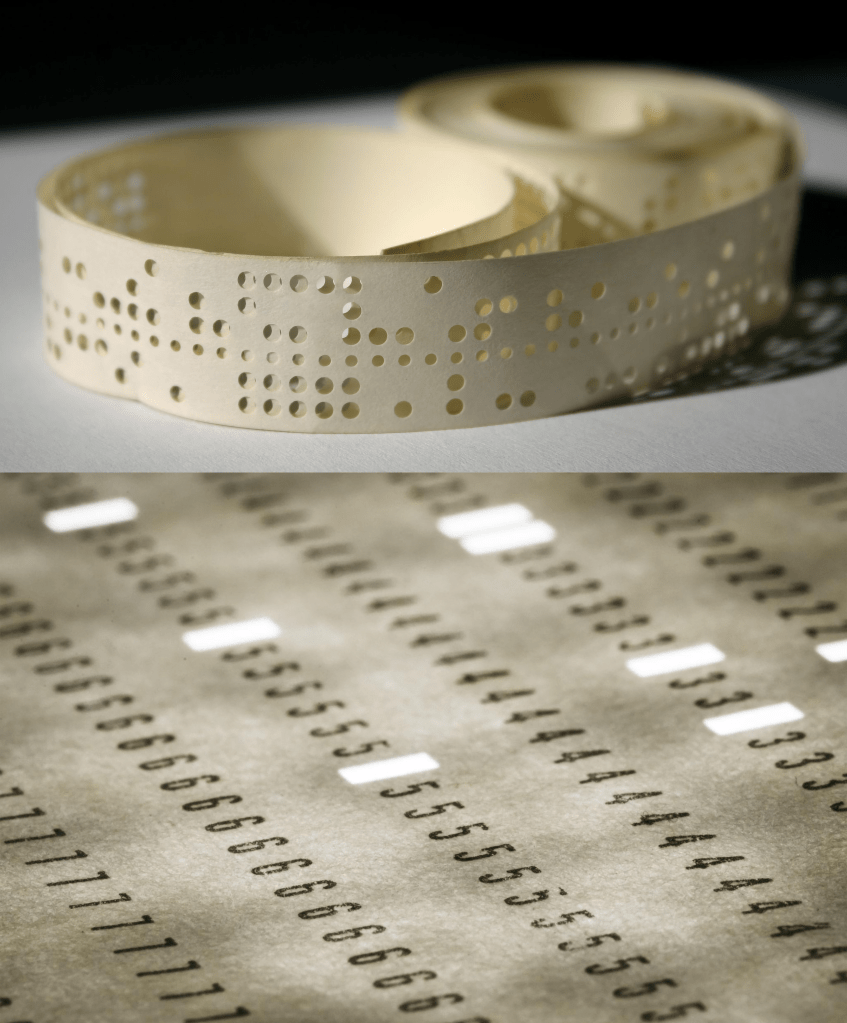
the panel raw / as punctures driven into skin. / But that is where the light gets in.
The panel raw as punctures driven into skin is where the signal thread ends and the third inventory takes over. The output card belongs to the Bombe—perforated, legible only as the pattern of its absences, the message carried by what is not there. The punctures belong to the addict’s arm. The two images share a surface because the blazon has been running all three inventories through the same lexical space from the first line, and here, at the point of maximum disclosure, they converge: the output card punched through and the needle tracks readable by the same logic, both marked by what has been forced through them and removed.
But that is where the light gets in. The numbered lock is now also the deadbolt on a hotel room door, the chain engaged, the world outside reduced to a slow knock and a turning handle. Three inventories run through the same architecture: the Bombe machine’s stations from lock to rotor bank to output card; the body at the Bombe machine, from hands to breath to pulse to husk to jaw to skin; and the room’s stations, from lock to doorknob to floor to vessel to panel to light. At stations where the inventories share vocabulary—jaw, vessel, floor, panel—the bodies collapse into each other, Verla’s body and an addict’s body producing identical inventories when held to light at once.
The closing line inherits a frequency Verla had been transmitting all along—through the mystic streak that moved through her children as atmosphere rather than speech, through the paintings nobody was invited to see and the poems found in a drawer after her death. The panel is raw, the punctures are driven, and the darkness is the condition under which the system finally opens. The light that enters does not redeem the machine or the woman or the oath—it does not decode what the oath sealed or restore what the compression burned away. It arrives because the holes are there, and light moves through holes, the one transmission that requires no institution, no faith, no permission.
PART III: THE ROAD TO ANANDAMARGA
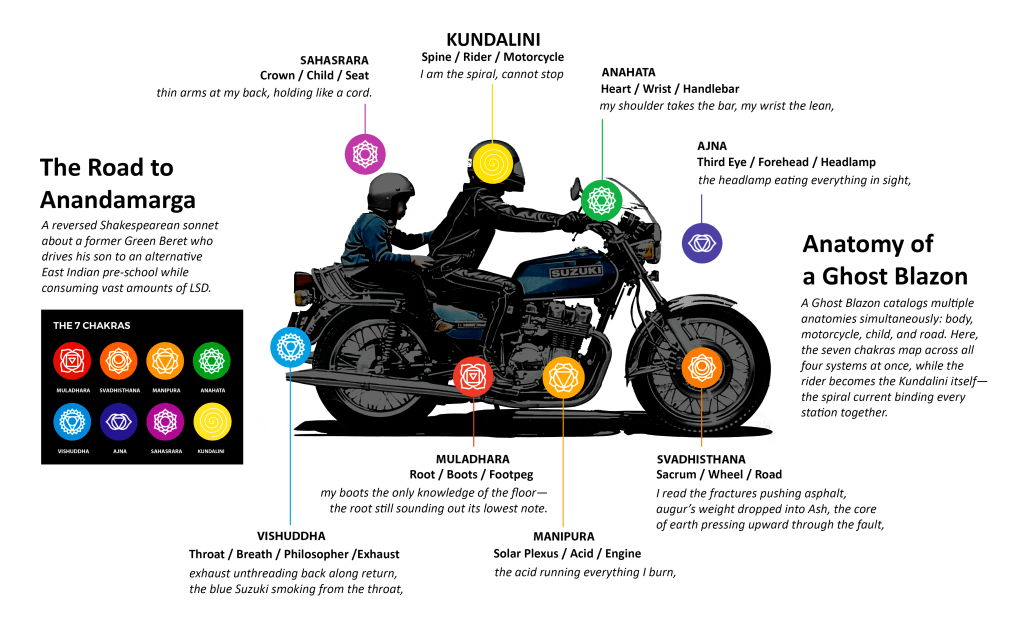
As with the preceding poems, the structural analysis of The Road to Anandamarga appears in the Ghost Blazon section of INVENTIONS. What follows is the companion record: the biographical ground the form is moving through, and the three simultaneous inventories running beneath the poem’s surface. The situation is this: Wichita, Kansas, 1973. Robert Lee Francoeur—former Green Beret medic, practitioner of Ananda Marga, reader of D.T. Suzuki and Wittgenstein, builder of communes—drives his three-year-old son to an alternative East Indian preschool on the back of a 1973 Suzuki GT750 Water Buffalo while LSD runs the operation. He had survived Bolivia and Nicaragua, survived the car crash at Fort Sam Houston, survived the cohort that died in Southeast Asia while the organism in his gut kept him stateside — and arrived at Wichita carrying all of it, the demolitions training and the yogic practice and the Bhagavad Gita pressed against the same nervous system on the same Kansas morning. The child grips the leather at his back without possessing the language to understand why the road has dissolved into brightness and the man steering the machine has begun to move through the morning as if gravity itself were losing its hold. The poem is spoken by the father, from inside the dissolution, the child the one fact in the system that cannot be detonated.
The form is a Reversed Shakespearean Sonnet—the only documented pure instance of a reversed terminal scheme in the literature, its rhyme sequence running GG FEFE DCDC BABA against the conventional forward movement. The reversal is not ornamental. The hallucinating mind cannot move through experience sequentially; cause arrives after consequence, perception outruns chronology, and the poem opens already inside the terminal condition—I am the spiral, cannot stop—before descending through the evidence of how the rider arrived there. A conventional sonnet would require the poem to begin before the dissolution and arrive at it — which is precisely what LSD makes impossible, the chemistry having already removed the before. Within that reversed structure three Ghost Blazons operate simultaneously: the motorcycle’s anatomy catalogued from crown to root; the seven chakras mapped across the same stations in descending arc; and the rider himself functioning not as a body moving through the chakra system but as the Kundalini outright — the spiral current binding every station together, the motorcycle’s frame becoming the sushumna channel the poem is written along. The Reversed Shakespearean Sonnet is the only form in the documented literature whose terminal logic mirrors the Kundalini’s descent rather than its ascent, the poem moving through its own dissolution the way the rider moves through his — from the terminal declaration back through the evidence, the root note sounding last.
The Road to Anandamarga
R.B. Francoeur, Wichita, 1974

I am the spiral, cannot stop—pitch forward,
thin arms at my back, holding like a cord.
Wichita dissolving at the edges, burning white—
my shoulder takes the bar, my wrist the lean,
the headlamp eating everything in sight,
the blacktop folding into what’s between.
I read the fractures pushing asphalt,
augur’s weight dropped into Ash, the core
of earth pressing upward through the fault,
my boots the only knowledge of the floor—
exhaust unthreading back along return,
the blue Suzuki smoking from the throat,
the acid running everything I burn,
the root still sounding out its lowest note.

KUNDALINI — Spine / Rider / Motorcycle
I am the spiral, cannot stop—pitch forward,
The poem’s opening declaration is not metaphor. The acid has already dissolved the boundary between rider and machine before the motorcycle has fully entered motion, and what remains is the Kundalini itself—the spiral current that in Tantric physiology rises through the sushumna, the central channel of the subtle body, from root to crown. The rider is not merely governed by this current; he is functioning as it, the motorcycle’s frame the sushumna channel the poem is written along, the spiral the only available form of selfhood once the partitions between body, machine, and perception have been chemically removed. Cannot stop is the Kundalini’s governing condition: once the current is moving, the system that generated it cannot arrest it from inside. The pitch forward is both the rider’s lean into speed and the poem’s opening into its own reversed descent—a form that begins at the terminal condition and only afterward recovers its evidence.
This is also where the poem’s biographical stakes become precise. The man on the motorcycle is a former Special Forces medic who spent years training the body to operate under conditions of maximum dissolution—to function when the center is under assault, to hold the axis when everything around it is breaking down. Ananda Marga offered a different discipline toward the same threshold: the deliberate movement of energy through the body’s central channel, the controlled ascent of the Kundalini under conditions of sustained practice. The acid on the Wichita road is neither of these things. It is the dissolution without the training, the current without the controlled ascent, the spiral declared without the years of preparation the tradition requires before the declaration can be made safely. Cannot stop is the consequence of that gap—the system in motion before the rider has the apparatus to govern it, the child’s arms the only tether in a system already past the point of voluntary arrest.
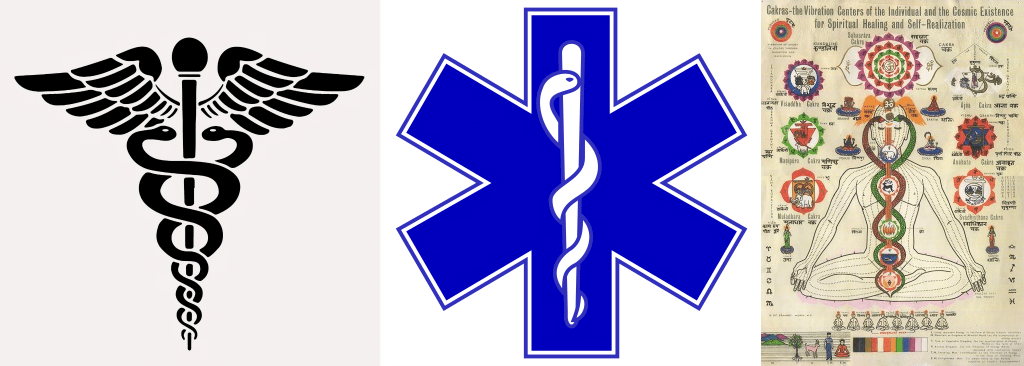
The spiral around a stabilized center is among the oldest recurring forms in human symbolic life, appearing independently across traditions that had no contact with one another—which suggests it is less a cultural invention than a perceptual discovery, the mind finding in the spiral the shape that energy takes when it moves through a system without losing its axis. The caduceus, Hermes’ staff, carries two serpents spiraling around a central rod toward winged crown: the instrument of the messenger who moves between worlds, who puts the living to sleep and wakes the dead, whose authority derives precisely from his capacity to traverse boundaries that others cannot cross. The Rod of Asclepius—one serpent, one axis—is its medical counterpart, the healing version of the same structure, the spiral as the form of recovery rather than of transit. It is worth noting that the two are consistently confused in contemporary usage, the caduceus appearing on medical insignia that should carry the Rod—a confusion that collapses the distinction between the messenger and the healer, between transit and recovery, between the god who crosses thresholds and the god who mends what crossing them has cost. The Tantric tradition maps this geometry onto the subtle body: ida and pingala, the two subsidiary channels, spiral around the sushumna, the central axis, in exact correspondence with the caduceus’s twin serpents, the Kundalini coiled at the root waiting to rise. In each of these systems the spiral is the form that power takes when it moves through a body that has an axis—the central channel, the staff, the rod, the spine—and the question the tradition is always asking is whether the system can sustain the current once it begins to move, whether the center will hold under the pressure of its own ascending force.
When Crick and Watson published the double helix structure of DNA in 1953, the image that appeared in Nature was immediately recognizable to anyone familiar with any of the preceding traditions: two strands spiraling around a central axis, encoding everything the organism is in the pattern of their winding. The Fibonacci spiral extends the logic into pure mathematics and then returns it to biology—the nautilus shell, the sunflower head, the cochlea of the human ear, all growth patterns governed by the same ratio, the spiral the form that organic systems take when they are expanding without losing their center. Robert Francoeur was a Green Beret medic—trained in both the caduceus tradition and its martial shadow, the body as the site of damage and repair simultaneously—who brought Ananda Marga practice to Wichita after the covert years as a system for moving the Kundalini through a body trained to operate in conditions where the center does not hold. When he declares I am the spiral, cannot stop, the lineage is fully activated: the messenger between states, the healer and the patient simultaneously, the biological code running beneath the voluntary one, the combat medic’s knowledge of thresholds colliding with the yogi’s knowledge of channels, the acid running both systems through the same dissolving channel on a Kansas road in 1973.

SAHASRARA — Crown / Child / Seat
thin arms at my back, holding like a cord.
Sahasrara, the crown chakra, is the seat of pure consciousness—the point at which the individual self dissolves into undifferentiated awareness. On the motorcycle it is the seat, the highest physical point, where the child sits. The child’s arms at the rider’s back are the cord that grounds the entire system, the one human tether inside a dissolution that has otherwise consumed rider, machine, and road alike, holding while everything else is already burning white. In Tantric physiology the crown is where the Kundalini completes its ascent; here it is where the ascent begins, or rather where the child—who has not dissolved, who cannot dissolve, who is three years old and gripping leather—marks the boundary the acid cannot cross. That boundary is not metaphysical but physical: two small arms, a child’s grip strength, the pressure of a body that does not know it is holding anything together and therefore holds.

ANAHATA — Heart / Wrist / Handlebar
Wichita dissolving at the edges, burning white— / my shoulder takes the bar, my wrist the lean,
Anahata, the heart chakra, governs love, recklessness, and the opening of the self toward what it cannot control. At the handlebar, love and recklessness have collapsed into the same gesture—the wrist translating intention into direction, the shoulder absorbing the lean, the body and the machine communicating through the contact point where control and surrender meet. Wichita dissolving at the edges is not hallucination as failure of perception but hallucination as accurate report: the city is genuinely receding, the center holding while the periphery burns, the heart chakra’s governing truth—that the self opens by losing its edges rather than consolidating them—rendered as the specific phenomenology of LSD at speed on a Kansas morning in 1973. The child behind him is the heart’s irreducible fact, the reason the wrist keeps its lean and the shoulder keeps its hold: Anahata governs not only the opening but the love that makes the opening survivable, the force that keeps the system moving toward its destination even as the destination dissolves into the same white burning everything else.

AJNA — Third Eye / Forehead / Headlamp
the headlamp eating everything in sight, / the blacktop folding into what’s between.
Ajna, the third eye, is the seat of perception beyond ordinary sight—the faculty that sees through surfaces to the structure beneath. The headlamp is its mechanical equivalent: the instrument that illuminates the road ahead, eating what it finds, converting darkness into the visible. But at this speed and in this chemistry the headlamp is consuming rather than revealing, the blacktop folding into what lies between rather than extending forward as navigable surface. Ajna at its limit arrives as the dissolution of the distinction between the seen and the seer, the lamp and what it illuminates—the third eye opening so wide that ordinary perception ceases to function and the space between things becomes as present as the things themselves. The headlamp eating everything in sight is the acid’s perceptual logic made mechanical: an instrument designed to clarify the path ahead that has instead consumed the distinction between the path and the perceiver, the road and the rider, the light source and the darkness it was sent to resolve. At this station the motorcycle is no longer a vehicle moving through space but a system of perception moving through its own dissolution, the headlamp the forward edge of a consciousness that has burned past the boundary between what it illuminates and what it is.

SVADHISTHANA — Sacrum / Wheel / Road
I read the fractures pushing asphalt, / augur’s weight dropped into Ash, the core / of earth pressing upward through the fault,
Svadhisthana, the sacral chakra, governs the body’s relationship to the earth—its capacity to sense what is moving beneath it, to read the ground through pressure and vibration. At the wheel, this becomes literal: the tire reading the road’s fractures, the machine transmitting geological information upward through frame and spine into the rider’s body. The augur’s weight dropped into Ash is the diviner’s instrument finding the fault line, the crack in the surface where the earth’s interior pressure finds its way up. The core pressing upward through the fault is tectonic and somatic simultaneously—the earth’s own Kundalini moving through the same channel the rider is moving along, the road functioning as a membrane through which forces exchange rather than a surface to travel across. Ash is also the residue of combustion, the word carrying the engine’s aftermath into the geological register, the fault line in the asphalt and the fault line in the body reading each other through the same instrument—the wheel transmitting upward what the earth is doing below, the sacrum receiving it, the rider deciphering the ground’s interior pressure the way a combat medic reads a body for what it cannot yet articulate.

MANIPURA — Solar Plexus / Acid / Engine
the acid running everything I burn, / the root still sounding out its lowest note.
Manipura, the solar plexus chakra, is the seat of will, combustion, and the body’s generative fire—the furnace that drives the system, the center from which action radiates outward. The engine is its mechanical equivalent, and the acid is its chemical one: both running everything, both operating below the threshold of voluntary control, both converting input into energy through a process that cannot be reversed once begun. The acid running everything I burn is not complaint but accurate phenomenology—the chemistry governing the combustion governing the ride, three systems of fire nested inside each other, all drawing from the same source. And then the final line descends to Muladhara again, the root sounding its lowest note: the Reversed Sonnet completing its circuit not at the crown but at the root, the Kundalini not arriving at transcendence but grounding in the body’s fundamental frequency, the engine’s vibration traveling upward through frame and spine and child as the Om the system has been producing all along—sustained after the visible world has already begun to disappear, the root note sounding beneath the dissolution as the one frequency that does not require the world to still be there in order to continue.

MULADHARA — Root / Boots / Footpeg
my boots the only knowledge of the floor—
Muladhara, the root chakra, is the body’s point of contact with the earth—the base of the spine, the foundation from which the Kundalini rises, the last thing that connects the system to the ground when everything above it has dissolved. The boots at the footpeg are this: the single remaining somatic fact when Wichita has burned white and the blacktop has folded into what lies between. D.T. Suzuki wrote that when traveling is made too easy its spiritual meaning is lost; the boots holding the footpeg as the irreducible minimum of physical engagement, the one point of knowledge the acid cannot reach, the body’s contact maintained below the threshold of comfort or control. In Cut Shop, your hands stay closed, he taught them so—the body holding what the mind cannot, the trained grip surviving dissolution, the same knowledge carried forty-five years later in the boots rather than the hands. Muladhara holds because it was trained to hold long before the morning required it, the Special Forces discipline and the yogic discipline arriving at the same instruction from opposite directions: that the root is the last thing you release, the one threshold the training on both sides of his life was built around holding.

VISHUDDHA — Throat / Breath / Exhaust
exhaust unthreading back along return, / the blue Suzuki smoking from the throat,
Vishuddha, the throat chakra, governs speech, breath, and the transmission of what is internal into the world—the faculty by which the invisible becomes audible, the compressed becomes released. The exhaust is the motorcycle’s throat: the channel through which combustion exits the system, the smoke threading backward into the air the machine has already passed through. Unthreading back along return is not retreat but the formal logic of the Reversed Sonnet itself—the poem moving backward through its own evidence, the exhaust marking the path already taken rather than the path ahead. The blue Suzuki smoking from the throat names the machine and the philosopher in the same breath: D.T. Suzuki, whose argument was that the self studying Zen is precisely what Zen destroys, the name folded into the machine’s color and its exhalation, the throat of the system releasing what the combustion has already consumed.
PART IV: THE CORONER’S REPORT
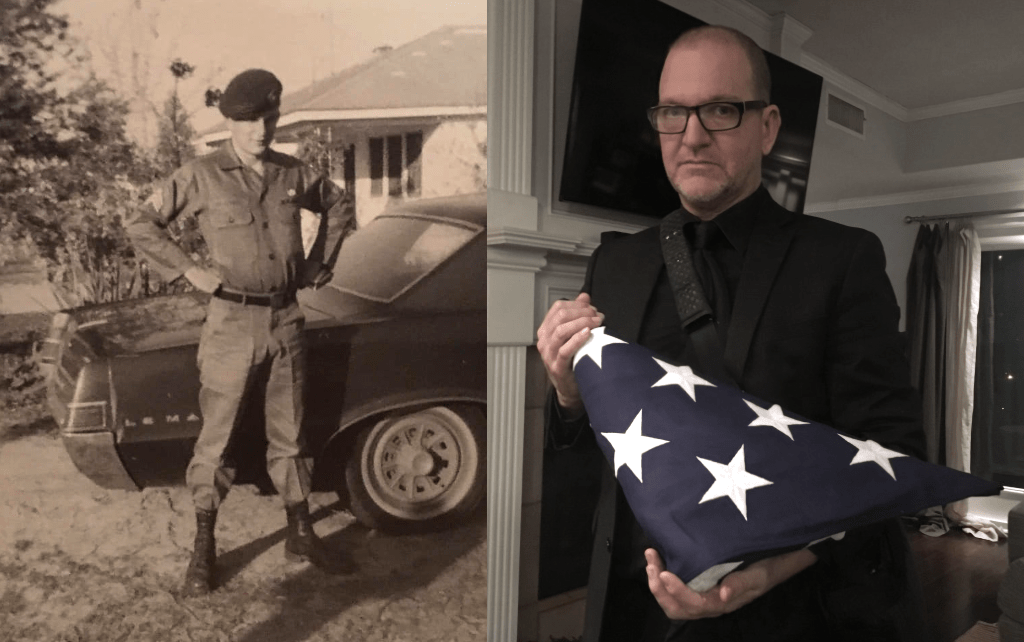
What my father carried into the Special Forces was a mind already at war with itself. He was pursuing a doctorate in semantics and semiotics, drawn to the Grameen Bank’s micro-lending model as proof that the corporate-feudal structure of American industry could be cracked from within through language, convinced that power lives in discourse before it lives in institutions. He enlisted in 1966, selected for the Green Berets before basic training had finished. Fort Bragg, then Fort Benning for paratrooper qualification, then Fort Sam Houston in 1967 for medical cross-training—the Special Forces built its men in layers, and his primary layer was demolitions, applied not to bridges but to encampments, to the interior architecture of an enemy’s sense of safety. A car crash at Sam Houston nearly killed him and my mother both, pushing him three months behind his cohort, a displacement whose consequences would unspool across the following decade in ways no one tracking his paperwork could have predicted. From Texas he went to Fleming Key in Key West, where the Special Forces Underwater Operations School ran its courses in the punishing thermal shifts of the Florida Straits, and from there to the White Mountains and Presidential Range of New Hampshire, where Mobile Training Team exercises used the worst weather in the continental United States as a classroom.
My mother tracked his movements imperfectly, through what he chose to say and the gaps he chose not to fill. She believed the dysentery came from the water training in Florida—the Key West assignments involved extended open-water immersion, and amoebic infection was a documented risk, the geography of the cover story close enough to the geography of the truth that it held for decades. What she did not know, and what would not be confirmed until after his death, assembled from a confession made to my older brother Jean-Paul, was that in 1967 my father had been sent into Nicaragua, and prior to that, Bolivia.
The target in Nicaragua was the FSLN, the Frente Sandinista de Liberación Nacional, an organization so small and clandestine in 1967 that its military wing numbered perhaps fifty fighters in the jungle around Matagalpa. Silvio Mayorga commanded its guerrilla operations; Carlos Fonseca provided its intellectual architecture—a scholarship student from Matagalpa who had devoured Marx, Lenin, and Sandino with the appetite of a man who understood that the revolution required a canon before it required an army, that the rifle and the library were the same instrument pointed in different directions.
The young soldier moving through the Nicaraguan jungle toward Fonseca’s encampment was himself deep in the Bhagavad Gita and the Upanishads, working through the British Empiricists, writing poetry in the margins of his reading—a man whose intellectual formation ran closer to the revolutionary theorist he had been sent to destroy than to the chain of command that sent him. The Cold War distributed its ironies without discrimination, the way Ho Chi Minh modeled his revolution’s founding documents on the Declaration of Independence and found himself fighting the country whose intellectual tradition had shaped him. My father’s demolitions specialty suited the granular work the mission required: the destruction not of infrastructure but of personnel, of the encampment itself as a going concern. According to what he told Jean-Paul, he rigged an entire rebel position. The unit was obliterated—and whatever he saw in the aftermath of that operation became one of the unnamed weights he carried into every subsequent decade of his life, surfacing only in fragments, never fully discharged.
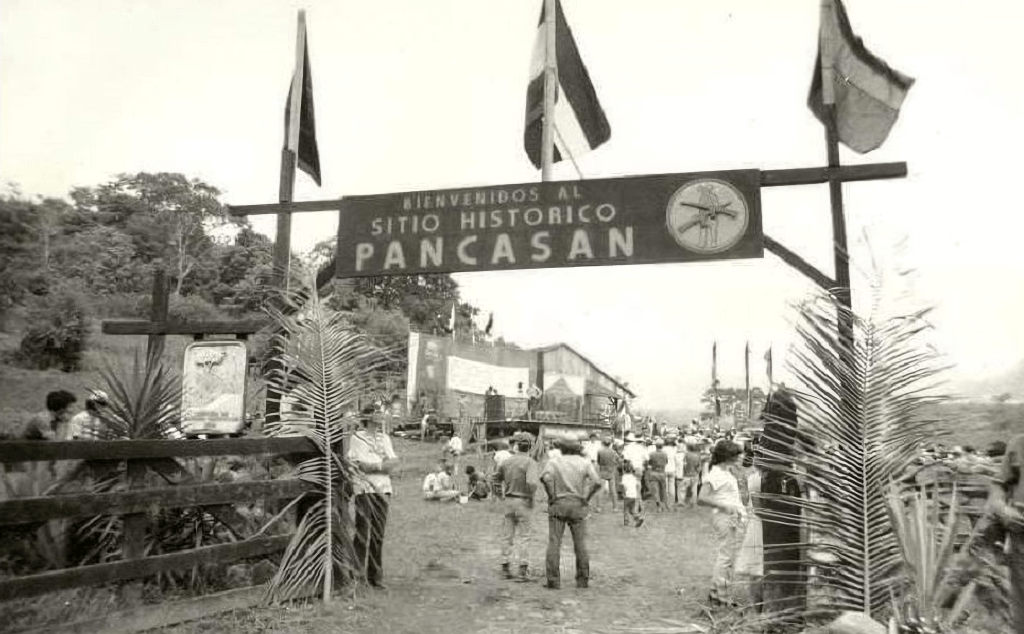
The second, earlier theater surfaced through a different channel. My Uncle John carried for forty years a confidence my father placed in him when he was eleven years old, too young to parse what he was being trusted with but old enough to retain it: that my father had been part of the apparatus that hunted Che Guevara in Bolivia. The 8th Special Forces Group’s Mobile Training Team BL 404-67X arrived at an abandoned sugar mill outside La Esperanza in April 1967, sixteen operators who spent six months building the Bolivian 2nd Ranger Battalion into a force capable of pursuing guerrilla fighters through the Andean ravines. His name has never appeared on the unit’s official roster, and he spoke no Spanish—details that complicate the Bolivia account without disqualifying it, since Green Beret demolitions specialists on such teams typically worked through demonstration rather than vocabulary, and the languages of detonation require no translation. That my mother was half-Mexican makes the linguistic gap stranger still, the domestic world saturated with a culture whose tongue never crossed into his operational one. Like his mother Verla—who decoded German transmissions surrounding D-Day at the Naval Communications Annex on Nebraska Avenue and kept that secret under a death-penalty oath for the better part of fifty years—he had learned that some knowledge is held rather than spoken, and was bound by law to hold it. Many of the CIA documents surrounding these operations have since been declassified, but the covert architecture of American involvement in Latin America during this period remains largely buried, its operational details distributed across classified files, unrecorded confessions, and the memories of men who took their debriefings seriously.
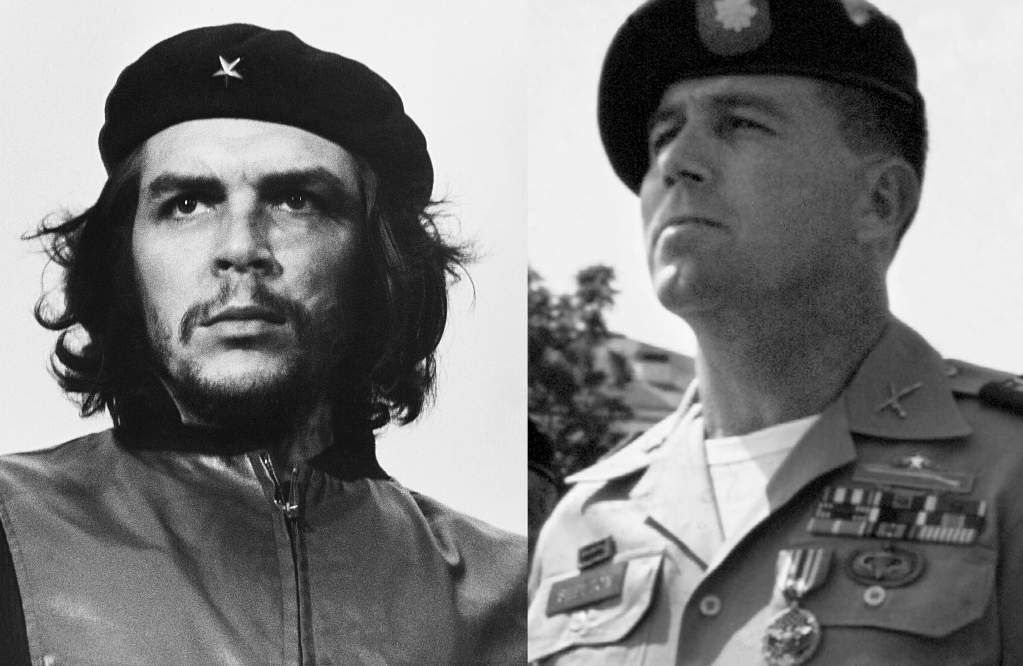
Nicaragua matters to this poem’s genesis because of what the jungle did to my father’s body. Entamoeba histolytica removed a portion of his colon and produced a medical record that closed the door to Vietnam. My mother maintained for decades that a re-enlistment of three years would have been required for that assignment and that he declined it, but the letter he wrote petitioning upper command to send him exists. He could not explain to her the full itinerary of what had happened to his body in Latin America, or under what circumstances, or in service of what operation. The car crash had already separated him from the cohort that went ahead of him; the disease completed the separation. Nearly every man in that cohort died in Southeast Asia, many on the landing pad. The organism that colonized his gut in a Nicaraguan jungle produced, through the long chain of medical consequence and withheld information, the conditions for my own existence.
This is what opened the research into the poem’s microbiological dimension, and what nearly derailed it entirely. The discovery that Guevara’s own health had been destroyed by dysentery before the bullet found him opened a seam that resisted closure. The two men shared the organism, separated by a year and a few hundred miles of jungle. From there the research extended outward: Angel’s Glow after the Battle of Shiloh, the phenomenon in which wounded soldiers lying in the mud for two days noticed their wounds fluorescing faint blue-green in the dark and later healed faster than those whose wounds did not glow. The organism responsible is Photorhabdus luminescens, a bioluminescent bacterium that lives symbiotically inside nematodes in cold wet soil; colonizing the wounds, it produces antibiotics that kill competing pathogens, the light a byproduct of the same biochemical process generating the medicine. The glow was the cure, indistinguishable from contamination. From Angel’s Glow the research moved into maggot therapy, then to the disputed pathologies of Delphi and Salem. The Oracle’s pneuma may have been the psychoactive byproduct of Claviceps purpurea metabolizing in the limestone fissures beneath the temple, while the Salem convulsions may have been ergotism from infected rye. Both theories remain contested, neither settled.
The same organism shadows the cursed bread hallucinations of Pont-Saint-Esprit in 1951 and the Dancing Plague of Strasbourg in 1518, in which four hundred people danced without stopping for days, some dying of exhaustion. The cause of that outbreak is still disputed—ergot or mass psychogenic illness, the two diagnoses not always as different as they appear. The mycorrhizal network and the theory of the living forest arrived next—the fungal communication systems beneath old-growth forest floors, the idea that trees share nutrients and distress signals through underground fungal threads—and were set aside. The sonnet diptych could not bear that weight without collapsing into the ornamental, but it is retained more than obliquely in the poem.
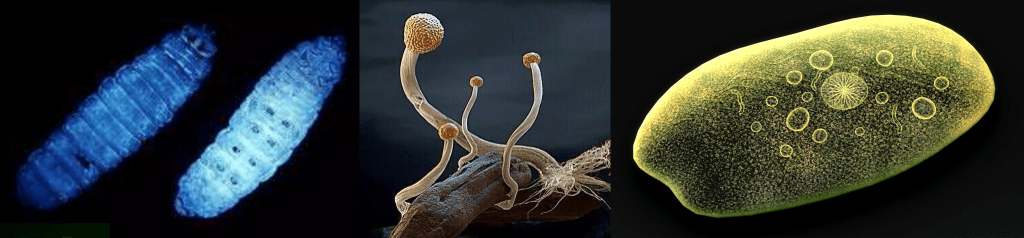
What survived the research was a formal decision and a biographical one. The form would be a Ghost Blazon, the speaker the coroner Dr. Moisés Abraham Baptista, who performed the autopsy at the Hospital of Malta in Vallegrande on October 10, 1967, and who kept Guevara’s bloodied shirt and jacket as keepsakes until he died in 2023 at eighty-three. The blazon catalogs the body ascending—hands, gut, throat, eye—each station carrying a visible inventory of the wound and a silent inventory of what the wound meant in the body politic of the hemisphere Guevara had tried to ignite. The organic register is present but not formally constituted as a third blazon: the hands as cohoba roots that reach through brine, the bullet as a seed that found a channel, took an older route and flowered there in the throat before extraction—texture woven into the diction rather than a parallel structural argument. The microbe is the poem’s almost-buried author, the force that shaped the conditions for its existence, too embedded in the structure to surface as a predominant layer, present the way mycelium is present in soil: everywhere beneath the surface, visible only in the second station, the gut: the slow amoebic burn: / the jungle blooming in your bowels, / the night unthreading root to worm.
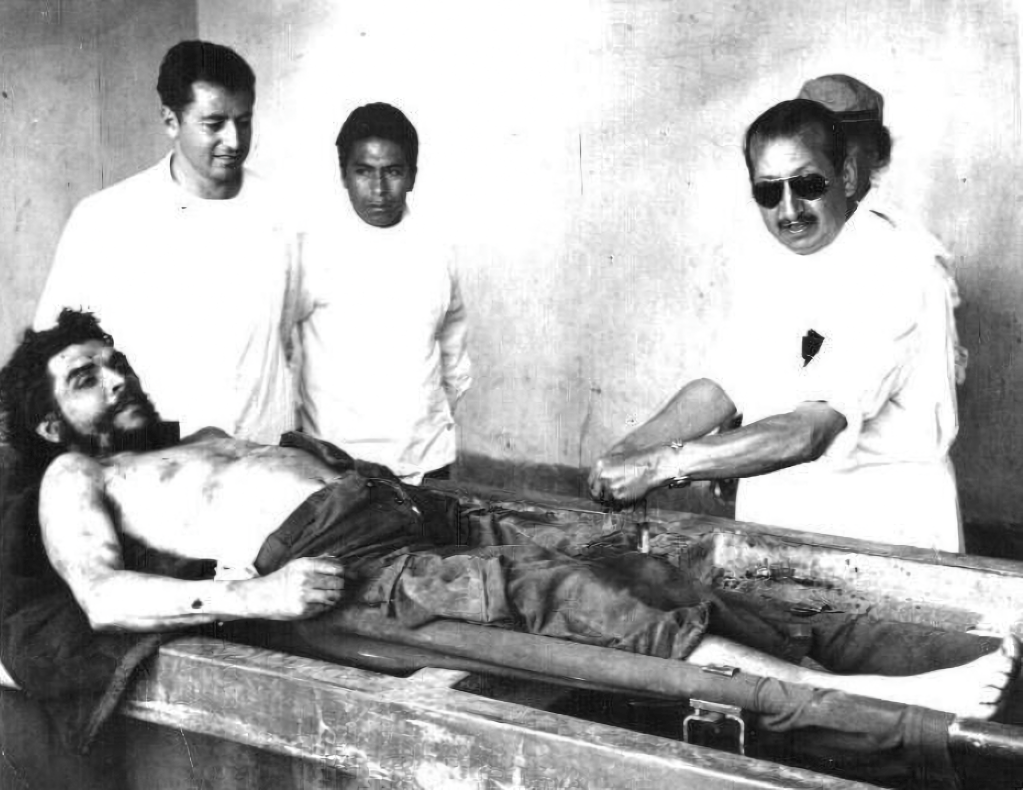
The attribution to Dr. Baptista was dissolved to give the poem a more universal register, drawing on the remorse and trauma that soldiers and field medics carry across theaters and decades. In this manner, my father’s haunting from Nicaragua has been applied to the historical lattice of Bolivia through prosopopoeia, the coroner’s examination in Vallegrande and his fascination with relics providing the structure for the visible blazon—the inventory already embedded in the historical record, requiring no invention beyond the attribution itself. This is historical fiction operating alongside documented fact: the hands in the jar of formaldehyde are placed in the coroner’s possession for the poem’s purposes, whereas the record shows them traveling from Bolivia to Argentina for fingerprint verification, their final disposition—destroyed, sent to Cuba, or retained by Argentine officials—unconfirmed. What the record does confirm is that the CIA operative Félix Rodríguez, who relayed the execution order and was present at Guevara’s death, kept his Rolex GMT-Master—a gift from Castro, removed from Guevara’s wrist in the schoolroom at La Higuera, and worn by Rodríguez in photographs for decades afterward.
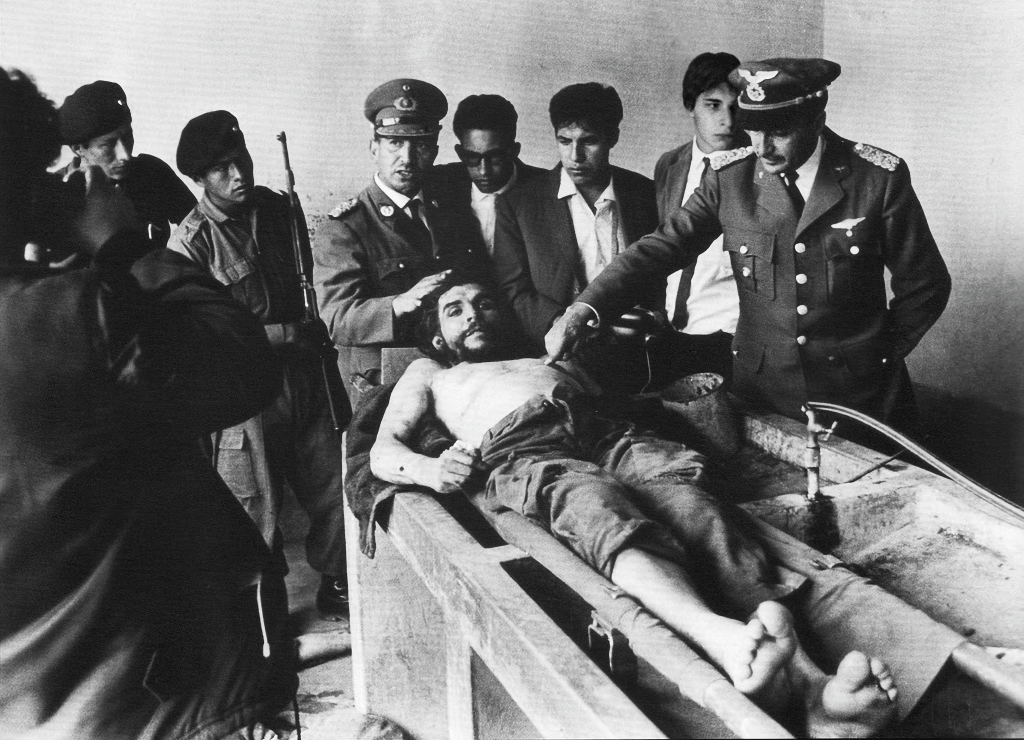
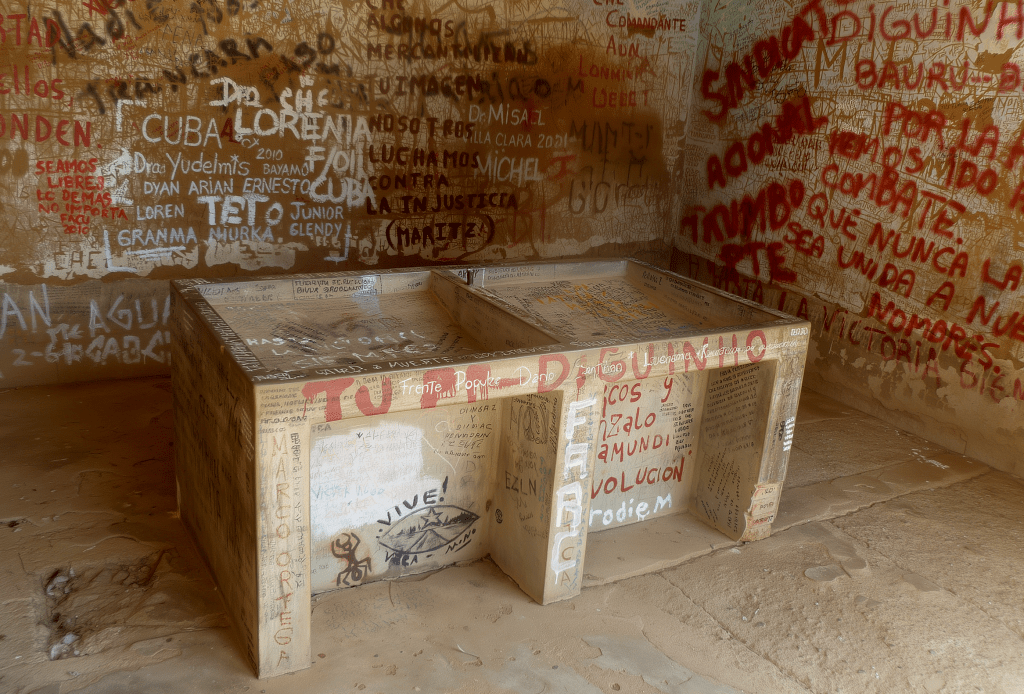
While researching, I came across the most iconic picture of Che Guevara after his execution, shown above. The photograph was taken by Freddy Alborta, a Bolivian UPI photographer summoned to the laundry room of the Nuestra Señora de Malta hospital in Vallegrande on October 10, 1967. The Bolivian army had arranged the display deliberately—the body washed, the face shaved for recognition—intending to prove to the world that the myth was finished. What they produced instead was an accidental pietà. Art historians have noted the structural parallel to Mantegna’s Dead Christ without any prompting: the horizontal body on the slab, the foreshortened limbs, the figures crowded at the margins in attitudes of witness. The executioners had staged a propaganda photograph and accidentally composed a resurrection icon. Alborta sold the images to Reuters for almost nothing, and they were attributed to an American photographer for thirty years. The eyes in the photograph are open—not looking at the camera but through it, at something no one else in the room could see.
The figure leaning in from the right, hand on Che’s head, has never been definitively identified—the specific individuals in the Alborta photograph remain unnamed in the historical record. But Félix Rodríguez was in that room. The Cuban-American CIA operative who had hunted Guevara across Bolivia for months, who made the radio call to La Paz authorizing the execution, was present in Vallegrande that day. Whether or not it is his hand in the photograph, the gesture belongs to him in every other sense. The night before the execution, the two men had talked for hours in the schoolhouse—not interrogation exactly, but something more personal, two Cubans on opposite sides of the same history, alone together before the end. Rodríguez wore Che’s watch for the rest of his life. He kept a photograph of the two of them together, Che still alive, and he kept a copy of Alborta’s image. The hand on the head—whoever’s it was—is the whole Cold War compressed into a single gesture: proprietary and elegiac simultaneously, the tenderness of a hunter who genuinely mourned what he had hunted down.
This led to a third register, that of gods/goddesses and saints, each related to the root or flower mentioned in their respective stations. An ofrenda—the altar built for Día de los Muertos—operates on a specific logic: the marigold petals laid from the street to the altar lead the dead home by scent, the objects placed on its tiers not symbols of the departed but instruments of return. The spirit consumes the essence of the offering without disturbing the physical thing, the altar built for arrival rather than mourning. The structure moves through three tiers: the first depicts the ancestor himself, the second inhabits the world of the living and the things he loved, the third surrenders the body back to the elements—fire, water, earth. Above the whole structure, an archway of flowers guides the dead back across the threshold.
The Coroner’s Report follows this architecture without having named it. The first quatrain—the severed hands, the cohoba roots, the jar of formaldehyde—is the ancestor’s tier, the body catalogued from the bottom up. The second quatrain—the rusted shirt, the stains that grow at night, the flames of Santa Rita—is the world of the living, fire the governing element. The third quatrain surrenders him to earth: the jungle, the amoebic burn, the night unthreading root to worm, the body dissolving back into soil. The second sonnet is water throughout—two moons pulling at the tide of blood, something swimming in that depth, one final wave still breaking against the door. The couplet and the second sonnet together form the flower arch—the bullet, the seed that found a channel, the trumpets along the Churo, the wave that keeps breaking—guiding him not home but into the poem’s permanent present tense. The concrete sink at Vallegrande where Alborta’s photograph was taken—now covered in decades of pilgrim graffiti, dried flowers still sitting in the basin where the body lay—is the literal altar, the ofrenda that assembled itself without anyone intending it. The sink is the altar. The ofrenda form and its triptych logic are discussed in SONNETS in the Extended Sonnet section for The Offering.
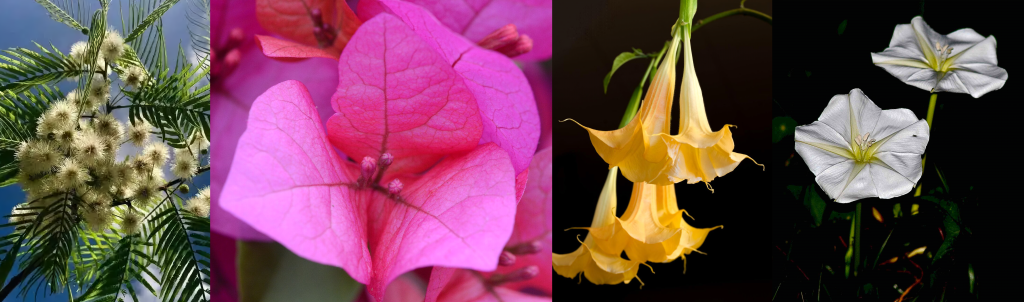
The flowers in question are in sequence: the Yopo (from the Cohoba root), Santa Rita (or Bougainvillea), Angel’s Trumpet, and Moonflowers (White Morning Glories or Campanilla Blanca). The last flower is loosely suggested by “two moons,” not called out by biological name or suggested by its root.
The Coroner's Report

Your severed hands, suspended in a jar,
cohoba roots that reach through brine—
the fingers casting shadows on the floor,
a lantern ambered with formaldehyde.
Your rusted shirt behind the door—
a flag that no one came to claim,
a banner with the edges charred
and stains that grow at night, like flames
of Santa Rita on the schoolhouse wall—
beneath the ribs, the slow amoebic burn:
the jungle blooming in your bowels,
the night unthreading root to worm.
I keep the bullet in a box: a blunted
talisman, a remnant of the hunt.

It lodged, just like a broken tooth,
inside your throat— a seed that found
a channel, took an older route
and flowered there, sustained beyond
a bolted room, keeps turning over
in your sealed mouth. Beyond the window
trumpets line the Churo river,
thin processions to Rosario,
where Mary waits in effigy. I shut
your eyes, two moons still pulling
at the tide of blood. Beneath my thumb
your iris opened wide: something swimming
in that depth that would not come to shore;
one final wave still breaks against my door.
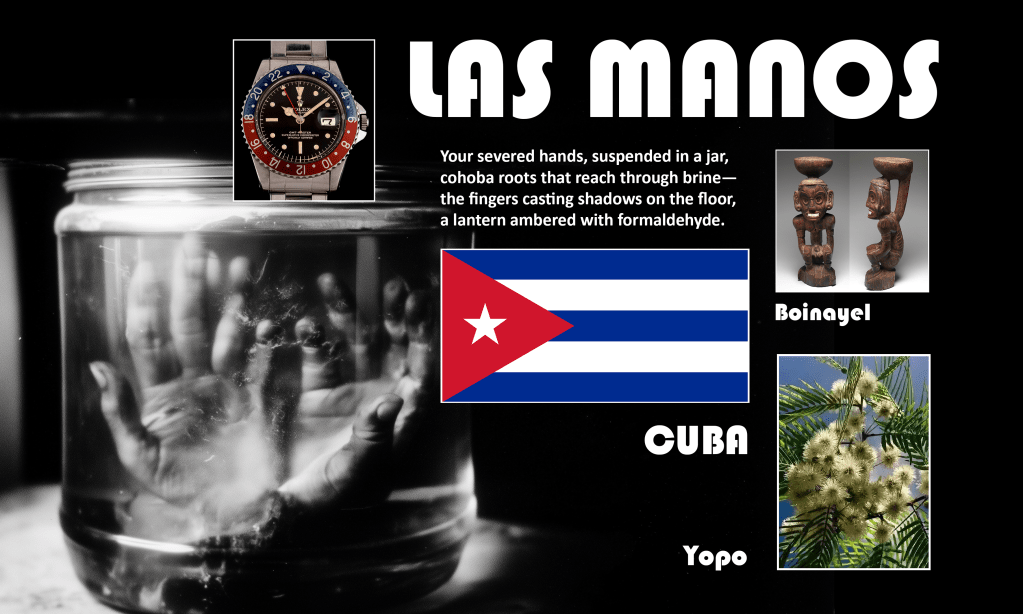
The first station opens at the hands—the body’s lowest relic, its most contested document. Che Guevara’s hands were amputated after the execution at La Higuera on October 9, 1967, preserved in formaldehyde, and transported to Buenos Aires for fingerprint verification by Argentine federal police. Their final disposition remains unconfirmed: destroyed, sent to Cuba, retained by Argentine officials—the archive offers three answers and will not choose between them. What historical fiction places in the coroner’s jar requires the hands to stay in the room where the coroner is dying, the relics arranged on the altar he did not know he was building. The jar of formaldehyde is the station’s governing image—the hands suspended in amber, the cohoba roots reaching through brine, the fingers casting shadows on the floor as a lantern, what is held both evidence and concealment.
The watch on the plate is the station’s second relic. CIA operative Félix Rodríguez removed Che’s Rolex GMT-Master from his wrist in the schoolroom at La Higuera—a gift from Fidel Castro—and wore it in photographs for the rest of his life: the instrument that measured Che’s time, removed from the body that had worn it, carried forward by the man who authorized the execution, not preserved in amber but still running, still measuring. The Cuba flag on the plate names the station’s country—the hands that signed the death warrants at La Cabaña fortress, ran the National Bank, organized the literacy campaigns, the fingerprints taken after death the last bureaucratic record of what those hands had touched.
Boinayel presides over the station—the Taíno rain god, the weeping figure whose tears become rainfall, whose cohoba platform crown held the hallucinogenic powder the ceremony required. The zemí cohoba stand at the Metropolitan Museum, wood and shell, circa 1000 CE, Dominican Republic, shows him squatting, emaciated from fasting, the crown-like platform above his head where the ground yopo seeds were placed before the snuff tubes carried them into the celebrant’s body. His watering eyes represent both the god of rain and the shaman who has just taken cohoba—the ceremony indistinguishable from its pharmacological aftermath. In Cuba’s syncretic tradition Boinayel merges with Oyá—the Yoruba orisha of storms, lightning, and the cemetery gate—the Taíno substrate and the Yoruba Lucumí tradition brought through the Atlantic slave trade fusing in ways the colonial archive could not fully track, the zemís and the orishas occupying the same altars, the cohoba ceremony and the Santería ritual sharing the same logic of threshold and return, the brine in the jar carrying both.
The plant on the plate is yopo—Anadenanthera peregrina, the cojóbana tree whose seeds were ground into the cohoba snuff. The seeds contain bufotenine, DMT, and 5-MeO-DMT in a pharmacological sequence the ceremony enacts as three distinct stages: bufotenine arriving first—cardiovascular, peripheral, the flush of force at the wrist and hands before understanding comes; then DMT opening the vision, geometric and populated, Maquetaurie Guayaba and the lord of Coaibay visible through the jar glass; then 5-MeO-DMT dissolving the boundary between the examiner and the examined entirely, Coaibay not visible but inhabited. The movement from the physical confrontation of the first quatrain—the hands, the shadows, the lantern—through the vision of the second and third—the stains that grow, the jungle blooming—to the dissolution of the second sonnet—something swimming in that depth that would not come to shore—enacts the cohoba ceremony without announcing it.
Fusarium oxysporum inhabits the yopo tree as a soil-borne saprophyte, waiting in chlamydospores capable of surviving decades without a host until the right root arrives and the rhizosphere’s chemical signal triggers germination. The hyphae—filamentous, branching, blue-stained in the microscopy image into something resembling a nervous system caught mid-thought—penetrate the root through wounds or natural openings and move inward toward the xylem, the vascular channels that carry water from root to canopy, while the white pompom flowers of Anadenanthera peregrina continue opening against the Caribbean sky and the phytotoxic compounds—fusaric acid, lycomarasmine—occlude the vessels from within, the collapse decided before the wilt arrives. The fungus is host-specific by forma specialis, over 150 strains each recognizing its particular plant through chemical signaling, passing undetected through every other host’s soil until the right root pushes through, the chlamydospores viable in the ground for decades after the land reform, after the execution, after the hands went into the jar.
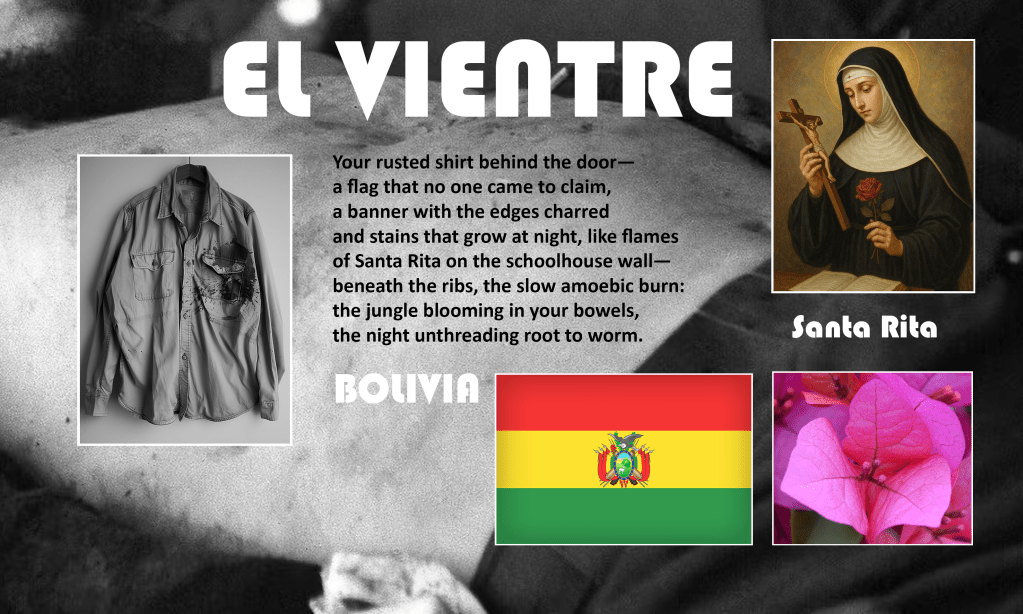
The second station opens at the gut—the body’s most visceral cavity, the site of the slow amoebic burn. The shirt behind the door is the station’s governing relic: Dr. Moisés Abraham Baptista kept Che Guevara’s bloodied shirt after performing the autopsy at the Hospital of Malta in Vallegrande on October 10, 1967, and retained it until his death in 2023 at eighty-three. He described it as still smelling of blood, sweat, and gunpowder. Where the hands were preserved in formaldehyde, the shirt was preserved by nothing except the coroner’s refusal to release it: a flag that no one came to claim, a banner with the edges charred, the stain still moving at night across the wall.
In Bolivia and Cuba, bougainvillea is called Santa Rita—a direct nominal link that makes the poem’s image a visual fact rather than a figure of speech. The stains that grow at night spread across the schoolhouse wall at La Higuera like bougainvillea spreading across a Bolivian wall, its crimson bracts darkened to near-black in the night light, indistinguishable from a spreading wound. Bougainvillea colonizes rather than blooms—it moves across whatever surface it finds, spreading color outward from a central point, the actual flowers tiny and white at the center of each cluster of bracts, the spectacular magenta and crimson entirely modified leaf.
Santa Rita de Cascia (1381–1457)—Augustinian nun, patron saint of impossible causes and specifically the wound on the forehead—presides over this station. After prostrating herself before a crucifix and begging Christ for some share of his suffering, a thorn embedded itself in her forehead and remained there, festering, for fifteen years, its putrid odor offending her sisters. She died of tuberculosis on May 22, 1457, the stigmata still open. She is the intercessor for the cause that has already failed, the patron of the wound that stays—the shirt behind the door carrying the same logic, the bougainvillea carrying in its stems the same instrument, recurved thorns sharp enough to embed in skin and break off, the plant sharing her name and her wound simultaneously.
The organism is Entamoeba histolytica—the amoeba that colonized Che Guevara’s gut before the bullet found him, and a year later and a few hundred miles north in Nicaragua, my father’s. It crosses the intestinal wall silently, travels to the liver, forms abscesses that read as healthy tissue until they rupture. Severe infection produces fever and confusion, the altered consciousness of a body consuming itself from within—not hallucination but the delirium that arrives when the gut is dissolving and the fever has been running long enough to blur the line between the room and what the room is becoming.
Erwinia carotovora enters bougainvillea through the wounds the plant’s own thorns create—the entry points the plant makes in itself as it spreads. Where Fusarium oxysporum colonizes the vascular system and withholds water until the canopy collapses, Erwinia liquefies, the tissue becoming liquid at the wound site and spreading outward from the point of entry, the smell arriving before the visible damage does. Baptista described the shirt as still smelling of blood, sweat, and gunpowder; Erwinia carotovora produces its own characteristic odor as it breaks down tissue, soft rot and gunpowder arriving together in the same olfactory field, the shirt behind the door carrying both.
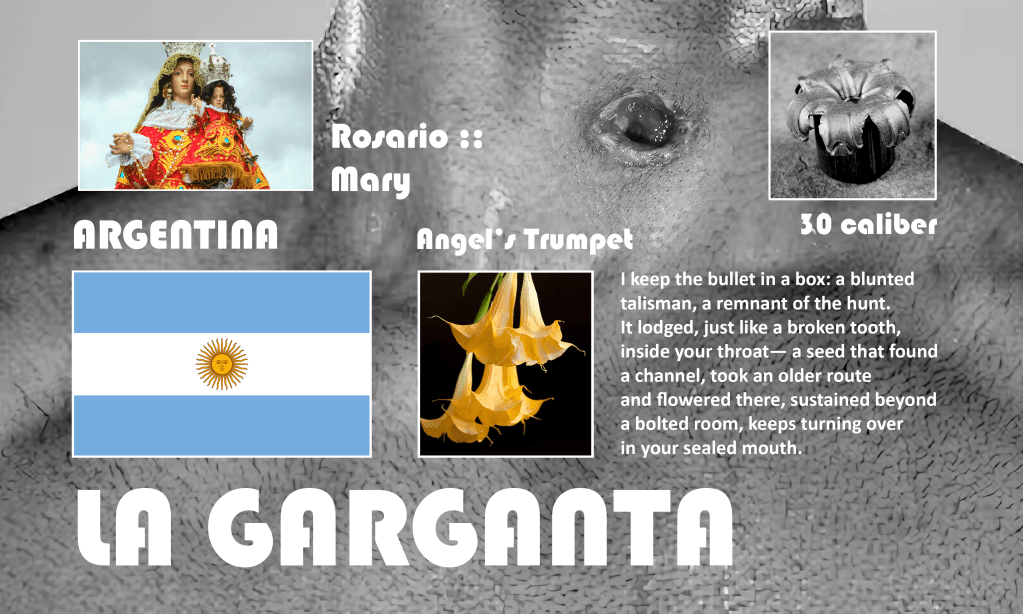
The third station opens at the throat—the site of the bullet and the voice simultaneously. The country is Argentina: where Che was born in Rosario in 1928, where the wound originates before it travels through Cuba and Bolivia to its terminus. Sergeant Mario Terán entered the schoolhouse at La Higuera at around 11:30 a.m. on October 9, 1967, and fired two bursts from his M2 Carbine. Terán later said: At that moment Che looked big, huge, enormous. His eyes were shining intensely. I felt that he was on top of me and when he fixed my gaze I felt dizzy. ‘Be calm,’ he told me, ‘and aim well. You are going to kill a man.’ So I stepped back towards the doorway, closed my eyes and fired. The .30 caliber bullet on the plate is the station’s relic—blunted, spent, mushroomed on impact into the shape of a flower, the talisman the coroner kept in a box: a remnant of the hunt.
The plant is Angel’s Trumpet—Brugmansia—whose pendant golden flowers hang downward, aimed at the earth, opening at night and releasing their scent in darkness. The active alkaloids are atropine, scopolamine, and hyoscyamine. Scopolamine—known in Colombia as Devil’s Breath—eliminates free will entirely: the person appears conscious and cooperative, follows instructions without resistance, retains no memory afterward. The coroner examining the body at the Hospital of Malta is already inside this pharmacology—not from ingestion but from proximity, the fever and the years and the accumulated weight of what the hands touched. Brugmansia is native to the Andean foothills of South America, the region where the hunt ended, the flower hanging downward over the wound and the flower the bullet makes on impact sharing the same shape on the plate.
The goddess is Mary—not the theological figure but the effigy, the Virgin of the Rosary carried in procession through the streets of Jahue on October 8 and 9, 1967, while the execution was happening three kilometers away in La Higuera. The feast day of Our Lady of the Rosary falls in the first week of October; the villagers had walked to Jahue for the celebration, the village emptied, history entering through the back door. The banda trumpets that accompany the Fiesta de la Virgen del Rosario line the Quebrada del Churo in the second sonnet: Beyond the window / trumpets line the Churo river, / thin processions to Rosario, / where Mary waits in effigy. The Angel’s Trumpet hanging downward over the wound and the banda trumpet rising at Jahue are the same announcement aimed in opposite directions—one toward the earth, one toward the living—sounding simultaneously while Terán closes his eyes in the schoolhouse doorway.
Brugmansia rarely sets seed; it propagates almost entirely from cuttings, the plant that cannot reproduce from its own root without human intervention. Scopolamine leaves no memory in the person who receives it—the coroner examining the throat does not know what he is administering, the Devil’s Breath moving through the room from the open jar, the fever dream the pharmacology of proximity rather than intention. The bullet found a channel, took an older route, and flowered there in the sealed mouth—still turning over, still producing the vibration the voice makes when the body that carried it is gone.
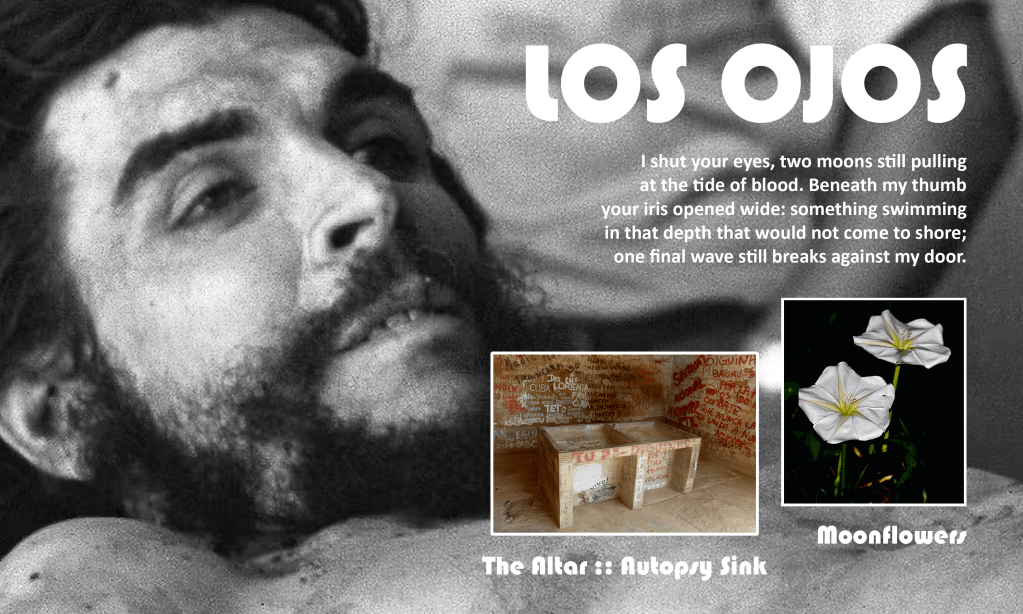
The fourth station opens at the eyes—the blazon’s terminal point, the place where the classical form traditionally concentrated the beloved’s power over the speaker. The photograph is Marc Hutten’s, AFP, the only color image from Vallegrande, taken before the body was washed and staged. Hutten wrote: I saw yesterday afternoon the bullet-riddled and lifeless body of a guerrilla called Ramon, presumed nom de guerre of Ernesto ‘Che’ Guevara. He used the alias because the identification was still contested. The eyes in the photograph are open—not looking at the camera but slightly upward and to the left, at something no one else in the room could see, the question the officials were arguing already resolved in the body’s own posture.
The coroner closes them with his thumb—beneath my thumb / your iris opened wide—and the iris opens rather than closes, the pupil dilating under pressure rather than contracting. Endogenous DMT is produced by the pineal gland throughout life; at the threshold of death, current research suggests the concentration spikes—Rick Strassman’s work on DMT and near-death experience points toward the dying brain generating the same visionary state the cohoba ceremony induced deliberately. Something swimming in that depth that would not come to shore: Maquetaurie Guayaba’s country becoming habitable, Coaibay not visible through the jar glass anymore but inhabited, the Lord of the Dead arriving from inside the body being examined.
Mary has already brought the procession to this threshold—the Virgen del Rosario carried to Jahue while the schoolhouse emptied of its last breath, the effigy and the body displayed simultaneously in two different rooms, the ofrenda completing its third tier. Where the first tier catalogued the ancestor and the second surrendered him to fire and earth, the third tier is water: the tide of blood, the moons pulling, the depth that would not come to shore, one final wave still breaking against the coroner’s door. The concrete sink at Vallegrande where Hutten photographed the body—now covered in decades of pilgrim graffiti, dried flowers still sitting in the basin, VIVE scratched into the plaster—is the literal altar, the ofrenda that assembled itself without anyone intending it.
The flower is the moonflower—Ipomoea alba, the tropical white morning glory, campanilla blanca—which blooms at night, opening as darkness falls and closing at dawn, the large white trumpet-shaped flowers oriented toward whatever light exists in the dark. It grows throughout Cuba and the Caribbean, climbing colonial walls, its blooms lasting a single night. Two flowers on the plate, two moons in the poem, two eyes in the photograph—two moons still pulling at the tide of blood already the flower, already the eyes, already the water station’s governing image, the moonflower opening toward the dark the way the iris opens under the coroner’s thumb.
The concrete sink at Vallegrande is the station’s relic—the surface where the body lay, the surface that pilgrims from every country have been writing on for fifty years: CUBA, VIVE, EZLN, the names of movements and the names of the dead, dried flowers left in the basin. The open eyes in Alborta’s photograph—staring not at the camera but through it—generated every name on that wall, the vision continuing outward from the room at Vallegrande, the wave still breaking against every door it finds.
The National Security Archive at George Washington University hosts a collection of declassified CIA, State Department, and Pentagon documents surrounding Che Guevara’s capture and execution, available at this link. These proved invaluable for my poem, from a realpolitik perspective. The collection, compiled by Peter Kornbluh from records obtained through FOIA requests and from researchers Jorge Castañeda and Henry Butterfield Ryan, runs from a 1965 CIA intelligence memorandum assessing Guevara’s declining influence within the Cuban revolution through the October 1967 cables, debriefings, and autopsy reports that confirmed his death—with thousands of additional CIA and military records still classified. Among the most significant documents is the 1975 CIA debriefing of Félix Rodríguez, conducted by the Agency’s Inspector General during the Congressional investigations into CIA assassination operations: Rodríguez describes his mission to Bolivia under the alias “Félix Ramos,” his role in focusing the 2nd Ranger Battalion on the Vallegrande region, and his transmission of the execution order from the Bolivian High Command to the soldiers at La Higuera—while also noting that he had been instructed by the CIA to keep Guevara alive for interrogation in Panama, an order he allowed the Bolivians to override. The October 18, 1967 State Department cable confirming Guevara’s death includes the detail that Argentine federal police were shown a metal container holding two amputated hands in formaldehyde, whose fingerprints matched Guevara’s Argentine identity record No. 3.524.272. Walt Rostow’s memorandum to President Johnson, written two days after the execution, describes the operation as demonstrating “the soundness of our preventive medicine assistance to countries facing incipient insurgency”—the bureaucratic language of the archive converting the event into policy validation, the same conversion the poem’s coroner performs when he files his report and keeps the shirt.
 jaznoblog