One poem that continued to trouble me was an early blank-verse piece titled The First Coming, published in Fountain Street in 2000. The poem uses the Laocoön sculpture as its central metaphor, and for many years I regarded it as juvenilia—an exercise in extended metaphor that never quite cohered. I eventually dismissed it as little more than a strange experiment in free association. But the poem lingered in my mind, largely because I remembered the experience that had produced it. In 1998 I had seen the Laocoön sculpture in person, and the figure left an unsettling impression on me: a sense of coiled motion frozen in marble.
The First Coming

Laocoön is still looking up sadly
before his own devouring,
wondering if this immense snake
fell from an emasculated god.

Before antiquity, gods shook
the columns of their temples,
the marble cracking through the clouds
like thunder, a dress rehearsal
before the buggering of Ganymede.

With indolent grins
they allowed the snake to writhe
in a leafy copse,
a tendril rising with the moon
licking at its canopy
until the first woman
could be born.
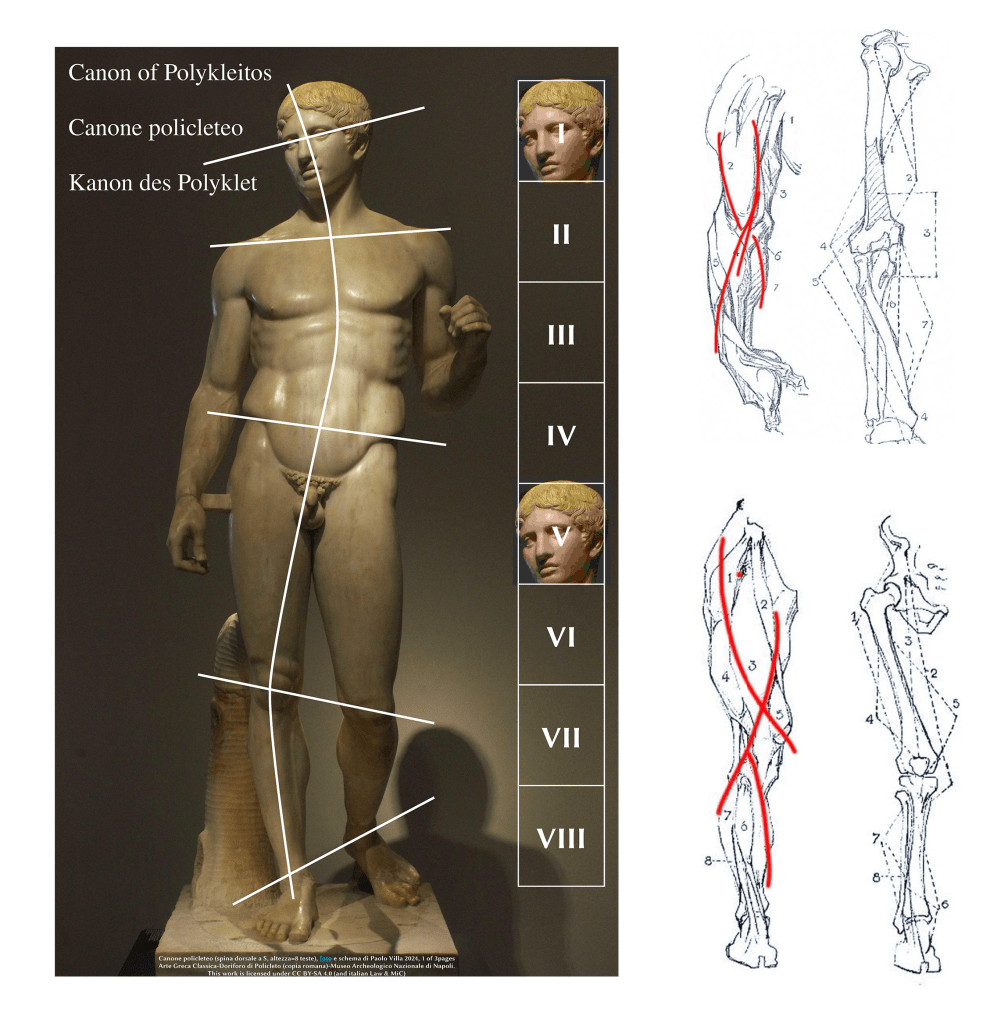
The insight arrived years later during a guest lecture in one of my classes. A colleague, John Hermanowski, was presenting examples of anatomical research used in professional modeling practice, and one slide in particular stopped me cold. In the presentation he overlaid double-helix curves onto Bridgman’s anatomical drawings and then onto the Laocoön itself, demonstrating that the same torsional structure appears in both master drawings and classical sculpture. The overlay traced opposing curves moving throughout the sculpture, revealing a dynamic system of counter-rotation embedded in the figures. Seen this way, the torsional structure of the body became unmistakable. The curves and counter-curves mapped across the figure bore an uncanny resemblance to a double helix.
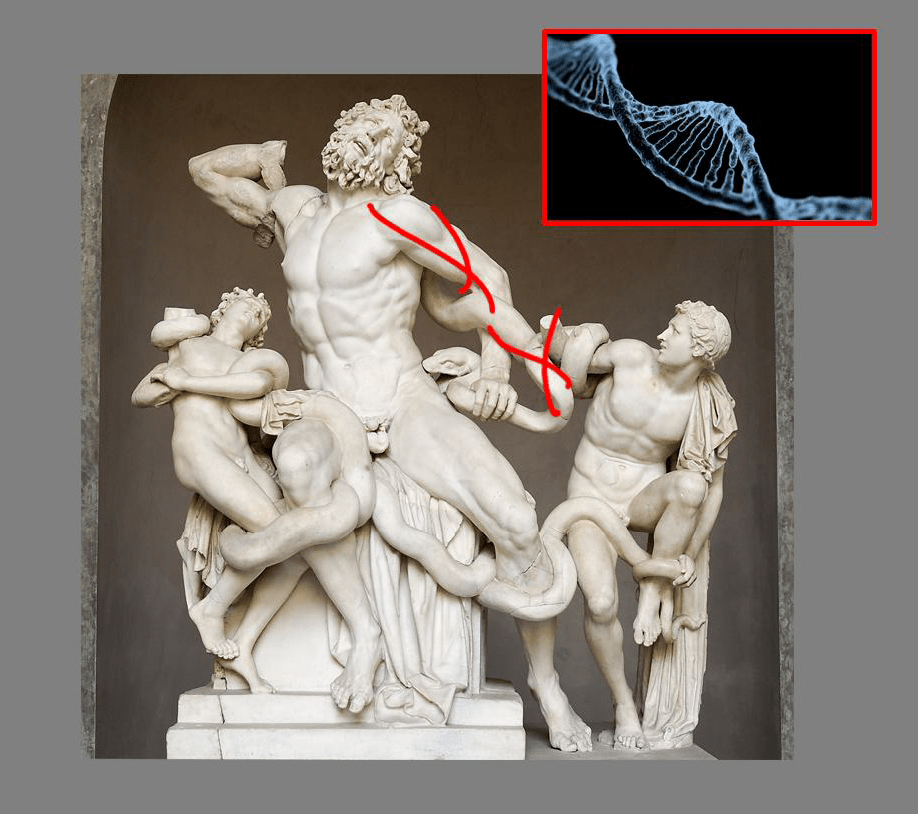
At that moment several lines of thought converged at once. For years I had lectured on the Greek principle of chiastic movement—the system of opposing forces that produces contrapposto in classical sculpture. Polykleitos’ canon relies on precisely this logic: tilt against tilt, curve against counter-curve, tension balanced by release. But the Bridgman overlay made something else visible. The movement of the Laocoön figure does not simply cross but spirals.
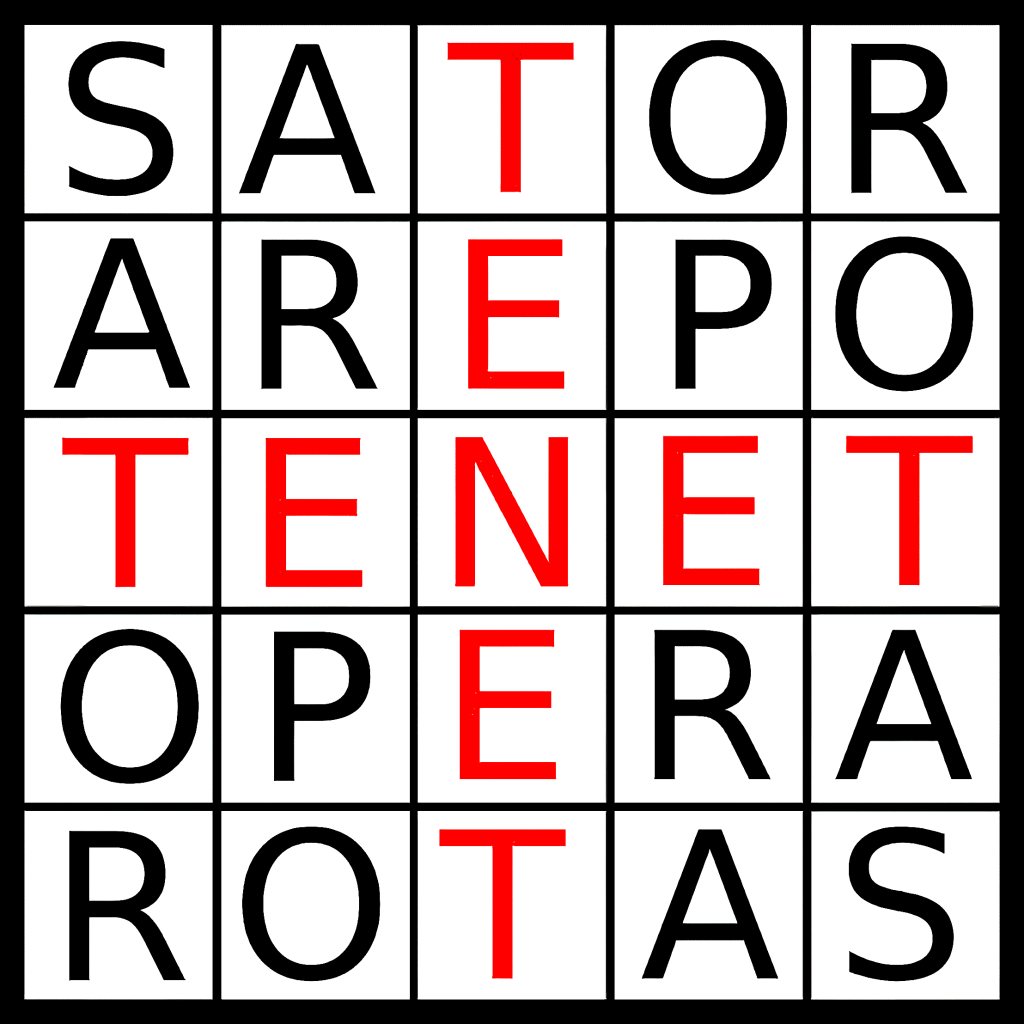
This realization connected immediately with another long-standing fascination of mine: the famous SATOR square, a five-word Latin palindrome that can be read in multiple directions and contains the hidden PATER NOSTER cross at its center. For years I had entertained the idea of constructing a poetic structure that behaved similarly, a form capable of recursive reading. Yet strict palindromes collapse quickly beyond a handful of words. A fully palindromic sonnet would be impossible. The solution, therefore, was not to replicate the palindrome literally but to build a structural analogue.
The form that emerged from these converging ideas is what I call the Chiastic Helix Sonnet, an inverted Petrarchan variant. In this structure the terminal words of the poem follow a Petrarchan circuit that reverses itself between the octave and the sestet, while the initial words of each line follow the same sequence along the poem’s central spine. This dual constraint produces mirrored inversions between the left and right columns of the poem. At the midpoint—the Lexical Torsion Point—the two circuits cross, functioning as the structural pivot. From that moment forward, the directional flow of the poem reverses, creating a pattern of recursive symmetry. The poem therefore behaves like a linguistic double helix, with two parallel strands twisting around a central axis and meeting at a point of torsion where the structure inverts upon itself.
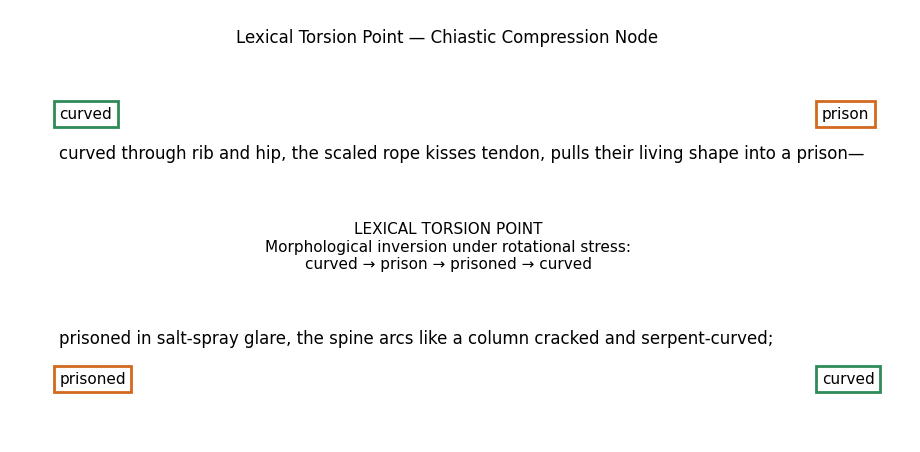
The Lexical Torsion Point extends the Sextain Pivot employed in my Mirrored Sestina, though the governing constraint differs. In that form, only the terminal words invert at the exact midpoint of the poem, a requirement that eliminates the envoi and forces the structure to close through lexical inversion alone. In this sonnet, however, the inversion is more immediate and structural: the octave and sestet are reversed in place, producing a chiastic architecture in which the poem folds back through its own framework. Rather than delivering a conventional sense of terminal resolution, the design destabilizes closure and redirects the reader toward the beginning of the structure itself.
The effect is recursive: the final lines mirror the initial ones so that the opening and closing word—Laocoön—becomes both point of origin and point of return. In this respect the poem behaves like a linguistic Crab Canon, advancing forward while simultaneously implying its own reversal. The structure also resembles Escher’s recursive drawing Drawing Hands, in which the image folds back upon itself and the act of creation becomes its own cause. The poem therefore concludes not by terminating its movement but by sealing a circuit, inviting the reader to return to the beginning and trace the helix once more.
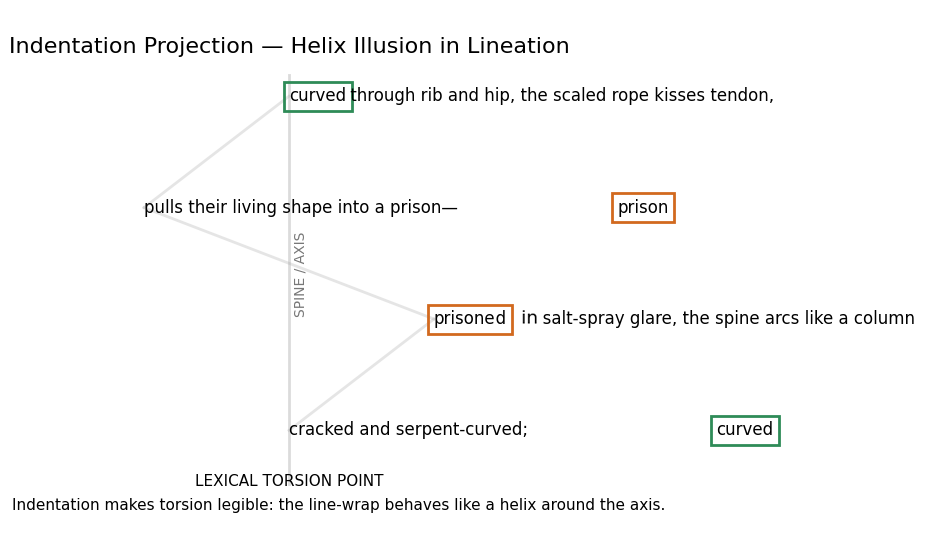
Because the poem is written in loose accentual-iambic hexameter, the lines are unusually long. When indented properly, the lineation produces a visual spiral descending the page, so that the typography itself begins to echo the form’s underlying structure. In this way the poem’s appearance reinforces the governing principle of the design: lineation enforces the double-helix structure. At the same time, this elongated line disguises the mechanism on first reading, masking any immediate recognition of a Petrarchan sonnet beneath the surface architecture.
Hexameter was chosen deliberately; as an even meter of six beats, it possesses a natural symmetry that supports the poem’s mirrored construction, allowing the lines to behave like paired segments within a rotating structure. The meter also accommodates the poem’s unusual constraint: the central spine is composed of terminal words drawn from an inverted Petrarchan sonnet, which must remain fixed while the surrounding language bends around them. In many cases this lexical obligation pushes the line well beyond the compression of iambic pentameter, requiring a longer metrical frame capable of absorbing the pressure. The resulting hexameter line therefore serves both structural and practical ends, providing the symmetrical measure necessary for the helix while giving the poem enough horizontal space to carry its inherited terminal words without breaking the rhythm of the form.
Hexameter also carries its own historical weight that the form requires. The meter of Homer, of Virgil’s Aeneid, of the classical epic tradition—it arrives already saturated with the literary world the Laocoön group inhabits. Dactylic hexameter is the meter in which prophecy gets delivered and ignored, in which gods intervene and men pay for it, in which the body’s suffering and the gods’ indifference are the twin registers of every major event. Writing The First Coming in loose accentual hexameter does not replicate that tradition but activates it as a resonance field—the meter functioning as a kind of atmospheric pressure surrounding the poem’s argument, the long line’s gravitational pull enacting the same drag the serpent exerts on Laocoön’s spine. The even six-beat measure also keeps the poem’s doubled structure from collapsing under its own mechanics: long enough to hold the pillar obligations without strain, symmetrical enough to make the counter-rotation audible in the ear before the eye has mapped the architecture.
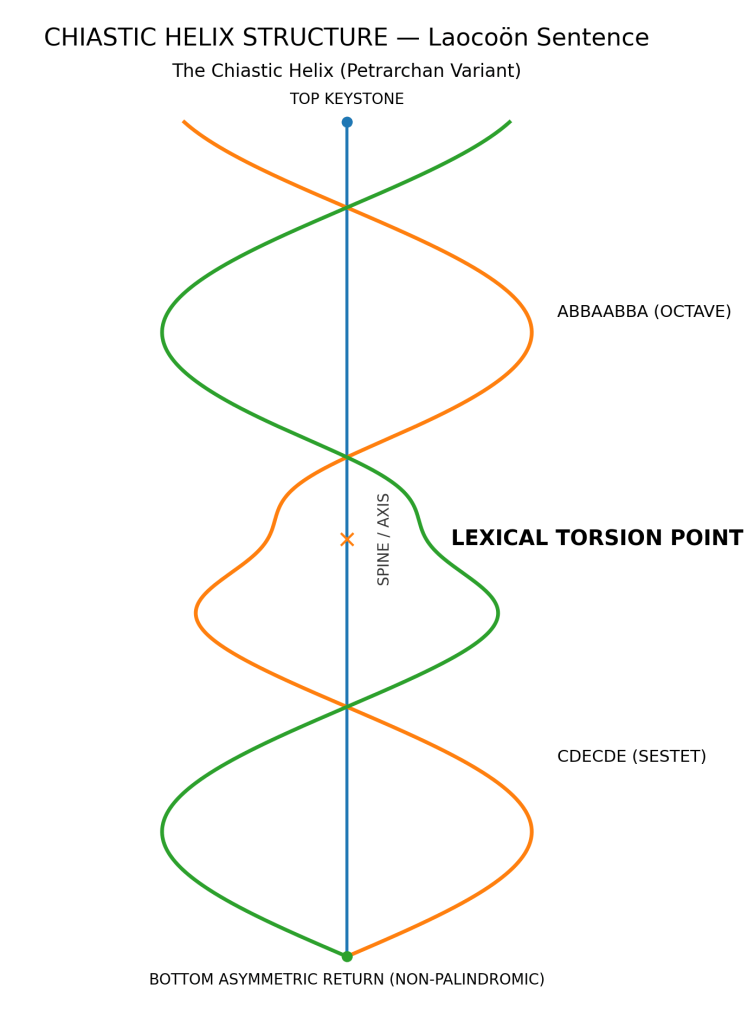
Despite its recursive mechanics, however, the form is not a palindrome. The terminal words invert between the octave and the sestet, but the poem does not return to its starting point in perfect symmetry. The final lines break the circuit. Visually the structure resembles not a square but an arch: a form that mirrors itself around a central keystone while resolving asymmetrically at its base. Seen from this perspective, the Chiastic Helix Sonnet is not the result of a single act of invention but the culmination of a long feedback loop between observation, research, and revision. The original poem that inspired the structure was written in 2000. The anatomical insight that revealed its latent geometry arrived decades later. Only then could the earlier work be re-engineered through a form capable of expressing the torsional logic that had first inspired it. In that sense, the form represents not merely a new poetic container but the completion of a twenty-eight-year cycle between experience, curiosity, and return. This will also be showcased in SONNET FORMS, for a more formal analysis of how the helical structure more specifically informs the narrative.
That asymmetric return is also what distinguishes the Chiastic Helix Sonnet from the closed systems it most resembles. A true palindrome seals its meaning by returning to origin; a crab canon advances while implying reversal; the SATOR square rotates through every axis and arrives, always, back at itself. The Chiastic Helix borrows the logic of all three without replicating any of them. Its final lines—dissipate blood, dissipate lineage—marble cools / around the twist and fixes the father, Laocoon—do not complete a rotation so much as arrest one. The circuit seals not because the structure has resolved but because the marble has. What closes the poem is the same thing that closes the sculpture: a body fixed at maximum torque, the twist refused release, the proper name that opened the spine sentence returning not as resolution but as terminus. The form ends where the figure ends—mid-motion, permanent. This is why the asymmetry is load-bearing: a perfect return would imply that the circuit could be traced again, the helix unwound, the prophecy reconsidered. The marble forecloses that. Laocoön does not get a second rotation. The form honors that foreclosure by refusing one as well.
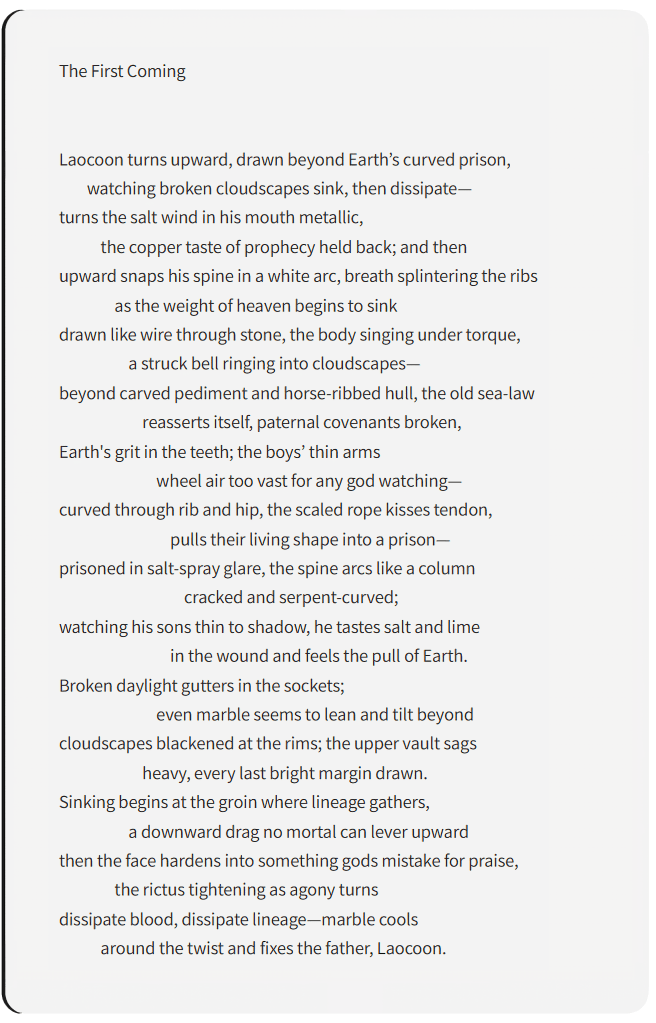
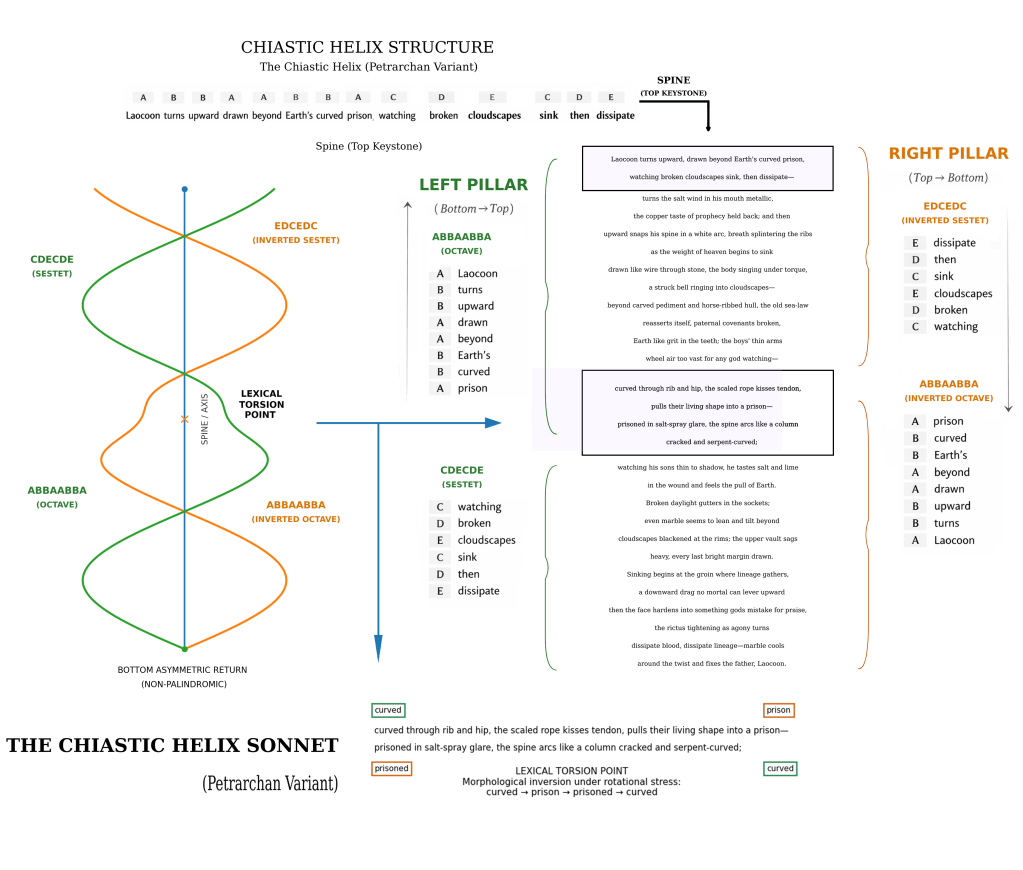
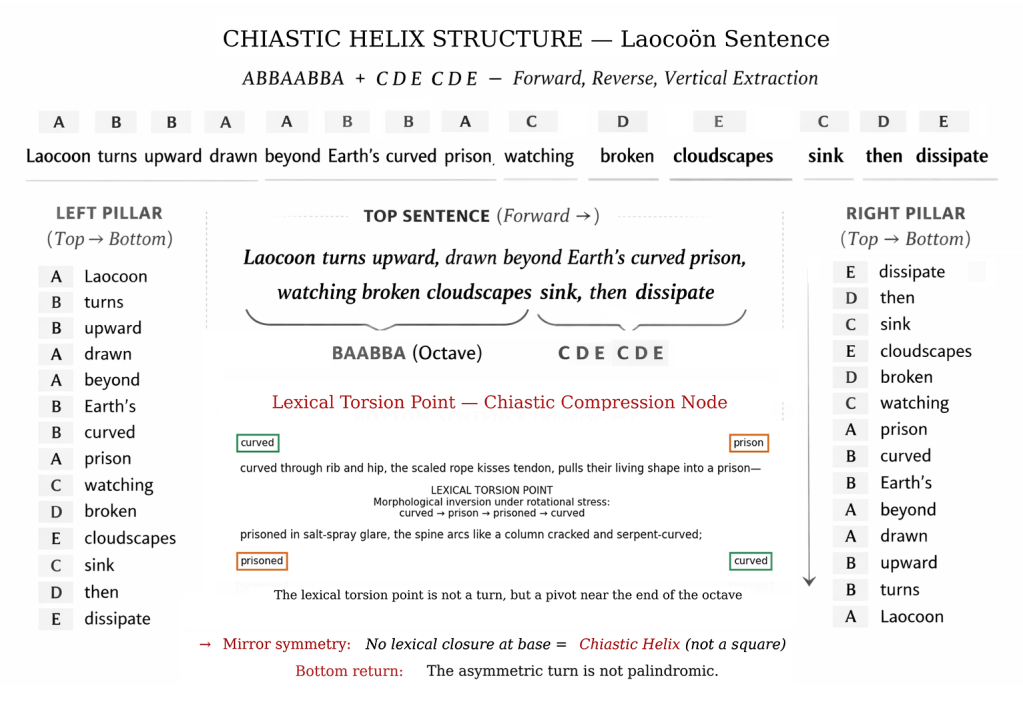
The schematic above makes the poem’s architecture legible as a system rather than a sequence, requiring four simultaneous registers: the spine running horizontally across the top, the left and right pillars descending vertically on either side, the full poem text in the center column, and the double-helix diagram mapping the rotational logic of all three. No single register is primary. The schematic runs alongside the poem as a second document written in the language of structural analysis.
The spine, extracted horizontally across the top—Laocoon turns upward drawn beyond Earth’s curved prison watching broken cloudscapes sink then dissipate—reads as a complete sentence, the formal armature made visible in isolation. The rhyme labels above each word identify its position in the dual circuit simultaneously: its role in the octave’s terminal sequence on the left, its role in the sestet’s on the right. The horizontal reading delivers narrative; the label system delivers mechanism, and every word in that sentence occupies a fixed coordinate in a three-dimensional structure the way a keystone occupies a fixed coordinate in an arch. Remove any word and the pillar sequences collapse.
The left and right pillars run in opposite directions, color-coded in the schematic—green for the CDECDE sestet circuit and its inversion, orange for the ABBAABBA octave and its inversion. Both pillars terminate on the same word: Laocoon. The left pillar begins there; the right pillar ends there. The name sits at the top-left of one column and the bottom-right of the other, the two furthest points in the diagram connected by the full arc of the structure between them. The central poem text, flanked by bracket lines connecting it to both pillars, reveals what the pillar system costs the individual line—most legibly at the boxed torsion section, where curved and prison are the fixed terminals of one line, and prisoned and curved are the fixed terminals of the next: the two words morphologically inverted and exchanged at the site of greatest structural stress. The color-coded boxes at the bottom of the schematic isolate this crossing—green curved / orange prison above the torsion lines, orange prisoned / green curved below—making the inversion visible as a physical crossing.
The double-helix diagram on the far left supplies the third dimension the flat pillar columns cannot show. The two spiraling curves twist around the vertical spine axis, crossing at the marked torsion point and continuing their counter-rotation through the bottom half of the structure—the ABBAABBA octave occupying the lower loop, the CDECDE sestet the upper, their positions exchanged in the right pillar so that EDCEDC runs at the top and ABBAABBA at the bottom. The notation at the base of the diagram—Bottom Asymmetric Return (Non-Palindromic)—identifies the schematic’s governing distinction: the two pillars converge on Laocoon from opposite directions, but the sequences that generated them have traveled different paths to arrive at the same terminus. The circuit seals on the same name it opened on, and the diagram holds the full arc of that movement in view simultaneously—the way the sculpture holds torque and stillness in the same marble, at the same moment, without releasing either.
Click here for all high-resolution Chiastic Helix Sonnet assets.
 jaznoblog