THE GHOST CAUDATE SONNET (or “THE TRIPLE FORM SONNET”)
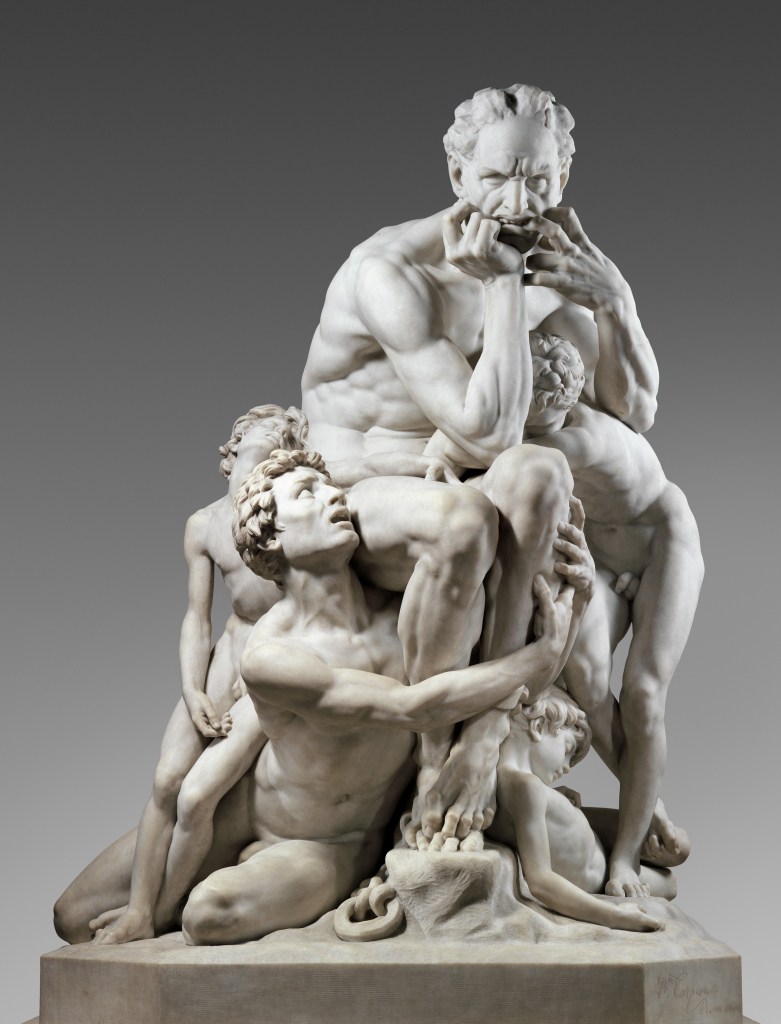
This section introduces my most recent invention, the Ghost Caudate Sonnet, first tested in a poem responding to the story of Count Ugolino. As with much of my work, the form did not precede the narrative. Instead, a visual encounter—in this case with Jean-Baptiste Carpeaux’s sculptural treatment of Ugolino—provided the initial conceptual spark. The process was neither linear nor systematic; rather, it unfolded through recursive experimentation, revisiting earlier drafts and reinterpreting past artistic experiences until a structural solution emerged.
Carpeaux’s rendering of Ugolino alters the emotional calculus of the well-known episode. Unlike the Laocoön group, where serpents visibly bind the father and sons, Carpeaux’s composition suggests an invisible force—hunger itself—that links the figures in a shared field of doom. The result is a psychological rather than purely physical entanglement, a configuration in which paternal failure becomes the organizing axis of the scene. This thematic proximity to other figures explored in Hallucinations, including Rasputin, reinforced my interest in how inherited narratives of catastrophe can be re-contained within highly regulated poetic structures.
Many of my sonnets could be described as ghost sonnets, a modern variation in which the traditional fourteen-line frame remains perceptible while several of its governing mechanisms are deliberately loosened. Strict rhyme schemes, regular meter, or sharply staged voltas may be displaced or partially erased. What persists is the residual pressure of the historical container: the reader senses expectation, argument, and terminal compression even when the load-bearing elements have been redistributed. In this sense, the ghost sonnet functions less as a literal execution of inherited rules than as a memory of form—a structure haunted by its own precedents.
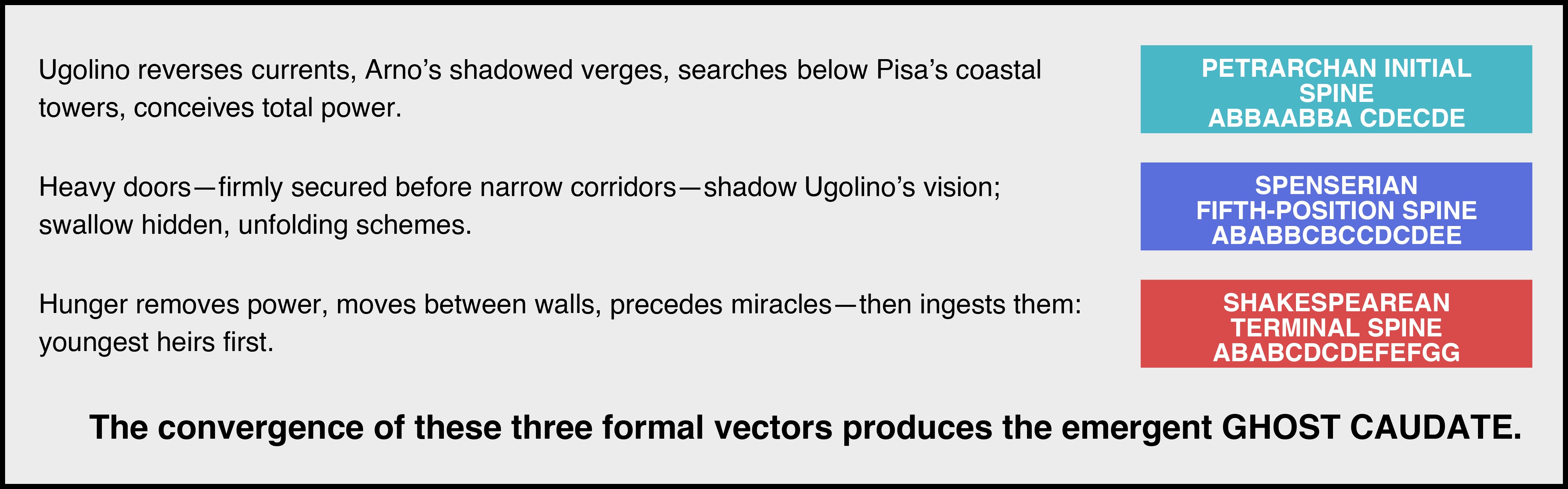
The Ghost Caudate Sonnet extends this spectral logic by introducing a concealed secondary structure within the visible poem. Historically, caudate sonnets appended additional lines or terminal clusters that complicated closure, often serving satirical, juridical, or rhetorical purposes. Such extensions did not simply lengthen the poem; they altered its adjudicative rhythm, reframing the authority of the closing gesture. While poets such as Milton more frequently destabilized sonnet logic through enjambed syntax and redistributed turns rather than literal caudate additions, the broader tradition demonstrates how terminal authority could be delayed, qualified, or re-purposed.
In this variation, the cauda is internalized rather than appended. A subpoem operates covertly within the primary architecture, producing what might be called a procedural echo. The poem appears to progress conventionally, yet beneath its rhetorical surface a second sequence of obligations is being fulfilled. This creates a three-tiered system of containment—visual, lexical, and adjudicative—in which meaning must be coaxed into legibility through attentive rereading. The hidden structure functions as a dispassionate response to the overt narrative, compressing judgment while expanding the field of retrospective authority traditionally assigned to the couplet. Where the traditional caudate sonnet appends its tail as a visible extension—a body answering a head it can see—the Ghost Caudate buries its tail inside the body itself, so that the extension is only recoverable by extracting the three spines and reading them horizontally as a separate document. The visible poem is therefore always already annotated, always already answered, the verdict running silently through every line in the same way that Ugolino’s sentence ran through every hour in the tower—not announced, not debated, simply present and structurally inevitable from the first moment of enclosure.
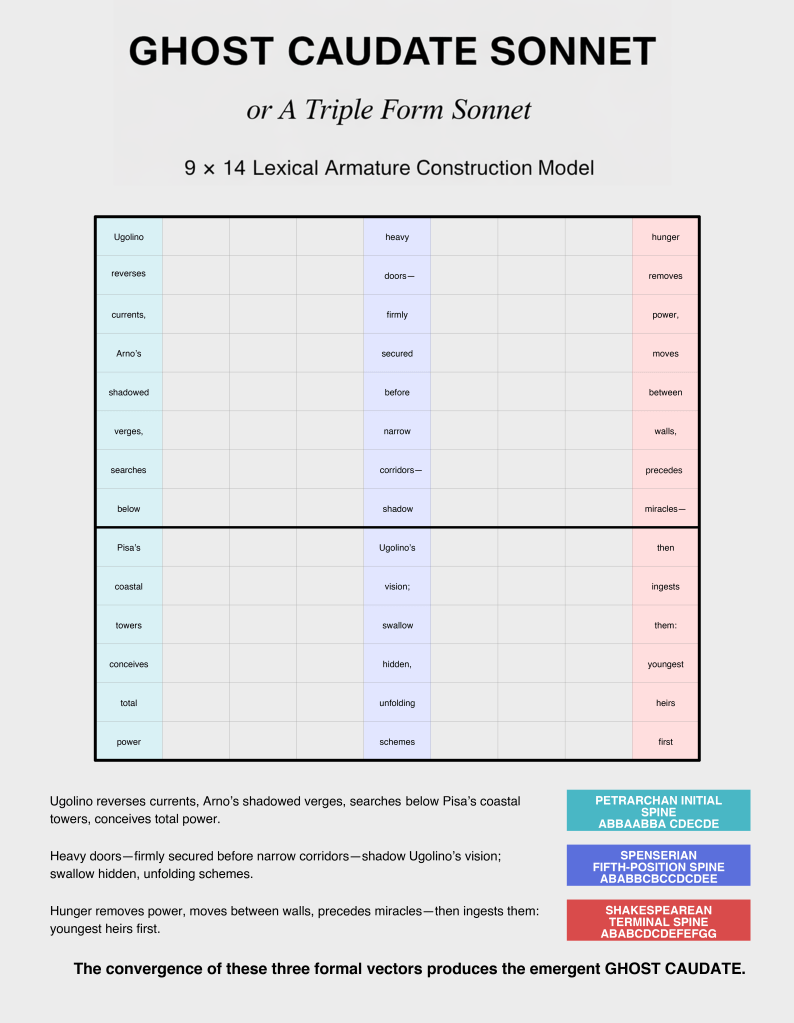
Formally, this system relies on three extracted “spines” derived from canonical sonnet traditions: a Petrarchan spine governing initial words, a Spenserian spine operating at medial positions, and a Shakespearean spine determining terminal rhyme. Because the Shakespearean sequence anchors the poem’s sonic closure, the overall structure can give the illusion of being conventionally English even as its deeper mechanics diverge sharply from that expectation. The poem must therefore be composed from the hidden lattice outward. One constructs the fixed lexical grid first, then writes the visible poem as a responsive body. The process resembles solving a crossword puzzle in reverse: structural necessity repeatedly forces revision of the spines themselves until temporal modality, narrative voice, and rhetorical pressure align. In this sense, the Ghost Caudate Sonnet may be understood as a reverse caudate. Rather than extending beyond the sonnet’s boundary, the form generates an internal adjudicative tail that the poem must answer. The visible narrative becomes secondary to the invisible juridical logic that governs it.
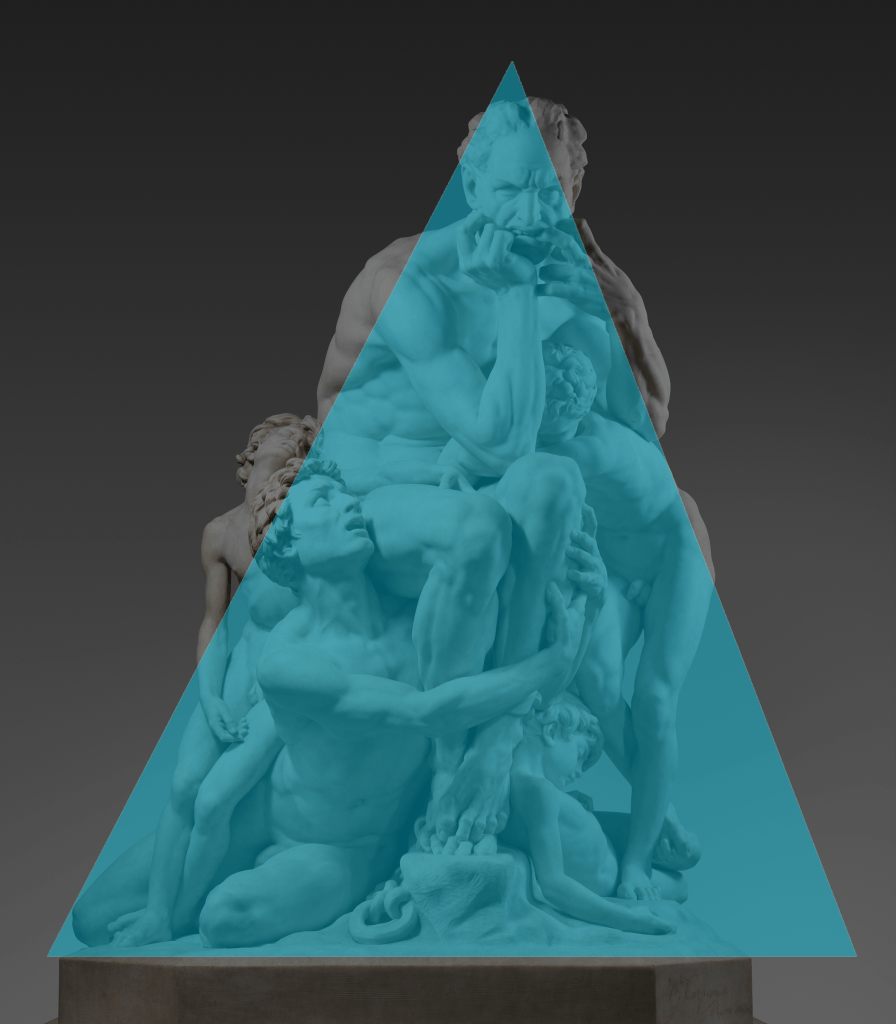
According to the historical record, Count Ugolino della Gherardesca was imprisoned in the Torre della Muda in Pisa with two sons and two grandsons, though later artistic and literary treatments often compress or reorganize this number for compositional clarity. In his monumental nineteenth-century sculpture Ugolino and His Sons, Jean-Baptiste Carpeaux resolves the group into a tightly interlocked pyramidal structure in which three youthful bodies visibly support and encircle the father’s imploding will. The triangular armature is not incidental: it stabilizes the violent emotional torque of the scene while simultaneously dramatizing enclosure. Critics have long noted that Carpeaux’s treatment departs from neoclassical restraint toward a proto-expressionist intensity, privileging psychological compression and corporeal entanglement over idealized proportion. While the work is often compared in ambition to sculptural landmarks such as Bernini’s Ecstasy of Saint Teresa or Michelangelo’s David, its true innovation lies in converting narrative catastrophe into spatial inevitability, the bodies themselves becoming the architecture of anguish, load-bearing rather than merely expressive.
This triangular logic provided a crucial visual antecedent for what evolved into the Ghost Caudate or Triple Form Sonnet. A fourth vertical channel would have imposed excessive rigidity, while a dual structure had already been explored in the Double Form Sonnet. Three spines allowed for escalation, counterpoint, and adjudication without collapsing into symmetry. The number itself carries deep cosmological resonance. Creation myths across cultures frequently organize experience into triadic systems: the Norse cosmology of Yggdrasil linking realms of gods, men, and the dead (ending with the Ragnarok); the Biblical sequence of Eden, fall, and eschatological reckoning (Armageddon); the Hindu Trimurti of Brahma, Vishnu, and Shiva; and the Christian doctrine of Father, Son, and Holy Spirit. In each case, the triad functions not merely as symbolic ornament but as a governing engine through which time, judgment, and transformation are processed. John Donne’s invocation of the “three-personed God” in his Holy Sonnets further demonstrates how theological number can generate rhetorical pressure within lyric form.
Ugolino’s own political biography reinforces this structural inheritance. As a Guelf noble accused of capitulating key Pisan strongholds—including Castelvecchio di Compito, Castelnuovo di Val di Cecina, and Viareggio—his historical narrative is already triangulated by loss, betrayal, and siege. In Carpeaux’s sculpture, these surrendered towers find a visual analogue in the rising configuration of limbs and torsos that cage the father at their apex. Transposed into poetic practice, this configuration evolves into three governing columns that function simultaneously as compositional scaffolding and as the echo of prison bars. Narrative energy must move through these vertical channels, yet the very act of progression intensifies the sense of confinement. The triangular stability promised by mythic and theological precedent is therefore complicated by juridical containment. Structure becomes not merely a device for balance but an instrument of sentence. Within the Ghost Caudate framework, the triple spine speaks with dispassionate authority—not as decorative symmetry, but as spatialized judgment enacted across the duration of the poem.
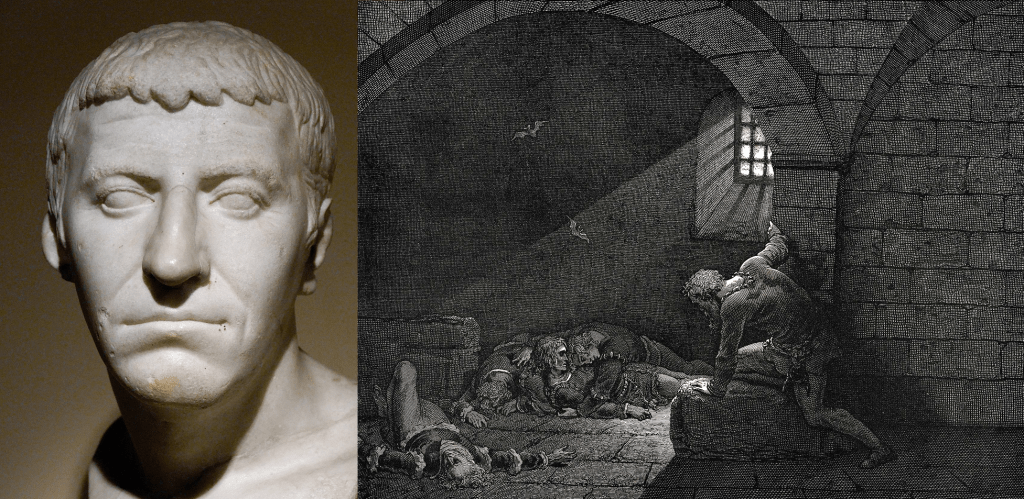
The voice of the Ghost Caudate in this poem is specifically Cassius—what remains of what was originally conceived as a dialogue. The formal solution, then, was to internalize that exchange: Cassius becomes both the invasive voice within Ugolino’s psychic field and the concealed adjudicative voice embedded within the poem’s structure itself. He operates simultaneously as tempter, analyst, and echo of starvation’s delirium—the condition in which thought fractures and begins to argue against itself. In this way, the form mirrors the experience it contains: a divided consciousness under pressure. The sculpture above depicts one of the principal architects of Caesar’s assassination. In Dante’s Inferno, Cassius is consigned to the lowest region of Hell—Cocytus—where he is eternally devoured in the mouth of Lucifer alongside Judas and Brutus. Here, however, I reposition him within the fourth ring, allowing him speech, mobility, and—most importantly—perspective. He becomes a figure who can see across time and narrative strata, consistent with the governing logic of Precedents, where speakers are less characters than enduring jurisdictions of voice. For a tonal reference, see The Tribunal, which also features a related caudate extension—the Acta Iterata—delivered by Marcus Brutus.
The etching to the right is Gustave Doré’s rendering of Ugolino’s final moments, drawn from his canonical illustrations of Dante’s Inferno. As no authenticated images exist of the interior of Ugolino’s prison within the Torre della Muda (later incorporated into the Palazzo dell’Orologio in Pisa), the cell persists primarily as a literary and artistic construct. Doré, like Carpeaux, therefore participates in the long visual reconstruction of a space that is historically real but imaginatively reconstituted. The Ghost Caudate Sonnet enters this lineage not by documenting the cell, but by rebuilding it as formal architecture: a chamber of voices, pressures, and judgments from which there is no rhetorical escape.
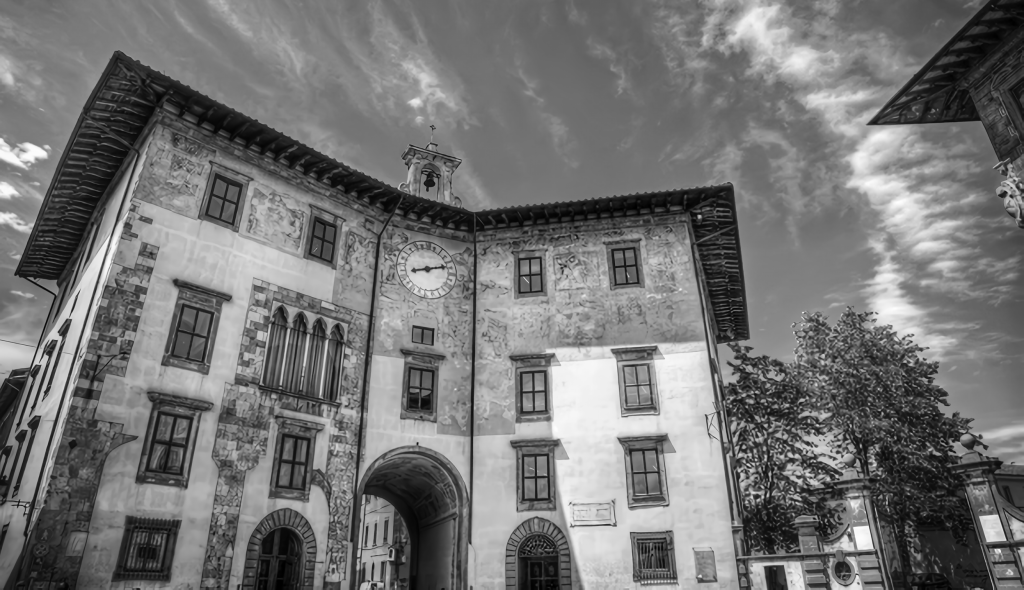
In 2001, skeletal remains attributed to Ugolino della Gherardesca were examined by a forensic team led by Italian paleoanthropologist Francesco Mallegni in an effort to evaluate the long-standing accusation of cannibalism derived from Dante’s Inferno (Canto XXXIII). DNA analysis, dental inspection, and microscopic study of bone wear revealed no evidence that Ugolino consumed human flesh during his imprisonment in the Torre della Muda—later known as the Tower of Hunger (Torre della Fame). The findings instead support death by starvation and complicate literal readings of Dante’s narrative, suggesting that the episode functions more powerfully as moral and political allegory than as verifiable historical record. In this sense, the legend of cannibalism persists less as forensic fact than as a formal mechanism through which literary tradition intensifies themes of betrayal, punishment, and civic collapse. Nevertheless, if nothing is definitive, it remains fertile ground for artists and storytellers. In this instance, I have chosen to print the legend. If the account is apocryphal, then the suggestion that he consumed his own kin is all the more incendiary—which is precisely why the historical and forensic details above are worth sharing. I present the final poem here, followed by the Ghost Caudate beneath it. It is important to remember that the caudate came first: it is the concealed skeleton upon which the sonnet itself was constructed.
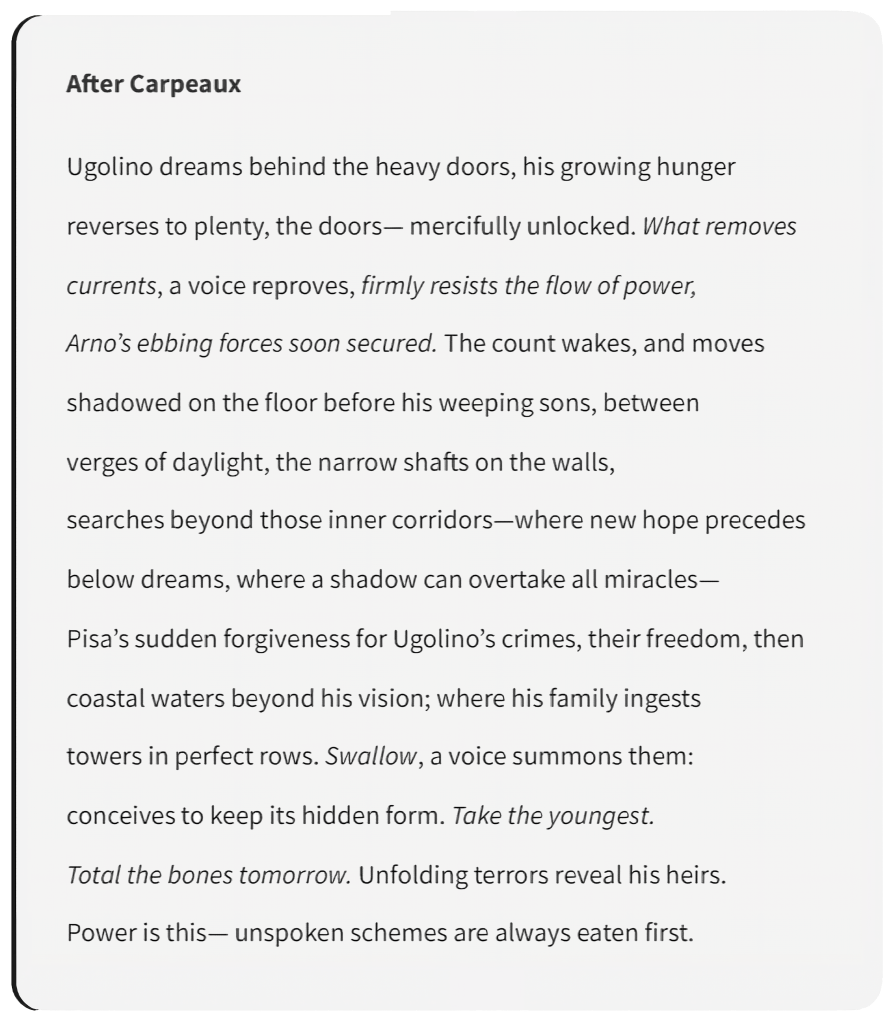
The ghost caudate below, composed of Petrarchan, Spenserian, and Shakespearean spines respectively, is embedded across three vertical vectors: the initial words, the median (fifth-position) words, and the terminal words of each line. The structure remains deliberately invisible at the level of ordinary reading, operating instead as a latent architectural system that organizes motion, pressure, and adjudication beneath the poem’s surface.
Ugolino reverses currents, Arno's shadowed verges, searches below Pisa's coastal towers, conceives total power.

Heavy doors—firmly secured before narrow corridors—shadow Ugolino's vision; swallow hidden, unfolding schemes.

Hunger removes power, moves between walls, precedes miracles—then ingests them: youngest heirs first.
Click here for all high-resolution Ghost Caudate Sonnet assets

