In many disciplines, research precedes execution. A hypothesis is formed, sources are gathered, and the work unfolds according to a plan. Poetry rarely behaves this way. Poems often arise in moments when accumulated experience and emotion suddenly condense into form, long before the poet fully understands the mechanics that produced them. Inspiration arrives first; explanation follows later. In my own practice, research typically occurs retroactively. The act of revision becomes a kind of archaeology—an attempt to understand puzzles the mind has already constructed. For this reason, the trajectory of poetic inquiry is rarely linear. It tends instead to be circular.
This circularity helps explain why my first book of verse continues to function as a springboard decades later. Many of the ideas that now occupy me began there in embryonic form. At the time I was too busy writing new poems to perform any sustained post-mortem on the earlier ones. Only with the vantage of time—and now being well into my fifties—have I begun to unpack the impulses that originally produced them. What once appeared to be casual interests have, over the years, metastasized into deeper fascinations and, in some cases, outright obsessions. Among the most persistent of these has been a fascination with recursion.
From an early age I was drawn to works that played with reversals and cyclical structures: palindromes, word squares, optical illusions, and recursive narratives such as Alice in Wonderland. These ideas surfaced repeatedly in my writing long before I consciously examined them. In retrospect the recurrence of these structures now seems less accidental than inevitable. They formed a quiet through-line in my work long before I began analyzing them critically.
The only time I consciously attempted to begin a poetic project with research was a long-abandoned sonnet cycle titled The Forum, conceived loosely as a modern analogue to Dante’s Divine Comedy. The project consisted of one hundred Shakespearean sonnets inspired by Roman historiography, particularly Julius Caesar’s Gallic Wars and the histories of Suetonius and Plutarch. In retrospect the result was largely unsuccessful. The poems often read less like poems than like lectures. The rhetorical scaffolding overwhelmed the emotional core, and the project was eventually abandoned for nearly twenty years.
Yet the effort was not wasted. During those years I continued writing poems informed by the rhetorical rhythms and idioms of Roman prose. That influence surfaced indirectly in a number of later works, particularly a series of sestinas—Via Sacra, Lupa Noctis, Retrogradatio Cruciata, Twelfth Night Masquerade, and The Song of Heraclitus. None of these poems required active research at the moment of composition; the research had already been internalized. In that sense, the years spent writing—and eventually abandoning—The Forum functioned as a kind of apprenticeship. What initially appeared to be failure was actually the slow construction of an internal technical vocabulary. I prefer to think of those years not as failing but as iterating.
Eventually the only way to salvage fragments of The Forum was to abandon the conventional Shakespearean sonnet entirely. In its place I developed a new form, the Mirrored Sonnet, in which each poem consists of two Shakespearean sonnets followed by two inverted Shakespearean sonnets, with a concluding coda called the Acta Iterata. The name is borrowed from the adjudicative rhetoric of classical discourse. Rather than moralizing, the Acta Iterata presents a form of reflective residue—a closing gesture that registers argument without resolving it. Out of the hundred sonnets originally drafted, only sixteen survived within this revised architecture, accompanied by four Acta Iterata. Yet the larger project clarified the structural problem that had originally undermined the work: rhetoric had been mistaken for form.
THE CHIASTIC HELIX SONNET
One poem that continued to trouble me, however, was an early blank-verse piece titled The First Coming, published in Fountain Street in 2000. The poem uses the Laocoön sculpture as its central metaphor, and for many years I regarded it as juvenilia—an exercise in extended metaphor that never quite cohered. I eventually dismissed it as little more than a strange experiment in free association. But the poem lingered in my mind, largely because I remembered the experience that had produced it. In 1998 I had seen the Laocoön sculpture in person, and the figure left an unsettling impression on me: a sense of coiled motion frozen in marble. The poem was my attempt to articulate that sensation, though at the time I did not fully understand what the sculpture had shown me.
THE FIRST COMING

Laocoön is still looking up sadly
before his own devouring,
wondering if this immense snake
fell from an emasculated god.

Before antiquity, gods shook
the columns of their temples,
the marble cracking through the clouds
like thunder, a dress rehearsal
before the buggering of Ganymede.

With indolent grins
they allowed the snake to writhe
in a leafy copse,
a tendril rising with the moon
licking at its canopy
until the first woman
could be born.
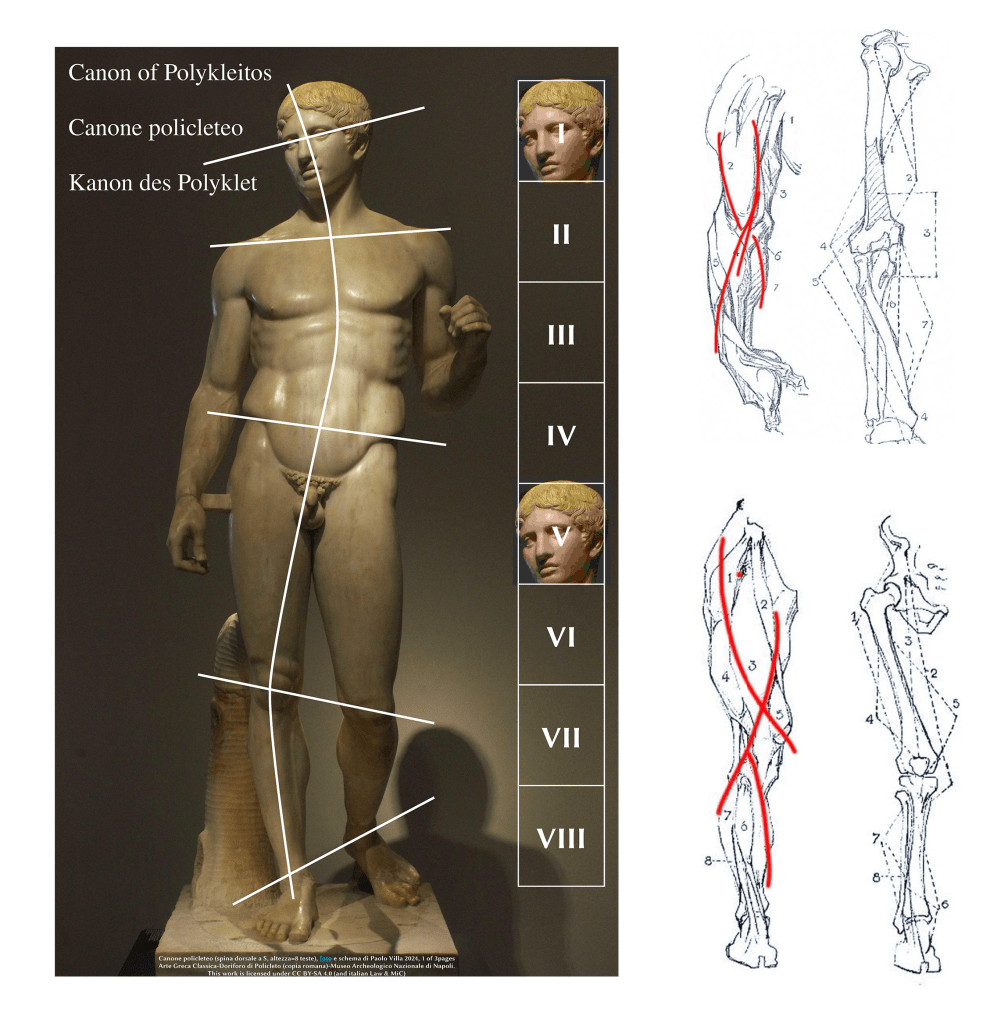
The insight arrived years later during a guest lecture in one of my classes. A colleague, John Hermanowski, was presenting examples of anatomical research used in professional modeling practice, and one slide in particular stopped me cold. In the presentation he overlaid double-helix curves onto Bridgman’s anatomical drawings and then onto the Laocoön itself, demonstrating that the same torsional structure appears in both master drawings and classical sculpture. The overlay traced opposing curves moving throughout the sculpture, revealing a dynamic system of counter-rotation embedded in the figures. Seen this way, the torsional structure of the body became unmistakable. The curves and counter-curves mapped across the figure bore an uncanny resemblance to a double helix.
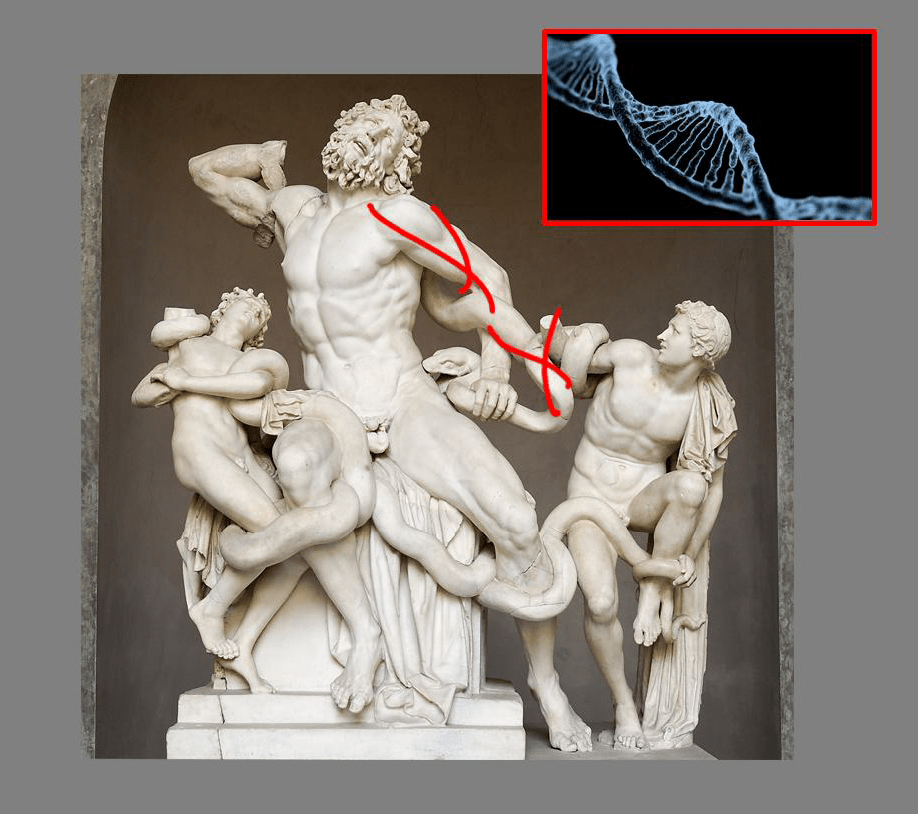
At that moment several lines of thought converged at once. For years I had lectured on the Greek principle of chiastic movement—the system of opposing forces that produces contrapposto in classical sculpture. Polykleitos’ canon relies on precisely this logic: tilt against tilt, curve against counter-curve, tension balanced by release. But the Bridgman overlay made something else visible. The movement of the Laocoön figure does not simply cross. It spirals.
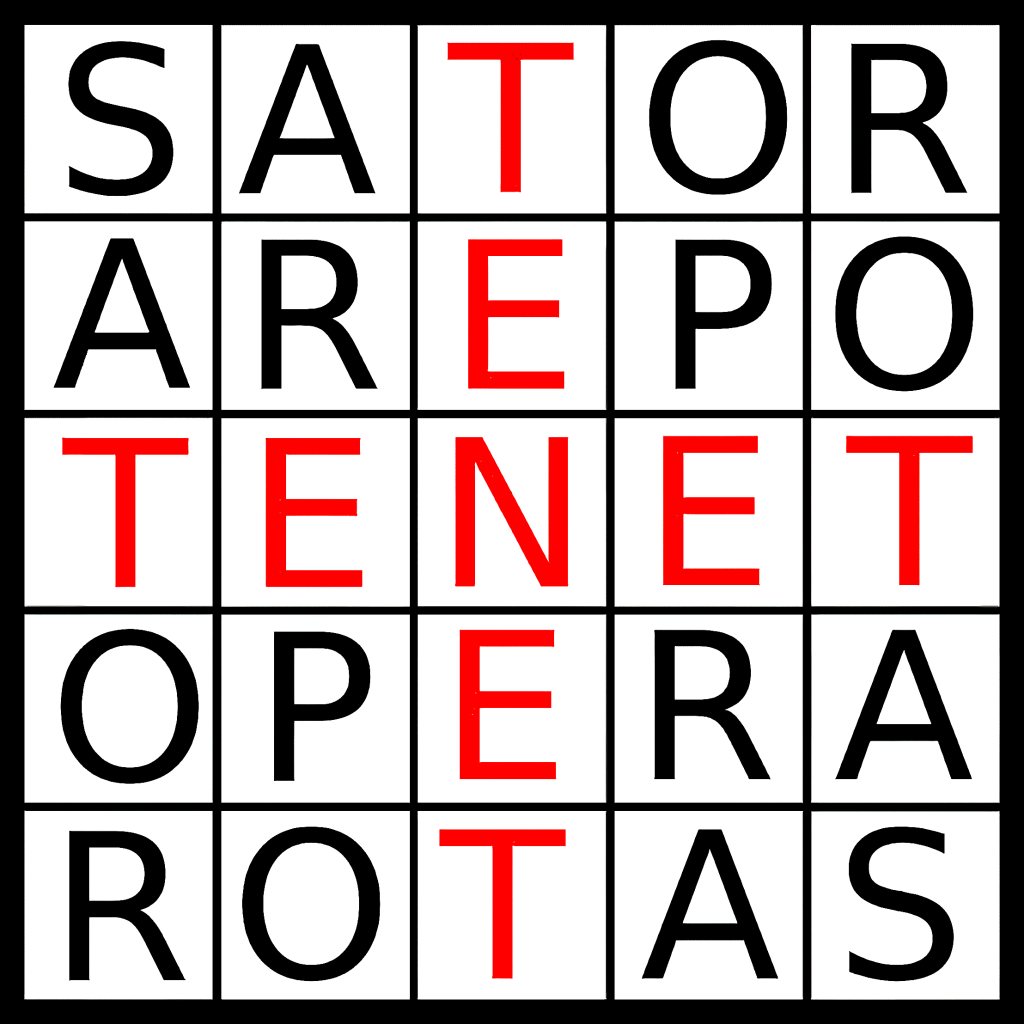
This realization connected immediately with another long-standing fascination of mine: the famous SATOR square, a five-word Latin palindrome that can be read in multiple directions and contains the hidden PATER NOSTER cross at its center. For years I had entertained the idea of constructing a poetic structure that behaved similarly, a form capable of recursive reading. Yet strict palindromes collapse quickly beyond a handful of words. A fully palindromic sonnet would be impossible. The solution, therefore, was not to replicate the palindrome literally but to build a structural analogue.
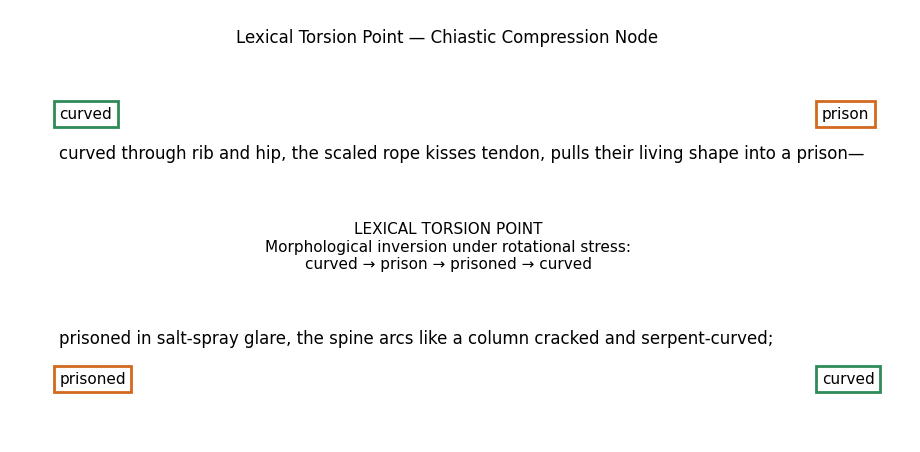
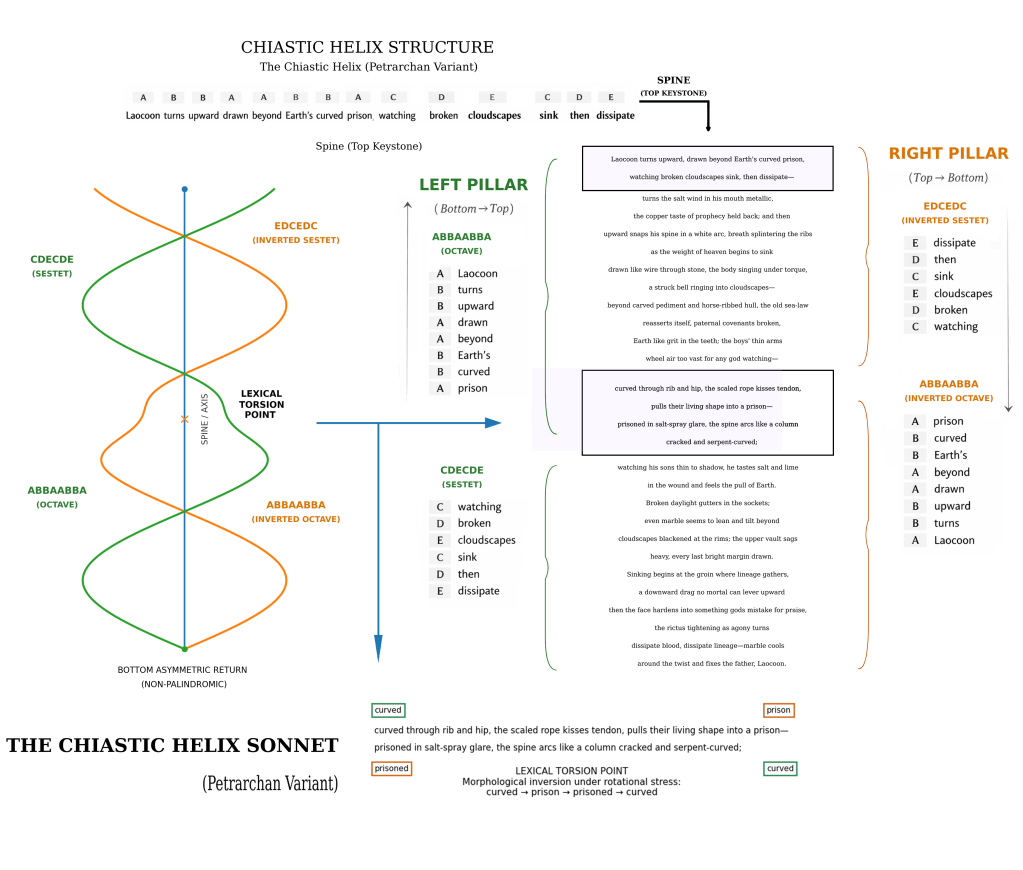
The form that emerged from these converging ideas is what I call the Chiastic Helix Sonnet, an inverted Petrarchan variant. In this structure the terminal words of the poem follow a Petrarchan circuit that reverses itself between the octave and the sestet, while the initial words of each line follow the same sequence along the poem’s central spine. This dual constraint creates mirrored inversions between the left and right columns of the poem. The midpoint—the Lexical Torsion Point—functions as the pivot where the two circuits cross. In effect, the poem behaves like a linguistic double helix.
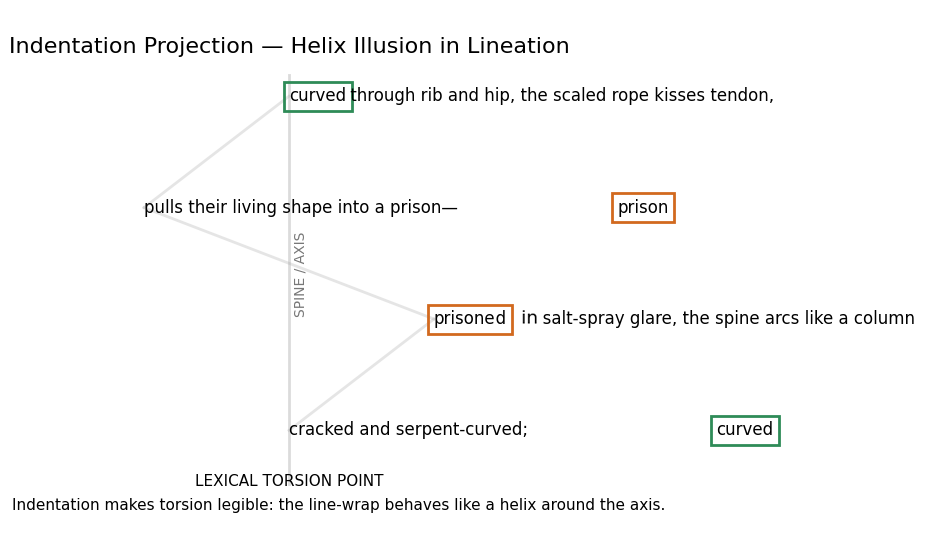
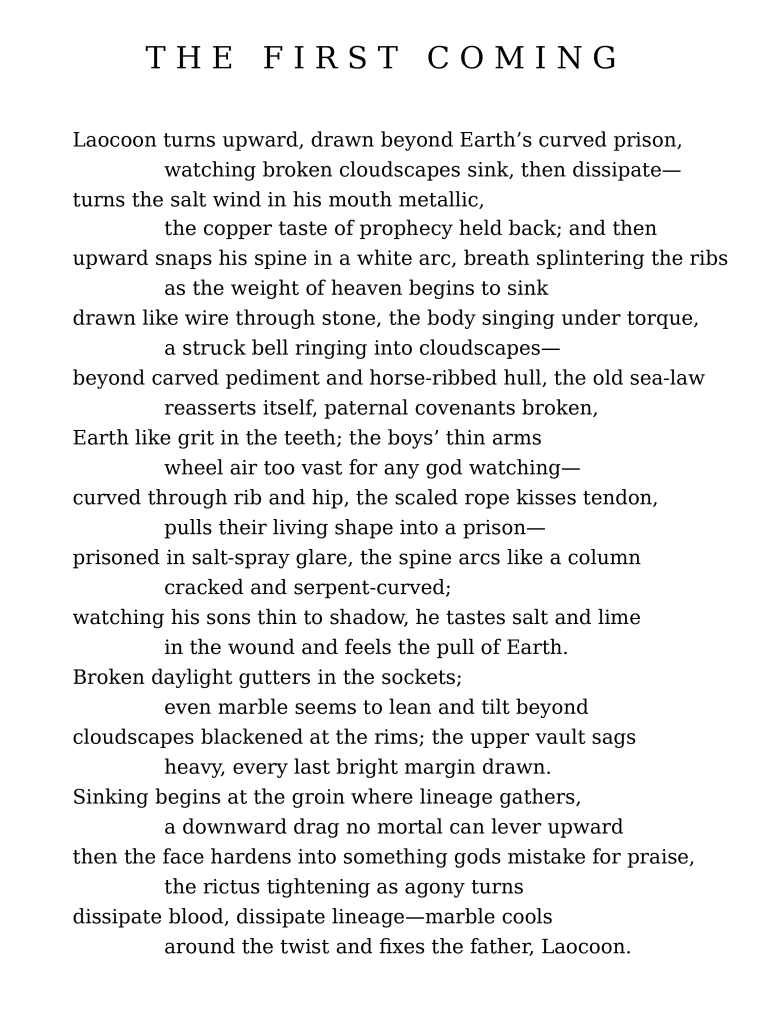
Because the poem is written in loose accentual-iambic hexameter, the lines are unusually long. When indented properly, the lineation itself produces a visual spiral descending the page. In this way the poem’s typography reinforces the structural principle underlying the form: lineation enforces the double-helix structure.
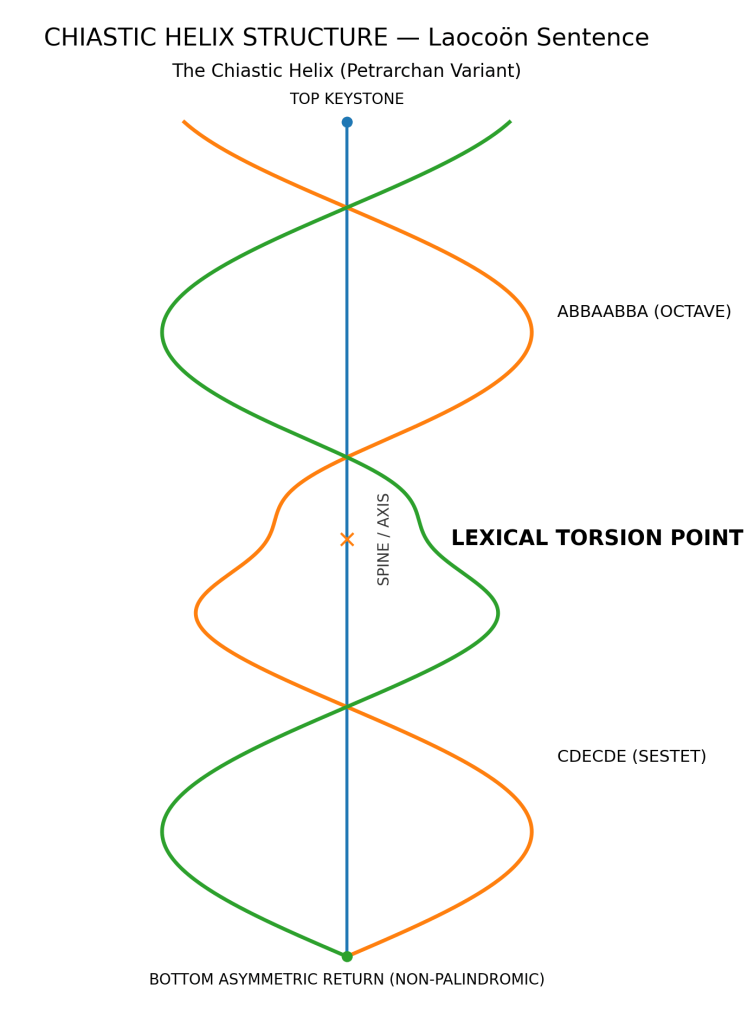
Despite its recursive mechanics, however, the form is not a palindrome. The terminal words invert between the octave and the sestet, but the poem does not return to its starting point in perfect symmetry. The final lines break the circuit. Visually the structure resembles not a square but an arch: a form that mirrors itself around a central keystone while resolving asymmetrically at its base.
Seen from this perspective, the Chiastic Helix Sonnet is not the result of a single act of invention but the culmination of a long feedback loop between observation, research, and revision. The original poem that inspired the structure was written in 2000. The anatomical insight that revealed its latent geometry arrived decades later. Only then could the earlier work be re-engineered through a form capable of expressing the torsional logic that had first inspired it. In that sense, the form represents not merely a new poetic container but the completion of a twenty-eight-year cycle between experience, curiosity, and return. This will also be showcased in SONNET FORMS, for a more formal analysis of how the helical structure more specifically informs the narrative. I normall put poems in the gray boxes, but to preserve lineation and visual structure, I’ve uploaded The First Coming as an image below:
 jaznoblog