Formal traditions endure not through preservation alone but through adaptive pressure. Across literary history, moments of linguistic consolidation have often coincided with formal transformation. Tulsidas’ vernacular rendering of Valmiki’s Ramayana helped stabilize literary Hindi; Dante’s Commedia elevated the Italian volgare to a vehicle of philosophical and theological argument; Shakespeare recalibrated inherited sonnet structures for the expressive demands of Early Modern English. In each case, form did not remain intact as a static inheritance but was reconfigured to meet the pressures of language, audience, and historical circumstance.
My experiments gathered in this section proceed from that premise. They are not attempts at novelty for its own sake, but efforts to test what established formal systems are capable of doing when subjected to contemporary linguistic conditions. Some recombine existing architectures; others introduce new axes of recurrence, inversion, or containment. All assume that form is not merely decorative scaffolding but an active mechanism for producing meaning — a way of structuring time, memory, argument, and recognition. Invention, in this sense, becomes a mode of preservation: by altering the machinery, one ensures its continued operation.
I do not claim the historical reach of those writers whose formal interventions reshaped entire linguistic cultures. My aims are necessarily more modest: to test whether inherited poetic machinery can be re-energized within contemporary language and sensibility. If any of the experiments presented here achieve even limited resonance with readers, they will have fulfilled their purpose. Innovation, in this context, is not pursued for spectacle but for continuity — an attempt to preserve formal lineages by subjecting them to renewed conditions of use.
This work proceeds largely outside institutional frameworks. It is not written in anticipation of tenure review, collective endorsement, or critical mediation. Such independence entails risk, but also confers a particular latitude: the freedom to attempt structures that may prove overly restrictive, impractical, or unsuccessful. Iteration is therefore integral to the process. Some forms presented here may remain provisional; others may function primarily as conceptual exercises. The manuscript in which many of these experiments are embedded has not yet entered the mechanisms of publication and may ultimately persist as an experimental body of work. Even so, the project remains oriented toward dialogue. It is offered in the hope of encountering other practitioners engaged in comparable formal inquiry.
INVENTED SONNET FORMS
While I work across a range of inherited structures — including villanelles, sestinas, and other recurrence-based forms — it is difficult to overstate the historical authority of the sonnet. Few lyric mechanisms have demonstrated comparable durability. From Petrarch’s dialectical octave–sestet tension to Shakespeare’s quatrain-driven adjudication and Milton’s syntactic expansions, the sonnet has repeatedly absorbed linguistic change while maintaining a recognizable core of argumentative pressure and closure.
My own practice engages these architectures from the conviction that formal systems cannot remain historically inert. They survive through recomposition. Form and language are inseparable: each conditions the expressive possibilities of the other. The relative difficulty of sustaining terza rima in English, for example, reflects structural differences in rhyme density between Italian and English phonologies. Traditions surrounding Qur’anic recitation likewise remind us that meaning inheres not only in semantic content but in sonic embodiment; translation inevitably redistributes these effects. To write formally in English is therefore to negotiate both inheritance and constraint.
The sonnet, which I have elsewhere described as a judicial engine — a compact mechanism for testing argument, memory, and consequence — becomes particularly suited to procedural experimentation. Its internal logic can be recombined with other recursive or architectonic systems. In the Sestonnet, the sonnet’s dialectical progression is fused with the sestina’s rotational terminal-word governance, producing a hybrid structure in which linear adjudication and cyclical recurrence operate simultaneously. In the Ghost Caudate Sonnet, terminal rhyme patterns derived from Shakespearean precedent intersect with Petrarchan and Spenserian containment strategies, while additional constraints on initial and medial lexical positions distribute structural obligation across the poem’s full surface. The caudate thus emerges not as an appended tail but as latent architecture embedded within the poem’s rotational field.
Other inventions explore axial reversibility and semantic mirroring — as in the Sator Square Sonnet, where meaning remains legible under vertical or horizontal inversion — or extend the historical tail, or cauda, of the form through devices such as the Acta Iterata extension, in which repetition functions as juridical aftereffect rather than ornament. Such procedures arise through prolonged apprenticeship within canonical forms. By internalizing their governing pressures, one may reverse-engineer their rhetorical energies and redeploy them for contemporary readers.
Formal invention, in this sense, resembles casting against type. The poet inhabits a structure deeply enough to redirect its force without dissolving its identity. The aim is not to abandon tradition but to discover what further work it can be made to perform. Constraint becomes not a limit but a generative field — a means by which inherited forms remain both intelligible and alive.
THE OCTAVANA
The Octavana is a fourteen-line sonnet-variant written in tetrameter (approximately eight syllables per line). It preserves the sonnet’s adjudicative duration while reorganizing its internal architecture around two equal sestets followed by a closing couplet. The governing unit is not the quatrain but the sestet, repeated under altered pressure before final compression. The form is derived from Andrea Dietrich’s HexSonnetta, which demonstrates that the sonnet’s structural logic can survive radical contraction of line length. The Octavana retains that doubled-sestet architecture while expanding the line from trimeter to tetrameter, restoring syntactic elasticity without abandoning constraint. It is neither Shakespearean nor Petrarchan; its movement is recursive rather than escalatory.
FORMAL STRUCTURE
Mapped to: The Documentarian (Canonical)
Duration: 14 lines
Architecture:  Two Sestets + Couplet (6 / 6 / 2)
Meter:  Tetrameter (≈ 8 syllables per line)
Rhyme Scheme (inherited from HexSonnetta): abb aab cdd ccd ee
a
bb
aa
b      }  SESTET I — Lines 1–6
       }  Establishing beat / Opening sequence
       }  Premise introduced
       }  Pressure initiated through early return
       }  Wide shot → medium shot: the system comes into view
c
dd
cc
d      }  SESTET II — Lines 7–12
       }  Second act beat / Re-pressurization
       }  Premise re-encountered under altered conditions
       }  Escalation without expansion
       }  Cut back to the same scene with new information
       }  Volta may begin at the sestet hinge

ee     }  COUPLET — Lines 13–14
       }  Final beat / Closing shot
       }  Compression rather than twist
       }  Adjudication without consolation
       }  Cut to black; meaning sealed, not explained
Unlike sonnets that turn through quatrain progression, the Octavana turns through recurrence. The second sestet does not advance the argument so much as re-encounter it under altered conditions. The couplet does not console or summarize; it adjudicates. The form’s engine is return under pressure rather than linear development.
Because each sestet contains its own internal return, the Octavana resists linear escalation at the level of argument. Meaning does not advance by accumulation but by controlled re-entry: the second sestet does not rebut or supersede the first, but subjects the same governing material to renewed pressure. Where quatrain-based sonnets rely on progression—statement, complication, turn—the Octavana relies on containment. The rhyme lattice forces early recurrence, preventing the poem from outrunning its premise and obliging it to remain inside the same conceptual chamber longer than a traditional sonnet would permit.
The tetrameter line is crucial to this behavior. It restores syntactic flexibility lost in trimeter—allowing enjambment, subordinate clauses, and sustained metaphor—while remaining short enough to deny discursiveness. Breath is regulated rather than released. Thought can extend, but it cannot sprawl. As a result, the poem can model systems that operate procedurally rather than narratively: institutional habits, inherited violence, ethical drift, or distributed responsibility. The form encourages persistence over revelation.
The couplet functions as compression rather than resolution. Having already passed through two cycles of return, the poem arrives at adjudication without the shock of reversal. The couplet seals what recurrence has rendered inevitable. Its authority derives not from wit or epigram, but from structural exhaustion: the sense that no further rotation will produce new information.
The Documentarian

He kept a briefcase in his room,
a numbered lock, a loaded gun.
“What’s in it?” Nothing. Just a shrug
the way a monk seals up a tomb.
A year of nights, a silent proof;
a secret tucked behind the rug.
Too young for badges or the trade,
all bone and reach in undershirt,
just street enough to film a world
where men spoke easy into tape—
gang lore, a birthday stolen late.
I guessed at film, or cash, or dirt.
He drank. He warned me. Click by click,
the case gave up the girls they picked.
— The Documentarian, Systems (Hallucinations)
This poem advances by procedure rather than disclosure, a logic enforced by the Octavana’s doubled-sestet architecture. The first sestet establishes a sealed system through inventory—briefcase, numbered lock, loaded gun—but the form arrests escalation. Because the sestet functions as a closed chamber rather than a stepping quatrain, the poem can only arrange, not reveal. The tetrameter line permits detail without release. The answer “Nothing” is structurally false because recurrence begins before expansion; the shrug completes a ritual of containment. Secrecy is not absence but practice.
The second sestet re-enters the same system under altered conditions, which is the Octavana’s governing move. Authority is defined through proximity rather than participation: “Too young for badges or the trade” places the speaker adjacent to institutional violence without agency. The body—“all bone and reach in undershirt”—registers that exposure. Tetrameter sustains enjambment while keeping the speaker syntactically vulnerable. Recording becomes credential not as mastery, but as conditional access. The form does not advance the argument; it forces the speaker to remain longer inside the apparatus.
The couplet performs adjudication without rhetoric. Revelation arrives mechanically—“click by click”—echoing both the lock and the form’s incremental compression. Earlier guesses are displaced by evidence rather than refuted. The verb “picked” frames violence as selection within a system already built. The Octavana does not interpret its contents. It opens the case, delivers the verdict, and closes the circuit.
DEEPER STRUCTURE
LINES 1–2 — Sealed System Introduced
Film: Establishing Shot / Engine Engaged
Poetry: Governing object named; recurrence begins early
The briefcase/lock establish containment as premise.
The system is introduced before motive.
Rhyme returns immediately, preventing expansion.

LINES 3–4 — Ritualized Denial
Film: Close-Up / Doctrine of Refusal
Poetry: Pressure initiated through repetition
“Nothing” operates as procedure, not answer.
The shrug seals the chamber.
Containment becomes moral posture.

LINES 5–6 — Duration Without Disclosure
Film: Time Compression / Evidence Withheld
Poetry: Chamber completes; recurrence sets authority
“A year of nights” signals continuity.
Secrecy is sustained, not episodic.
The first sestet closes without revelation.

LINES 7–8 — Threshold Positioning
Film: Secondary Figure at the Edge
Poetry: Premise re-entered under altered pressure
“Too young for badges” situates the speaker
adjacent to power. Access exists without agency.
The second sestet reframes rather than advances.

LINES 9–10 — Recording as Access
Film: Documentary Insert / World Revealed Indirectly
Poetry: Escalation without expansion
"Film a world” replaces participation with witnessing.
The apparatus becomes credential.
The system tightens rather than opens.

LINES 11–12 — False Inference / Contained Ignorance
Film: Misread Motive / Deferred Disclosure
Poetry: Pressure increases through misclassification
Guesses—“film, or cash, or dirt”—fail.
Knowledge is deferred structurally, not dramatically.

LINES 13–14 — Mechanical Verdict
Film: Final Compression / Case Opens
Poetry: Seal without consolation
“Click by click” enacts the form’s incremental closure.
The couplet exposes outcome, not redemption.
The chamber empties; the system remains.
The Octavana favors arguments in which judgment emerges through tensions rather than persuasion, and where closure exposes a system rather than correcting it—poems about procedural violence, institutional inheritance, ethical complicity, recursive desire, or forms of love and loyalty that persist after intention has failed. By contrast, the Octavana resists narratives that depend on discovery, redemption, or irreversible transformation—conversion stories, quest arcs, epiphanic lyrics, or plots driven by surprise—because its engine is return rather than rupture, and its closure seals inevitability instead of opening escape.
I did not adopt the HexSonnetta wholesale because trimeter is among the most austere and restrictive meters in English; its compression leaves little room for syntactic or imagistic extension. Expanding the line to tetrameter provides the additional breath this architecture requires, but that breath remains tightly regulated. Diction must stay lean, and the form does not tolerate accumulation across cycles. The Octavana is therefore best suited to singular moments, compressed experiences, and sharply defined observations rather than extended narrative development or elaborate metaphysical argument.
LINEAGE OF THE OCTAVANA
The Octavana’s immediate antecedent is Dietrich’s HexSonnetta (2009), which preserves the sonnet’s fourteen-line duration while contracting the line to trimeter and reorganizing the architecture into two sestets and a couplet. The innovation is structural rather than stylistic. It inherits that architecture intact and expands only one parameter: line length. This single-axis expansion alters what kinds of syntax and argument the form can sustain without loosening its pressure system. The lineage is therefore direct: not imitation of voice or subject, but inheritance of mechanism.
March wasn’t like a meek
and gentle lamb when she
moved on; then gloomily
came April, and the week
stayed cold and wet and bleak,
but hope’s returned to me
— Andrea Dietrich, The Bringer of Spring’s Cheer
This excerpt demonstrates the HexSonnetta’s defining compression. Written in strict trimeter, the poem relies on paratactic stacking rather than syntactic development: each line delivers a discrete weather-state, and meaning accrues through accumulation rather than argument. The tight rhyme lattice forces early return, giving the stanza a circular, boxed-in quality that mirrors the emotional climate it describes. Seasonal progression (March → April → week) suggests narrative movement, but the meter prevents expansion; the poem advances in increments of pressure, not discovery. The final turn—“but hope’s returned to me”—arrives not as earned transformation but as a tonal counterweight, demonstrating how the HexSonnetta often resolves by balance rather than depth, its strength lying in containment and tonal calibration rather than sustained psychological development.
I encountered this form through an online workshop where writers were generating large numbers of newly invented and hybrid poetic forms. Most were ornamental curiosities, but the HexSonnetta stood out as structurally serious. A through-line in this section—and throughout the book—is my preoccupation with the marriage of form and function. I rarely begin with a fixed container; more often, the poem arrives first, and the form must be discovered afterward.
In this case, The Documentarian began as a more expansive narrative. As the draft developed, it became clear that certain observations—while accurate—were diluting the poem’s center of gravity. The material required compression rather than elaboration. I knew a restrictive form would be necessary. Having written Ice Breaking as a sonnet in trimeter, I was already familiar with the disciplinary force of severe metrical constraint, but I did not want to impose quite that level of austerity again. Trimeter can be punishing. I needed slightly more breath without sacrificing pressure.
Expanding the HexSonnetta’s architecture into tetrameter solved that problem. The result was a variant of a variant—a form built not for novelty, but for confinement. More than half of the original poem was cut in the process. What remained was what the structure could carry. Derived from the formal logic of Andrea Dietrich’s Hex Sonnetta, this variant adapts the structure to a tetrameter system while preserving its recursive architecture. The lineage here does not reach back to antiquity or medieval precedent; it is local, practical, and opportunistic. The influence was found close at hand, and the form emerged in response to a specific problem of craft.
THE INVERTED SONNET
The Inverted Sonnet is not a new rhyme scheme or stanzaic invention, but a temporal reorientation of sonnet logic. It retains the inherited architecture of the sonnet—whether Shakespearean, Petrarchan, Spenserian, curtal, Octavana, extended, or any other variant—but reverses the direction of narrative causality. Instead of moving from initiating act toward consequence, the poem begins in aftermath and rewinds toward origin. Effect precedes cause. Residue appears before contact. The poem ends not in resolution but at the threshold of the event itself.
Historically, the sonnet has functioned as an adjudicative engine: a compact structure designed to introduce tension, test it under conflict, and arrive at judgment or reframing. The Inverted Sonnet preserves that adjudicative duration while altering where judgment sits in time. Closure is no longer terminal. The couplet, or its functional equivalent, does not seal the argument; it exposes the moment before inevitability hardens. Where the traditional sonnet decides, the inverted sonnet suspends.
This reversal arises not from formal novelty but from narrative necessity. Certain experiences resist frontal narration. In such cases, consequence carries greater moral density than the initiating act itself. Aftermath contains more information than contact. Forward motion can feel evasive, theatrical, or reductive. The poem must therefore move backward—toward an origin that cannot yet be named without diminishing its force.
FORMAL STRUCTURE
Duration: 14 lines (or inherited sonnet variant)
Architecture:  Retains original sonnet proportions
Meter: Inherited from host form (typically iambic pentameter)
Logic:  Temporal reversal of causality
Rhyme:  Unchanged (Shakespearean, Petrarchan, Curtal, Octavana, etc.)

ABAB
CDCD   }  OCTAVE (Lines 1–8)
       }  Aftermath / Residual Field
       }  World already altered
       }  Consequence visible; cause withheld
       }  Exposition displaced by evidence
       }  Inciting act implied but unnamed
       }  Equilibrium appears restored—but is diagnostic


EFEF   }  THIRD QUATRAIN (Lines 9–12)
       }  Temporal Retraction / Hinge
       }  Incremental rewind toward origin
       }  Prior states unearthed
       }  Chronological rather than argumentative turn
       }  Volta as reversal of direction
       }  Tension shifts from outcome to incipience


GG     }  COUPLET (Lines 13–14)
       }  Threshold / Pre-Event Exposure
       }  Moment before commitment
       }  Inevitability not yet sealed
       }  Adjudication suspended
       }  Resolution refused
       }  Poem halts before the act occurs
The reversal logic has precedents outside poetry. Film structures such as Memento demonstrate how reversed chronology can intensify moral weight by forcing the viewer to encounter consequence before motive. Musical analogues—Bach’s crab canon, for example—show that inversion need not destroy coherence: independent lines may move backward and forward simultaneously while remaining harmonically intact. The Inverted Sonnet operates according to the same principle. Time reverses; structure holds.
Crucially, inversion is logical, not mechanical. The poem does not merely reverse line order. It reconstructs causality. Images appear already altered. Objects settle before they are disturbed. Language describes repair before damage. The reader is asked to infer origin from residue, assembling cause retroactively as the poem retracts through time. Because the Inverted Sonnet preserves the sonnet’s internal proportions, it can be executed within nearly any sonnet architecture. Shakespearean quatrains, Petrarchan octave–sestet divisions, curtailed forms, and modern hybrids such as the Octavana all remain viable containers. What changes is not the container but the direction of force applied within it. The governing requirement is simple and absolute: events must move backward toward their own cause.
The Arrangement

“Yet why not say what happened?”
—Robert Lowell

The clock reclaims the room one murmur at a time.
Smoke thins; the glasses dry to chalky rings.
The sheets uncrease. What loosened learns its seam.
Your breath goes even. Nothing touches, clings.
A cat cries once beneath the radiator,
or maybe that was earlier—before
the light was killed, before the second pour,
before your watch came off beside the door.
The minute hand returns what it displaced:
the words you practiced, then the careful pause;
the bedroom clock, still ticking out of phase;
the name I didn’t ask you to withdraw.
At last the hour yields what started this—
a body standing where it wasn’t yet a kiss.
— The Arrangement, Protocols (Hallucinations)
The Arrangement is written in a Shakespearean sonnet structure, but its narrative logic is inverted. The poem opens in a room already reclaiming itself—smoke thinning, glasses drying, sheets reforming. These are not neutral details; they are forensic. They function as evidence photographed after the fact: traces of disturbance presented as ordinary objects returning to ordinary use. The octave inventories aftermath. The clock “reclaims” the room, smoke “thins,” glasses dry into rings, sheets “uncrease,” breath goes “even.” Each verb marks recovery rather than stability. Calm here is diagnostic, not peaceful. The world appears settled, but that settlement implies prior disruption. The sonnet’s traditional engine—introduce tension, test it, judge it—remains intact, yet tension enters as residue rather than premise. The room becomes a report; consequence precedes cause.
The third quatrain initiates the rewind. Temporal markers—“earlier,” “before,” “returns,” “displaced”—pull the poem backward through prior states. What seemed settled becomes provisional. The clock, first a stabilizing presence, becomes an instrument of excavation: the “minute hand returns what it displaced.” Language retracts; certainty loosens. The poem does not reverse mechanically by flipping sequence; it reverses logically by shifting implication. Details begin to un-happen—the watch came off, the second pour occurred, the light was killed—each phrase moving closer to origin without staging the act itself. The hinge is chronological rather than argumentative. The reader approaches cause through residue.
The couplet does not resolve; it halts. “A body standing where it wasn’t yet a kiss” names the threshold while refusing contact. The phrase “wasn’t yet” embodies the form’s governing principle: time suspended at incipience, inevitability not yet hardened into outcome. In a conventional Shakespearean sonnet, the couplet adjudicates; here it exposes. Moral gravity relocates from aftermath to the second before commitment. The poem ends where narrative would normally begin. Nothing has occurred yet; everything already has. The Inverted Sonnet fulfills its design by stopping at the brink of cause, allowing suspension—not resolution—to serve as closure.
DEEPER STRUCTURE
OCTAVE
Lines 1–8 — Aftermath / Residual Field
Film: Environmental Reset
Poetry: Consequence Before Cause
The poem opens among settling objects:
clock, smoke, glasses, sheets.
“What loosened learns its seam.”
Breath evens; nothing touches, clings.
Temporal qualifiers—“earlier,”
“before”—enter within the octave,
signaling that equilibrium is provisional.
Effect is visible; origin is withheld.

THIRD QUATRAIN
Lines 9–12 — Temporal Retraction
Film: Rewind / Causal Excavation
Poetry: Chronological Volta
“The minute hand returns what it displaced.”
Time reverses through implication, not argument.
Practiced words, measured pauses, withheld name—
speech retracts toward commitment.
The hinge is temporal, not rhetorical.

COUPLET
Lines 13–14 — Incipience / Pre-Event Exposure
Film: Threshold / Cut to Black
Poetry: Moment Before Contact
“A body standing where it wasn’t yet a kiss.”
Inevitability is visible but not sealed.
Judgment is suspended. Closure refused.
The Inverted Sonnet is best suited to narratives in which consequence outweighs action—where aftermath carries more force than event. It accommodates stories of hesitation, trespass, regret, deferred refusal, and moral latency, in which dramatizing the initiating act would risk spectacle or reduction. What matters is not the moment of contact but the recalibration that follows. By rewinding toward origin, the form restores density to the overlooked second before commitment and isolates the threshold at which agency remained possible. It is particularly apt for episodes shaped by complicity rather than catastrophe—private betrayals, ethical misjudgments, silences whose effects outlast their cause. Reversed causality resists melodrama and foregrounds inevitability in formation, asking not only what occurred but when inevitability began. By concluding at incipience rather than resolution, the Inverted Sonnet relocates moral gravity from outcome to origin.
Conversely, the form is poorly suited to stories driven by discovery, redemption, triumph, or irreversible transformation. Conversion narratives, quest arcs, epiphanic lyrics, and plots dependent upon surprise require forward propulsion and cumulative revelation. In such cases, inversion drains momentum rather than intensifying it, dispersing energy that depends on escalation. The Inverted Sonnet does not reward spectacle; it refines inevitability. The Inverted Sonnet is therefore not a gimmick but a precision instrument. It is designed for stories that must end before they begin—where moral weight resides not in what happened, but in the second before it did.
LINEAGE OF THE INVERTED SONNET
Before proposing the Inverted Sonnet as deliberate temporal reversal, it is worth noting that Shakespeare occasionally destabilizes chronology within the sonnet form. He does not rewind events outright, but several meditative sonnets begin within residue rather than action. Reflection precedes event. Time bends inward.
Sonnet 30 offers a clear example. The poem opens in retrospection. Loss is not narrated as it occurs but inventoried after the fact. Memory becomes the engine. The octave audits absence; the third quatrain intensifies reckoning; the couplet recalibrates emotion. The poem advances by looking backward.
Sonnet 30

When to the sessions of sweet silent thought
I summon up remembrance of things past,
I sigh the lack of many a thing I sought,
And with old woes new wail my dear time’s waste;
Then can I drown an eye, unused to flow,
For precious friends hid in death’s dateless night,
And weep afresh love’s long since cancelled woe,
And moan the expense of many a vanished sight:
Then can I grieve at grievances foregone,
And heavily from woe to woe tell o’er
The sad account of fore-bemoaned moan,
Which I new pay as if not paid before.
But if the while I think on thee, dear friend,
All losses are restored and sorrows end.
— William Shakespeare, Sonnet 30, Shakespeare’s Sonnets (1609)
Shakespeare reconstructs causality through recollection. The action is complete before the poem begins; what unfolds is re-entry into its trace. The “sessions” of thought function as tribunal and archive simultaneously—the mind reopens what history has already sealed (Helen Vendler, The Art of Shakespeare’s Sonnets). Grief is not occurring; it is being rehearsed. The octave gathers losses already sustained, converting memory into renewed expenditure. Only in the couplet does consolation appear, and even there it operates as recalibration rather than erasure. The wound is not healed; it is temporarily counterweighted.
Through the prism of the Inverted Sonnet, this structure becomes newly legible. The Inverted Sonnet begins not with premise but with consequence; it withholds origin and moves backward toward catalytic pressure. Shakespeare’s sonnet gestures toward that architecture: it opens in residue—“sweet silent thought”—and gradually approaches the emotional source that governs the grief. Memory precedes cause; effect precedes event. The poem’s true inciting force lies beneath articulation, and the couplet briefly reorders the field by invoking the friend as restorative presence. Causality is reconstructed retrospectively.
The Arrangement radicalizes this logic. Where Shakespeare ultimately offers a stabilizing counterweight, the Inverted Sonnet refuses to re-secure origin. It begins in aftermath and ends at the threshold of first cause, stopping before relief can intervene. Consolation becomes suspension. The couplet does not adjudicate; it exposes the hinge. Instead of closing the wound through remembered friendship, the Inverted Sonnet holds the reader at the brink of the originating fracture. Closure is replaced by structural revelation: the poem ends where causality becomes unavoidable but remains unspoken.
THE MIRRORED SONNET
The Mirrored Sonnet—what I have elsewhere called the Dialectical Diptych—is a paired structure of two sonnets that occupy the same imagistic and spatial field while reversing interpretive authority. The second sonnet does not extend the first; it re-enters and reclassifies it. Forward motion becomes recursive return. The governing premise is simple: progression in lyric time can also function as revision. The form advances by reorientation rather than addition.
Its origins were practical rather than theoretical. In 1996 I wrote a brief poem about Lake Eola. Years later, revisiting a related image from The Surface Holds—a body entering water, the surface restoring itself—I recast the scene as a sonnet The Surface Holds. That sonnet clarified the central intuition: disturbance is absorbed; the visible world realigns; the surface repairs. What it did not yet test was vantage. What happens when the same field is revisited from another consciousness? When outward restoration is set against inward fracture? The diptych answers by pairing two sonnets that share imagery and setting but invert orientation. The surface closes. The speaker does not.
In this respect, the structure participates in a lineage of recursive lyric argument—from Donne’s theological recoil to Bishop’s patterning of return—yet distinguishes itself by reversing not merely thesis but perception (John Donne, Holy Sonnets; Elizabeth Bishop, Geography III). The world resets; the witness remains misaligned. The second sonnet does not contradict the first; it exposes its limit.
FORMAL STRUCTURE
Mapped to: Lake Eola (Canonical)
Duration: Two sonnets (28 lines total)
Architecture: Shakespearean Sonnet × 2 (4 / 4 / 4 / 2) + (4 / 4 / 4 / 2)
Meter: Iambic Pentameter (≈ 10 syllables per line)
Governing Rhyme Scheme: ABAB CDCD EFEF GG (repeated identically)

SONNET I — ABAB
CDCD   }  OCTAVE (Lines 1–8)
       }  Exposition / Initial State
       }  Premise introduced; governing field established
       }  Disturbance enters (often obliquely)
       }  Pressure reinforced; equilibrium destabilized

EFEF   }  THIRD QUATRAIN (Lines 9–12)
       }  Development / Escalation
       }  Complication intensifies
       }  Volta may begin at Line 9

GG     }  COUPLET (Lines 13–14)
       }  Compression / Adjudication
       }  Closure (audible) without full repair

SONNET II — The Shakespearean scaffold repeats exactly:
ABAB CDCD EFEF GG
Mirror operates on sequence and pressure, not on form.

The second sonnet must:
       }  Reintroduce the same physical elements
       }  Return them in altered order (mirror-by-sequence)
       }  Preserve external Shakespearean pattern unchanged
       }  Absorb or conceal the central disturbance
       }  Leave internal fracture unresolved (no catharsis)

Mirror Principle:
The mirror is structural, not mechanical.
Imagery returns re-ordered;
surface symmetry masks ontological asymmetry.
The notion of the mirror here is not repetition but reversal. The second sonnet does not correct the first; it reorganizes it. Where the initial structure exposes disturbance, the second restores visible equilibrium. Yet that restoration is procedural rather than redemptive. What appears healed at the level of pattern remains unstable at the level of perception. The diptych thus stages two forms of knowledge: the event as it occurs and the event as it is absorbed into order.
Closely related is the notion of the palimpsest—erasure layered over trace. In visual work this layering is often literal; here it becomes structural. The lake rewrites itself. The surface reforms. The image closes. The disturbance leaves no visible mark—except within the consciousness that witnessed it. The second sonnet overwrites the first, yet its clarity depends upon what it suppresses. The Surface Holds became both catalyst and companion to Lake Eola. What began as a discrete image matured, under formal discipline, into mirrored design. Story precedes structure; once the governing tension clarified, the form followed. As with the Sestonnet, the same elements return in reverse order—not mechanically, but deliberately.
Lake Eola

I
The fountains lift; the plastic geese fall out of time.
Still water brings them back in line again.
Wind lifts the hanging moss; the red gazebo shines
then settles back from view, half-hidden.
A weight shifts in the hedges’ shade,
then jackdaws break—a unison of black;
the sun is crossed, then instantly remade,
as if the air itself had folded back.
Across the lake, a bird suspends itself,
then drops, the water closes where it dived.
No shape returns—only the widening swell
of rings, the water’s surface misaligned.

II.
The water holds. I stand where something sank.
My breath comes late, as if it missed a cue.
The surface shines—a clean and polished blank,
and I am what it will not give to view.
The sky repairs itself. The birds unmake
their blackness, thinning into leaves.
I feel the air forget the cut it took;
my body keeps what light retrieves.
The moss parts; the red returns; the fountains rise.
The geese resume their harmless, hollow spin.
I take my place beside the watching eyes
and feel the surface closing in.
— Lake Eola, Oracles (Hallucinations)
What I came to understand—slowly, and only in revision—was that the volta did not elevate the metaphysics; it translated it. What first appeared as a question of ontology—surface and depth, disappearance and return—resolved, at the turn, into feeling. The metaphysical problem contracted into emotion. The early draft possessed recurrence but not stake. The only viable movement was backward. This reversal belongs to an older philosophical intuition. Kierkegaard’s claim that life can only be understood backward, though it must be lived forward, becomes structural principle rather than aphorism here (Søren Kierkegaard, Journals and Papers). The second sonnet does not progress; it re-enters. Return replaces advance. What emerges in that re-entry is not explanation but sorrow—unnamed, and therefore durable. The poem requires no biography; it requires only the gravitational pull of recurrence.
In a dialectical diptych, the shift in voice is structural, not confessional. If the second sonnet maintains the tonal register of the first, the poem collapses into duplication. The turn must alter authority. What seemed external becomes interior; what seemed stable becomes implicated. The facts remain; the vantage shifts. The effect approaches Nietzsche’s psychological eternal recurrence more than metaphysical fate: not cosmic repetition but perceptual entrapment. The world repairs itself; the pattern resumes; the self does not reset (Gilles Deleuze, Difference and Repetition). The second sonnet is not answer but echo. The asymmetry between external continuity and internal fracture becomes the true subject—the one the first movement could not yet name.
DEEPER STRUCTURE
SONNET I — Establishment of Pattern

ABAB — First Quatrain
(Octave functionally)
Film: Exposition / Atmospheric Pattern
Poetry: Governing Image Introduced
The world is arranged.
Motion or pattern is established.
The speaker’s position relative
to that pattern isimplied.
The inciting disturbance is misalignment;
begins within stability.

CDCD — Second Quatrain
(Octave continued)
Film: Rising Action / Pinch Point 1
Poetry: Pattern Destabilized
The disturbance intensifies.
Imagery grows more unstable.
What seemed cyclical becomes fragile.
The equilibrium begins to show fracture.

EFEF — Third Quatrain
(Sestet functionally begins here)
Film: Escalation / Central Rupture
Poetry: Development; Possible Early Volta
A disappearance, break, or misalignment occurs.
The governing pattern fails.
This is the hinge event.
The rupture defines the diptych.

GG — Couplet
Film: Compressed Climax
Poetry: Structural Seal
The couplet crystallizes the disturbance.
It may appear conclusive, but in a diptych
it functions provisionally.
The argument is not finished.

––––––––––––––––––––––––––––––––––––

SONNET II — Reflective Reconstitution

ABAB — First Quatrain
Film: Aftermath / Reflective Entry
Poetry: Counter-Premise Introduced
The second sonnet re-enters the same spatial field.
The original elements return—not duplicated,
but reconfigured. The speaker becomes explicit.
What was external becomes internal.

CDCD — Second Quatrain
Film: Reversal in Motion
Poetry: Atmospheric Repair
Imagery from Sonnet I reappears in modified order.
Fountains rise where they fell.
Birds return where they scattered.
Surface motion resumes. The sequence reverses
perceptually, not mechanically.

EFEF — Third Quatrain
Film: Structural Reconstitution
Poetry: Optical Inversion
The original elements are now fully restored
in reverse progression. The environment stabilizes.
The hinge is visual rather than argumentative.
The world repairs itself through mirrored recurrence.

GG — Couplet
Film: Compressed Denouement
Poetry: Final Image / Ontological Residue
The closing couplet seals the reflection.
External symmetry is reestablished.
Internal fracture remains.
The world resets. The witness does not.
The mirrored sonnet is not rigid but selective. Its mirrored design suits narratives already shaped by internal reversal—where authority shifts, perception fractures, or an event must be retold under altered moral light. It favors testimony under revision, myths reframed from within, inherited conflict, recursive memory, theological tension, and intergenerational dialogue—stories in which return changes meaning without erasing what came before. It is ill-suited to linear ascent or ornamental meditation. The second movement must destabilize the first while preserving it. Used indiscriminately, the structure feels mechanical; used where recurrence is latent, it registers not as device but as necessity.
LINEAGE OF THE DIALECTICAL SONNET
The dialectical sonnet did not arise in isolation. While the Mirrored Sonnet or Dialectical Diptych, as I practice it, involves deliberate architectural pairing, the instinct toward answering one sonnet with another has precedent in the tradition. What interests me is not thematic similarity alone, but structural dialogue: one sonnet reaching a resolution that another reopens; one establishing a metaphysical posture that another destabilizes. When two poems share not merely subject but argumentative gravity, they begin to behave like panels of a diptych.
John Milton offers a useful example. His Sonnet XIX (“When I consider how my light is spent”) and Sonnet XXIII (“Methought I saw my late espousèd saint”) are not formally labeled as a pair, yet read together they enact a movement strikingly close to dialectic. The first wrestles with paralysis and usefulness under divine scrutiny; the second stages a dream visitation that appears to restore what was lost. In sequence, they form a structural oscillation between inward endurance and visionary consolation (Stanley Fish, Surprised by Sin; Barbara Lewalski, The Life of John Milton).
Sonnet XIX — When I consider how my light is spent

When I consider how my light is spent,
Ere half my days, in this dark world and wide,
And that one talent which is death to hide
Lodged with me useless, though my soul more bent
To serve therewith my Maker, and present
My true account, lest He returning chide,
“Doth God exact day-labour, light denied?”
I fondly ask. But Patience, to prevent
That murmur, soon replies, “God doth not need
Either man’s work or His own gifts; who best
Bear His mild yoke, they serve Him best. His state
Is kingly: thousands at His bidding speed
And post o’er land and ocean without rest;
They also serve who only stand and wait.”


Sonnet XXIII — Methought I saw my late espousèd saint

Methought I saw my late espousèd saint
Brought to me like Alcestis from the grave,
Whom Jove’s great son to her glad husband gave,
Rescued from death by force though pale and faint.
Mine, as whom washed from spot of child-bed taint
Purification in the old law did save,
And such as yet once more I trust to have
Full sight of her in Heaven without restraint,
Came vested all in white, pure as her mind;
Her face was veiled, yet to my fancied sight
Love, sweetness, goodness, in her person shined
So clear as in no face with more delight.
But O, as to embrace me she inclined,
I waked, she fled, and day brought back my night.
— John Milton, Sonnet 19: When I consider how my light is spent, Poems (1673)
— John Milton, Sonnet 23: Methought I saw my late espousèd saint, Poems (1673)
What makes these sonnets dialectical is not shared circumstance alone but the way resolution functions in each. Sonnet XIX concludes with the famous adjudication, “They also serve who only stand and wait.” The couplet seals the argument. Patience answers doubt; theological order is restored; paralysis is reframed as obedience. The sonnet achieves closure through submission to divine economy (John Carey, Milton).
Sonnet XXIII appears to move in the opposite direction. It offers vision instead of argument. Where Sonnet XIX resolves through doctrine, Sonnet XXIII resolves through apparition. Yet its closing line—“I waked, she fled, and day brought back my night”—reopens the wound that the dream momentarily sealed. The poem grants restoration only to revoke it. If Sonnet XIX stabilizes through inward discipline, Sonnet XXIII destabilizes through the collapse of vision. One sonnet teaches endurance; the other dramatizes loss renewed (Christopher Ricks, Milton’s Grand Style).
Read together, they enact oscillation rather than progression. The first subordinates desire to obedience; the second allows desire to surge, only to be extinguished by waking. In diptych terms, the first sonnet establishes a theology of waiting; the second exposes the emotional cost of that waiting. The external order may remain intact, but inwardly something trembles. This structural conversation—one sonnet answering another under altered pressure—places Milton within the lineage that the Dialectical Diptych formalizes consciously (Helen Vendler, The Art of Shakespeare’s Sonnets, on lyric sequence and recursive pressure).
THE SESTONNET
The sestonnet is a hybrid form that unites sonnet adjudication with sestinal recurrence, organized around a mirrored hinge that revoices its own premises. It is not a collage of devices but a single mechanism in which escalation, rotation, and inversion operate interdependently. When I speak of inventing a form, I do not mean imposing ornament upon neutral language. I mean the opposite: narrative demand generates structural response. The sestonnet emerged not from novelty-seeking but from the convergence of three impulses—compression, recurrence, and reflective inversion.
From the sonnet it inherits proportion, pivot, and adjudicative force; from the sestina, lexical rotation and semantic drift. What distinguishes it is the hinge. Midway through the structure, the poem reflects itself—not mechanically, but dialectically. The second movement does not abandon the first; it revoices it under altered authority. The mirror is therefore epistemological rather than decorative. The opening movement establishes a governing premise; the hinge destabilizes it; the final movement reframes the same material without relinquishing its lexical field. Meaning is not replaced but reclassified. The structure advances while simultaneously turning back upon itself. Forward motion depends upon reflective recognition.
Unlike the mirrored sestina—which refuses terminal compression in order to preserve symmetry—the sestonnet retains the sonnet’s instinct toward adjudication. Yet that adjudication is refracted rather than singular. It does not culminate in synthesis but in clarified tension. The dynamic is closer to what D.T. Suzuki describes when he writes that Zen “does not argue; it overturns.” The dialectic is elliptical. The answer emerges obliquely, not as resolution but as reorientation.
Thus the sestonnet operates as a compound mechanism:
• It compresses like a sonnet.
• It recurs like a sestina.
• It inverts through reflective hinge.
• It destabilizes through recursive reclassification.
The mirror is not ornamental symmetry but structural interrogation. If the sonnet adjudicates and the sestina encloses, the sestonnet interrogates through return. It stages the same event twice—under different light—and allows authority itself to shift within the design.
FORMAL STRUCTURE
Mapped to: The Threshold (Canonical)
Duration: 4 Sonnets + Acta Iterata
(14 / 14 / 14 / 14 / 6 = 62 lines)
Architecture:
Authority (Forward Construction) →
Authority (Intensified) →
Mechanical Inversion (Cross-Examination) →
Mechanical Inversion (Exposure) →
Residual Chorus (Acta Iterata)
Rhyme Scheme:
Sonnets I–II: ABAB CDCD EFEF GG
Sonnets III–IV: GG FEFE DCDC BABA (exact mechanical reversal)
Acta Iterata: No fixed rhyme scheme (any 6 terminal words)
Meter:Sonnets I–IV: Iambic Pentameter
Acta Iterata: Fixed 10 beats per line (six lines)

SECTION I — SPEAKER I (Authority — Forward Argument)

SONNET I
(1 — Mobile / 2 — postern / 3 — sculptures / 4 — garden /
 5 — Earth / 6 — capital / 7 — covered / 8 — sandals /
 9 — Perseus / 10 — scepter / 11 — Jesus / 12 — water /
 13 — him / 14 — end)
} ABAB CDCD EFEF GG
} Standard Shakespearean (Forward Movement)
} Exposition → Escalation → Couplet Adjudication
} Authority Frame Established

SONNET II (SPEAKER I, cont’d)
(1 — water / 2 — it / 3 — Father / 4 — lips /
 5 — finished / 6 — me / 7 — Beatrice / 8 — speak /
 9 — end / 10 — us / 11 — perfection / 12 — darkness /
 13 — living / 14 — be)
} ABAB CDCD EFEF GG
} Argument Intensified
} Pinch Reinforced; Stakes Deepen
} Couplet = Provisional Resolution

SECTION II — SPEAKER II (Inversion — Mechanical Reversal)

SONNET III (Exact Reverse of Sonnet II)
(1 — be / 2 — living / 3 — darkness / 4 — perfection /
 5 — us / 6 — end / 7 — speech / 8 — Beatrice /
 9 — me / 10 — finished / 11 — lips / 12 — Father /
 13 — it / 14 — water)
} GGFEFEDCDCBABA
} Original Couplet Now Opens
} Narrative Rewind / Structural Cross-Examination

SONNET IV (Exact Reverse of Sonnet I)
(1 — end / 2 — him / 3 — water / 4 — Jesus /
 5 — scepter / 6 — Perseus / 7 — sandals / 8 — covered /
 9 — capital / 10 — Earth / 11 — garden / 12 — sculptures /
 13 — postern / 14 — Mobile)
} GGFEFEDCDCBABA
} Original Couplet Now Opens
} Authority Destabilized / Argument Exposed

SECTION III — ACTA ITERATA
} Six Lines / 10 Beats Per Line
} No fixed rhyme scheme
} Terminal constraint: each line must end with a word drawn from the
  terminal-word inventory of Sonnets I–IV (selection curated, not sequential)
} No new argument / No further inversion
} Structural echo / Residual chorus

Structural Summary:
• Authority installed through inherited sonnet adjudication
• Argument driven forward under canonical pressure
• Mechanical inversion reopens sealed couplets as thresholds
• Verdict destabilized by recursive structural rewind
• Authority collapses without rhetorical counterclaim
• Acta Iterata preserves procedural residue
• Closure withheld; architecture remains operative
The sestonnet resists improvisatory fluency. Its constraints are not decorative but structural, and they foreclose the illusion of a purely “flow” state. In my own practice, the difficulty does not reside in the initial sonnets, nor in the Acta Iterata—the final, unrhymed choric residue—but in the mirrored inversion of Sonnets III and IV. These must function simultaneously as fully realized sonnets and as exact reversals of the terminal architecture established in Sonnets I and II. The result is not simply a sonnet in reverse, but a dialectical system governed by recurrence: adjudication re-entering itself under altered sequence. The demand is as much conceptual as technical.
While drafting Precedents, I discovered that the rigidity of reversal eliminated sentimentality. Looser forms allow rhetorical drift, spatial vagueness, or metaphorical inflation. The mirrored constraint permits none of this. Inversion exposed structural weakness with forensic clarity. Paradoxically, the reversed sonnets were often more exacting—and therefore more convincing—than the original arguments they unsettled. This required recursive revision. The mirror did not merely reflect; it judged. The form itself became an instrument of correction.
This recursive logic bears affinity to the Zen koan tradition that profoundly shaped my father’s intellectual life. In Zen Flesh, Zen Bones, the koan does not argue; it destabilizes. As D.T. Suzuki writes, Zen bypasses discursive reasoning in order to rupture habitual perception. Illumination arrives not through accumulation but through reversal—through a break in linear cognition. The sestonnet operates in a related register. The second movement does not negate the first; it repositions it within a different horizon of authority. Meaning emerges not by refutation, but by recursive reframing. The dialectic is elliptical rather than oppositional.
My father’s life work sought to braid Greco-Roman rational inquiry with Eastern contemplative systems. The sestonnet, in compact form, becomes a site of that convergence. Greek dialectic supplied the architecture of argument; Zen and Hindu cosmology supplied the logic of recursive awareness. The result is not synthesis but tension held in design. The form does not advance toward triumph or closure. It turns, inverts, and returns—forward and backward at once.
THE THRESHOLD
The Threshold

The guide and I entered upon that hidden path
to return again into the clear world.
—Inferno XXXII

I. Dante Alighieri

When I dreamt of Primum Mobile,
Beatrice led me through a silver postern
to a baptismal font and sculptures
arranged about a primitive garden.
To my left, a brass replica of Earth
rested on a marble capital,
the entire length of Italy covered
by a finely molded Roman sandal.
To my right, a statue of Perseus
pointed upward with a golden scepter.
When I walked the garden, Jesus
stood before the churning water,
a cross-beam turning slowly over him,
a goat and lamb head fixed on either end.

Each head dipped below the water—
he cupped his hands to drink from it
and said, “It is evenly mixed, Father,”
as it turned to blood upon his lips.
I bowed in deference when he finished
and trembled as he came to me,
gripping the hand of Beatrice,
afraid to lift my head to watch him speak:
“Having drunk from the source, the end
arises; the thirst that came before us—
a flaw in the midst of perfection—
thirst that wells up in an empty darkness
to shape every story of the living—
it precedes us and brings the world to be.”


II. Guido Cavalcanti

They fixed your name where you were meant to be:
in Santa Croce, between the nave and living—
years before, we sheltered here in darkness,
limestone newly set toward its perfection.
You, Lapo, I—three coats against the cold—just us,
the hour before our words had found their end.
Planks shifted overhead; we held our speech.
But when I said the name of Beatrice—
you paused, half-smiled, and looked at me;
the joints were rough, the edges partly finished,
lime dried in grit like words between the teeth and lips;
no gilt or paint was needed for the Father.
We left through separate doors; her name had sealed it.
We crossed the ruts half-filled with water.

To seek the source is but to prove the end,
to bind the intellect to follow him—
who now configures wine to common water.
Reverse the parables of Jesus—
who never held a sword or scepter,
only seed and soil—no bronze of Perseus;
but dust that clings to pilgrim’s sandals:
through fields left fallow, nameless, and half-covered.
No bust imbalanced on a capital;
just questions pressing into earth—
the naves of trees; transepts of the garden;
a reliquary born of light, not sculptures
bearing symbols by a silver postern,
nor vision born of Primum Mobile.


III. Beatrice Portinari

The mixture held, settled back as water.
Thresholds cannot circumscribe the garden.
Breath moved between darkness and the living.
The body, once laid down, returned to earth.
Thirst remained and gathered into darkness.
The circle closed—nothing here was finished.
— The Threshold, Precedents (Hallucinations)
To my knowledge, the sestonnet occupies a narrow and largely uncharted space within the sonnet cycle tradition. It has antecedents in recursive and dialogic forms, but not in strict mechanical inversion. Its closest analogues include the crown of sonnets (linked by inheritance of lines rather than reversed terminals), Oulipian constraint (permutational but lexically transformative), and dialectical sonnet sequences such as Meredith’s Modern Love or Donne’s Donne’s Holy Sonnets, where argument intensifies but architecture does not invert.
What distinguishes the sestonnet is its hybrid operation: it retains the Shakespearean scaffold while reversing the terminal sequence under mirrored authority. It does not merely respond to a prior sonnet; it re-enters and inverts it. The design itself performs the adjudication.
What follows, then, is not simply a poem but a structural demonstration. The opening sonnets establish the narrative field and its governing claims. The mirrored movement reclassifies those claims without altering the lexical frame. The Acta Iterata stands apart as choric residue—observing rather than resolving. The narrative unfolds within this scaffold: premise, assertion, inversion, and reflective remainder. The story is not told and then judged; it is built to encounter its own reversal.
DEEPER STRUCTURE
SONNET I — Forward Authority
Film: Exposition → System Established
Poetry: Premise Introduced; Governing Tension Set
The first sonnet establishes the architecture.
Imagery defines the world.
Authority appears coherent.
The quatrains escalate pressure within that system.
The couplet seals the governing axiom.
The turn, if present, affirms structure
rather than destabilizes it.

SONNET II — Forward Intensification
Film: Escalation → Ideological Consolidation
Poetry: Thesis Radicalized; Pressure Reinforced
The second sonnet deepens the system.
Symbols harden into doctrine.
The quatrains reinforce inevitability.
The couplet locks the thesis.
By the end of the second sonnet,
the structure appears complete.

SONNET III — Reverse Architecture (Inversion of II)
Film: Verdict First → Causal Excavation, Rashomon Story
Poetry: Couplet Repositioned as Premise; Structural Rewind
The inverted sonnet opens with what had been closure.
The couplet becomes premise.
The quatrains move backward through causes
rather than forward through consequences.
Escalation is replaced by exposure.
If there is a turn, it occurs through
reversal of sequence, not argument.

SONNET IV — Reverse Architecture (Inversion of I)
Film: Aftermath First → Origin Revealed
Poetry: Foundational Conditions Exposed
The structure continues to unwind.
What appeared stable in Sonnet I is recontextualized.
The quatrains peel back surface authority.
The final lines reveal the human or material
substrate beneath abstraction.
The reversal completes the mirror.

ACTA ITERATA — Residue
Film: Aftermath / Choric Stillness
Poetry: Curated Recurrence; Non-Adjudicative Echo
Six lines. Ten beats per line.
At least six inherited terminal words reused.
Selection is deliberate, not mechanical.
No new thesis. No further inversion.
The architecture has already performed adjudication.
The Acta records what remains.
The sestonnet, like any engineered form, must withstand external testing. Because it depends upon mechanical inversion and terminal precision, its weaknesses reveal themselves only in practice—particularly in the hands of others. Early lessons are already clear: Sonnets I and II should avoid terminal words so specific that they become intractable under reversal. What seems manageable in forward motion becomes exponentially complex in mirrored sequence. Lexical foresight is not ornamental; it is structural necessity.
The Acta Iterata provides calibrated release. Bound only by decasyllabic measure and curated recurrence of prior terminal words, it abandons rhyme and inversion. It does not extend the argument but registers its residue. Within the system, it functions as reflective chamber rather than adjudicative voice—the architecture has already rendered judgment.
The sestonnet is therefore selective rather than universal. It is best suited to narratives structured by internal contradiction, contested authority, or recursive inheritance—stories in which an initial thesis must be re-entered and structurally overturned without lexical escape. Theological disputes, philosophical reversals, juridical cross-examinations, intergenerational reckonings, mythic reframings, and ideological reckonings all benefit from its mirrored adjudication. It is ill-suited to linear ascent or ornamental meditation. The form requires material that can survive reversal and remain legible under inversion. Where a story demands not progression but structural interrogation, the sestonnet ceases to be device and becomes necessity.
LINEAGE OF THE SESTONNET
Oedipus Tyrannus (Choral Ode)

STROPHE:
Wonders are many, and none is more wonderful than man...

ANTISTROPHE:
Speech and wind-swift thought he has taught himself,
and the temper that governs cities...
— Sophocles, Oedipus Tyrannus (Choral Ode)
Greek tragedy formalized return as structure. In the strophe and antistrophe, the chorus advances through matched metrical units that revisit the same thematic field from altered emotional and philosophical vantage (Sophocles, Oedipus Tyrannus; Aristotle, Poetics). The movement is not linear argument but calibrated re-entry—a reclassification of the same material under shifting ethical pressure (Jean-Pierre Vernant, Myth and Tragedy in Ancient Greece; Simon Goldhill, Reading Greek Tragedy). Meaning accrues through reversal rather than progression.
The Mirrored Sonnets (Dialectical Diptychs)—which comprise the first four sonnets of the sestonnet—stand most clearly within this antiphonal tradition. The first two sonnets establish authority under forward motion; the subsequent pair re-enter the same lexical and spatial field under reversed sequence. As in the strophe/antistrophe model, the second movement does not introduce new terrain but revisits the existing terrain under altered moral pressure (Aristotle, Poetics; Vernant, Myth and Tragedy in Ancient Greece). This return operates not as reiteration but as structural negation, akin to dialectical reversal in which a position reappears under its own exposure (G. W. F. Hegel, Phenomenology of Spirit; Søren Kierkegaard, Repetition).
This is distinct from simple repetition. Renaissance sonnet sequences frequently intensify argument across adjacent poems, advancing accumulation rather than recursion (Petrarch, Canzoniere; Stephen Greenblatt, Renaissance Self-Fashioning). Here, adjacency is structural rather than thematic. The second sonnet in each mirrored pair opens where the prior closed and proceeds by reversal rather than escalation. Authority shifts from assertion to exposure. The field remains constant; vantage destabilizes.
Within the larger architecture of the sestonnet, the Mirrored Sonnets form the dialectical engine. They enact forward thesis and structural cross-examination before the Acta Iterata enters as choric residue. If the Shakespearean sonnet compresses adjudication into a couplet, the Mirrored Sonnet externalizes that adjudication into an answering structure. The turn is no longer rhetorical alone; it becomes architectural.
Antigone — First Stasimon (excerpt)

Wonders are many, yet none more wondrous than man.
He moves across the gray sea driven by storm,
year after year he wears down the earth,
the eldest of the gods, immortal, unwearied.
Speech and thought he has learned,
and the temper that rules cities.
— Sophocles, Antigone — First Stasimon (excerpt)
The choral ode in Greek tragedy does not redirect the action; it metabolizes it. After an episode advances plot and conflict, the chorus enters not to intervene but to process—to take what has occurred and expose its pressure on a wider field (Aristotle, Poetics; Simon Goldhill, Reading Greek Tragedy). The action pauses, but consequence does not. Instead, the scale widens. Individual choice is re-situated within civic law, ancestral custom, natural order, or divine constraint (Jean-Pierre Vernant, Myth and Tragedy in Ancient Greece). What seemed like a private act is revealed as symptomatic.
This metabolizing function is why the stasimon feels both reflective and ominous. The chorus does not argue with the preceding scene, nor does it console the audience. It names patterns. Through mythic analogy, aphorism, and generalization, the ode converts event into condition (Charles Segal, Tragedy and Civilization; Goldhill, Reading Greek Tragedy). Human ingenuity, pride, fear, or violence is abstracted into principle. The chorus speaks not as agent but as medium—absorbing shock and redistributing it across time, history, and fate (Vernant, Myth and Tragedy in Ancient Greece).
Crucially, the choral ode neither resolves nor revises what has happened. It does not soften consequence or offer moral closure. Its work is diagnostic rather than remedial (Aristotle, Poetics; Segal, Tragedy and Civilization). By holding the action still and letting resonance expand, the stasimon makes visible the cost already incurred and the inevitabilities now set in motion. It registers. In doing so, it prepares the audience—not for relief, but for recognition: that the tragedy unfolding is no longer only personal, and no longer reversible.
The Acta Iterata (‘repeated acts’) functions in this lineage. Following the mirrored reversals of the sestonnet’s central sonnets, it introduces no new thesis and pursues no further inversion. It relinquishes rhyme, preserves selected terminal language, and shifts into measured residue. Where the diptych adjudicates through structural reversal, the Acta stands apart as reflective chorus—recording what remains once the mechanism has completed its turn.
Structurally the parallel is clear:
Episodes → Mirrored Sonnets
Stasimon → Acta Iterata
THE CHIASTIC HELIX SONNET
The Chiastic Helix Sonnet is a Petrarchan variant built on inversion and rotational symmetry. Instead of treating the octave and sestet as a simple rhetorical progression, the form reorganizes them into a mirrored circuit. The terminal words follow a Petrarchan sequence that reverses between the octave and the sestet, while the initial words of each line trace the same sequence along the poem’s central spine. Together these two constraints produce mirrored correspondences between the left and right margins of the poem.
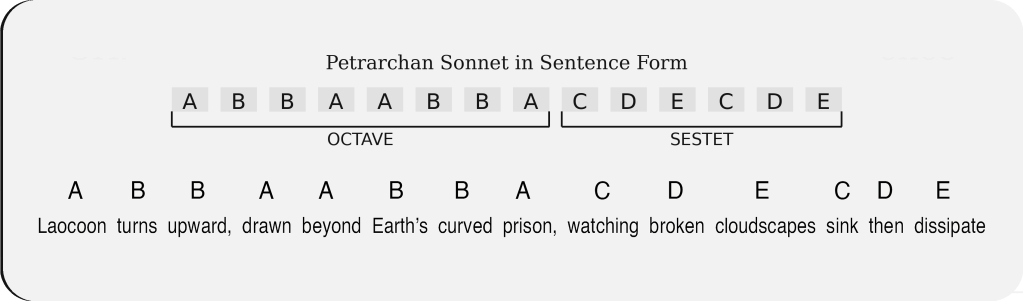
For the spine of the Chiastic Helix Sonnet, the most effective words are those that carry semantic or directional weight rather than merely grammatical function. Nouns and verbs are particularly strong because they anchor the structure in concrete images and actions, while prepositions and directional or temporal adverbs (such as then, upward, or beyond) help articulate movement through space or sequence. Adjectives can also work when they introduce meaningful qualities that sharpen the image or tension of the line. By contrast, articles, conjunctions, and most auxiliary verbs tend to weaken the spine because they primarily serve grammatical linkage rather than conceptual force.
Proper nouns require particular caution. Because they stand out so prominently, they should appear only when they carry clear symbolic or thematic importance within the poem. In the example shown, Laocoön appears at both the beginning of the spine and the final line of the poem, functioning as the only lexical outlier in the sequence. While the other thirteen spine words recur three times—once in the keystone sentence, once as a terminal word, and once as an initial word—Laocoön appears only twice, serving instead as the axis of return around which the helix rotates.
Before moving further, it is useful to examine the two pillars generated by the spine, which provide a visual guide to the structure. The right pillar lists the terminal words, while the left pillar lists the corresponding initial words that arise when the poem returns through the sequence. If you mentally connect each matching word across the two columns, the pattern reveals itself: the pairings trace an intersecting helical path through the poem, demonstrating how the terminal words of one movement become the initiating words of the next.
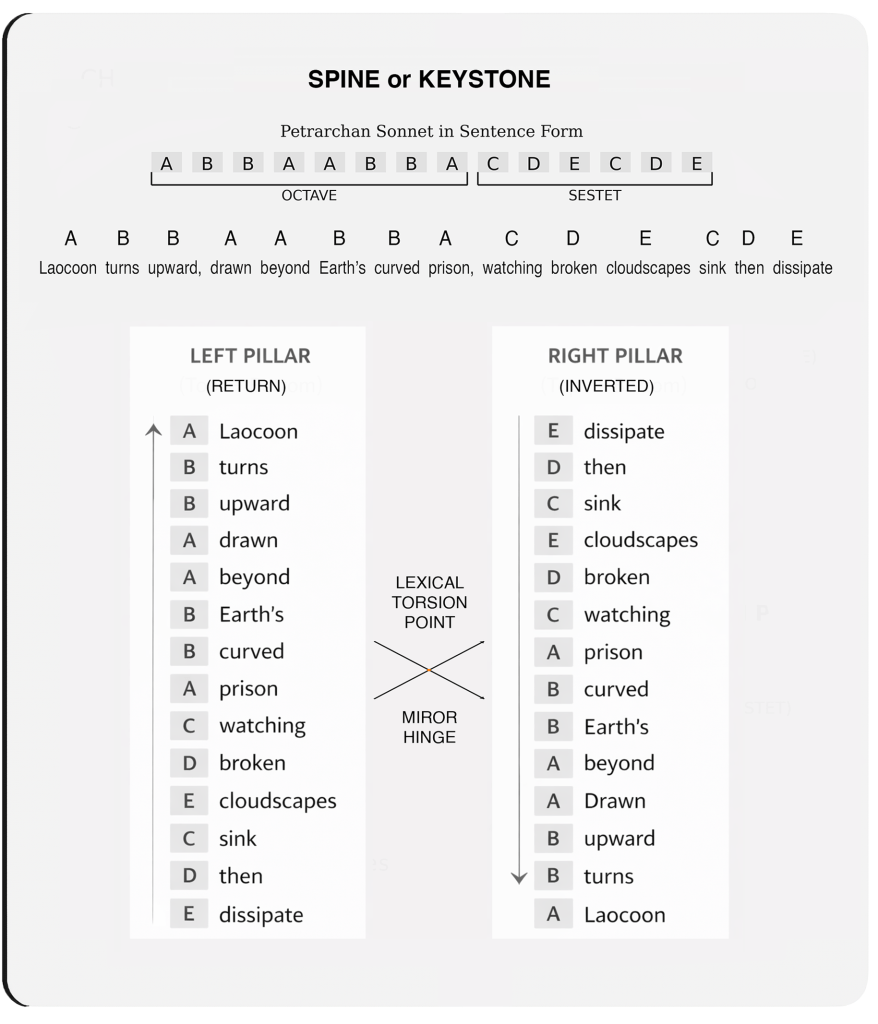
In practice, the spine should consist of words that can stand independently as meaningful units—objects, motions, relations, or qualities—so that each lexical point can bear the structural pressure of the helix without relying on surrounding syntax. Important note: so long as the word is contained within a plural or compound word, it can be used. Examples in the mirror hinge, or Lexical Torsion Point below: prison / prisoned and curved/serpent-curved. Other examples would be sink/sinking and Earth’s/Earth.
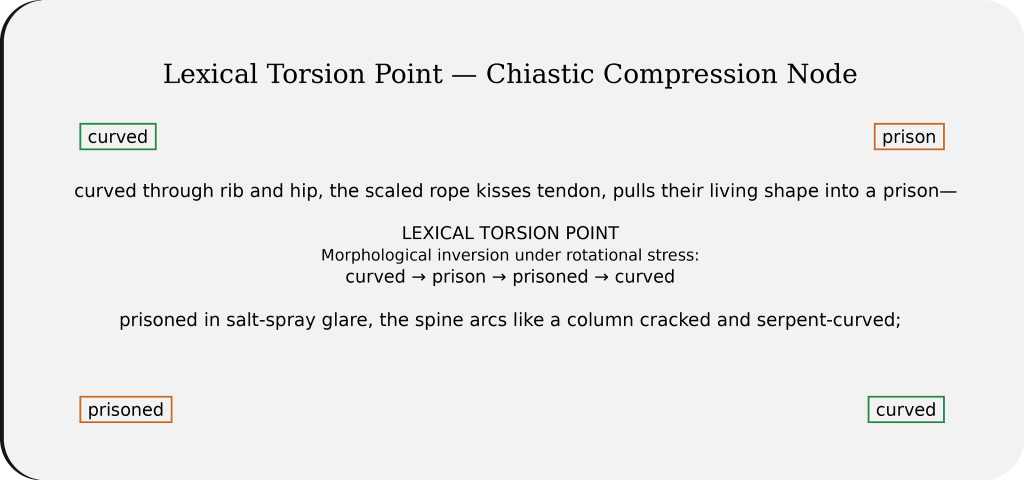
At the midpoint of the structure, the two circuits intersect at a Lexical Torsion Point—a structural pivot where the directional flow reverses. Unlike the traditional Petrarchan volta, which marks a shift in argument, this torsion point operates mechanically: the poem begins to fold back through its own framework, producing a recursive pattern of reflection. The most important words in the entire spine occur here—the final two terminal words of the octave (A and B of the sentence and left pillar octave, not the reversal). These become the form’s mirror hinge, because the second must transform morphologically into the first during the return sequence. Choosing this pair therefore determines the viability of the entire helix. In the example shown, curved and prison create the torsion pair, allowing the structure to rotate through curved → prison → prisoned → curved. If these words cannot sustain such inversion under lexical pressure, the rotational logic of the form collapses.
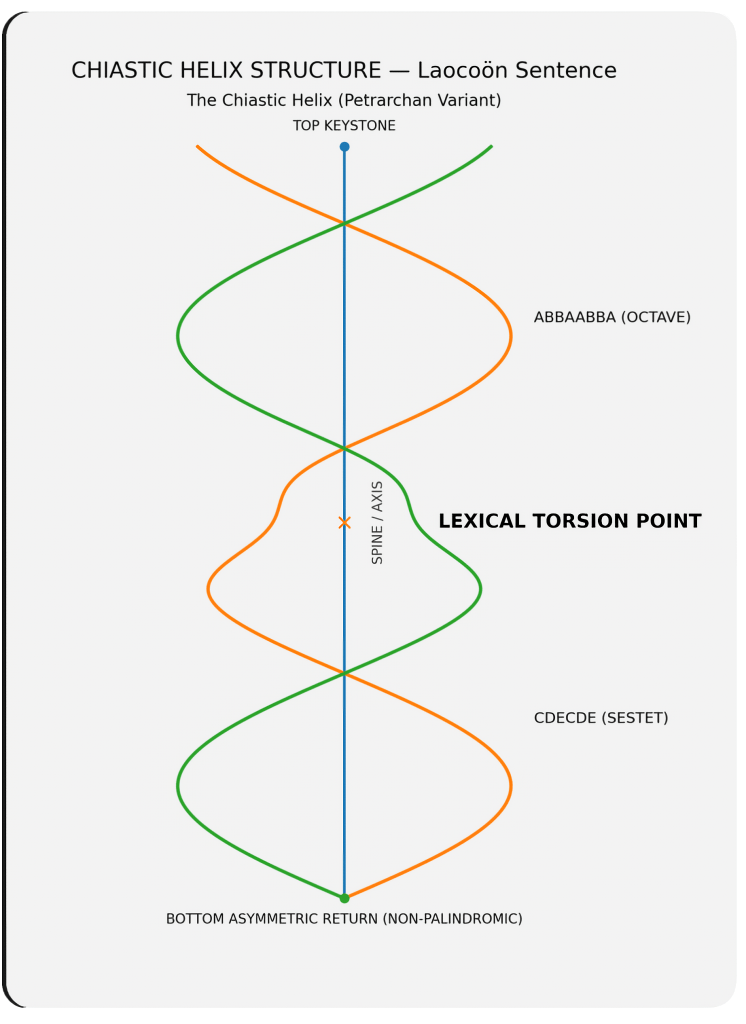
The resulting design resembles a linguistic double helix. Initial and terminal word sequences coil around a central axis, periodically crossing and reversing direction. Although the structure appears recursive, it is not a strict palindrome. The final lines break the circuit, producing an asymmetric closure that resembles an architectural arch: the structure mirrors itself around a central keystone but resolves unevenly at its base.
The form is typically written in loose accentual-iambic hexameter, whose longer line accommodates the rotating lexical constraints. Indentation can further reinforce the design by producing a visual spiral on the page, allowing the typography itself to echo the poem’s underlying helical structure. For a full technical discussion of the mechanics behind this form, see
the research link here.
FORMAL STRUCTURE
Mapped to: The First Coming (Canonical)
Duration: 14 structural lines (lineation is typographic, not formal)
Architecture: Flipped Petrarchan (Sestet → Octave) with mirrored return
Meter: Loose accentual-iambic hexameter
(long line to carry torque + recurrence)
Rhyme Scheme (Lexical Circuit):
Terminal-word sequence is the spine reversed:
EDCEDC ABBAABBA
(Note: rhyme is strict by terminal recurrence;
slant/near-rhyme permitted inside the circuit.)

Terminal Word Order (Right Pillar — Spine Reversed)
(1 — dissipate / 2 — then / 3 — sink / 4 — cloudscapes /
5 — broken / 6 — watching / 7 — prison / 8 — curved /
9 — Earth / 10 — beyond / 11 — drawn / 12 — upward /
13 — turns / 14 — Laocoön)
} This column preserves the spine in forward order.

Initial Word Order (Left Pillar — Forward Spine)
(1 — Laocoön / 2 — turns / 3 — upward / 4 — drawn /
5 — beyond / 6 — Earth / 7 — curved / 8 — prison /
9 — watching / 10 — broken / 11 — cloudscapes / 12 — sink /
13 — then / 14 — dissipate)
} The left pillar reconstructs the Petrarchan engine that the
  terminal sequence executes in reverse.

Initial Word Order (Left Pillar — Forward Petrarchan Return)
ABBAABBA CDECDE
(Visible as the “return” sequence generated by the spine’s forward momentum.)

Governing Mechanism:
Sonnet structure exists not as stanza breaks but as a rotational lexical system:
• Terminal words (right pillar) execute the circuit in reverse Petrarchan order.
• Initial words (left pillar) mirror the circuit as a forward Petrarchan order.
• Matching words across pillars form helical crossings (counter-clockwise rotation).

SECTION I — SESTET (Flipped Entry: EDCEDC | Lines 1–6)
(1 — dissipate / 2 — then / 3 — sink / 4 — cloudscapes /
 5 — broken / 6 — watching)
} The poem begins in the “back half” of Petrarchan logic:
  pressure arrives first.
} Cosmic drift / dissolution lead  the argument
  (dissipate / sink / cloudscapes).
} Witness posture is installed early (watching)
  rather than earned by development.

SECTION II — OCTAVE (Mirrored Return: ABBAABBA | Lines 7–14)
(7 — prison / 8 — curved / 9 — Earth / 10 — beyond /
11 — drawn / 12 — upward / 13 — turns / 14 — Laocoön)
} The octave is a mirror-field: the form “returns”
  into the canonical Petrarchan body.
} Earth / beyond / drawn / upward restore the vertical axis
  under tightened constraint.
} The closure is a proper-name seal: Laocoön stands
  as the axis of return (the lone lexical outlier).

LEXICAL TORSION POINT — Mirror Hinge (Midpoint of Circuit)
The decisive hinge occurs at the octave’s threshold,
where the mirror must hold under pressure:
• Two key hinge-words are the octave’s terminal pair (A and B);
  viability determines whether helix can rotate without collapsing.
• In The First Coming, the hinge is anchored by the torsion pairing:
  curved ↔ prison. Morphological / compound tolerance allowed:
  prison → prisoned; curved → serpent-curved.
} Unlike a Petrarchan volta (argument-turn), this is mechanical:
  the poem folds through its own lexicon.

FORMAL LINEATION — Helical Indentation
Lineation renders the poem’s torsion visible. Indentation increases
in fixed four-space increments until the poem reaches its point of
maximum rotational stress, after which the indentation reverses.
The lineation begins at the first indent of the spine at eight
spaces, increasing, then decreasing by four spaces thereafter.

8 → 12 → 16 → 20 → 24 → 28 → [32] → [36] →
32 → 28 → 24 → 20 → 16 → 12

[Lexical Torsion Point in brackets]

} Indentation expands outward until the hinge at 36.
} The apex line at 36 represents the maximum torsional extension.
} Immediately afterward the indentation reverses, producing the
  mirrored descent of the helix.
} Because the pivot coincides with the octave’s hinge words
  (curved / prison), the twist becomes visible on the page.

This geometric indentation is therefore not decorative but structural:
the page itself diagrams the poem’s rotational mechanics.

Structural Summary:
• Sonnet duration preserved within elongated line field
• Terminal-word rhyme establishes a closed lexical circuit
• Petrarchan progression reversed: sestet precedes returning octave
• Initial and terminal pillars generate helical crossings
• Torsion hinge is lexical rather than rhetorical
• Proper-name closure functions as axial return
• Rotational spine completes without epigrammatic resolution
The form of this poem arises directly from the physical logic of the Laocoön sculpture itself. The statue is defined by torsion: bodies twist against the constricting coils, limbs oppose one another across diagonals, and the entire composition organizes its energy around a central axis of strain. I wanted the poem to operate under the same mechanical pressure. The spine sentence carries the Petrarchan engine, but the decisive hinge occurs at the final pair of octave terms—curved and prison. Those words were chosen not simply for their semantic relevance, but because they can sustain torsion under morphological stress (prison → prisoned, curved → serpent-curved). At this Lexical Torsion Point the poem experiences its sharpest rotational force, echoing the moment in the sculpture where Laocoön’s body twists most violently against the serpents. In this sense the structure does not merely describe the statue; it attempts to reproduce its internal mechanics.
This decision also places the poem within a long tradition in which systems of opposition—mirroring, chiasmus, rotational balance—move easily between the visual and literary arts. Classical sculptural theory organized the body through counterbalanced forces, and literature has long adopted similar strategies through inversion and chiastic movement. Writing a rigorously structured sonnet about Laocoön is therefore deliberate: I am using the form itself to reenact the same principle of opposed motion embodied in the statue. There is an added historical irony here. The famous sculpture was created from Virgil’s account of Laocoön in the Aeneid, so the poem completes a kind of circuit in which text becomes sculpture and sculpture returns to text. Within the larger architecture of this project—alongside inverted sonnets, mirrored sonnets, and mirrored sestinas—the Chiastic Helix Sonnet extends my mirror-cosmology: the poem’s structure and its subject share the same rotational grammar, allowing form to function not as ornament but as the mechanism through which the poem thinks about the Laocoön.
The First Coming


Laocoon turns upward, drawn beyond Earth’s curved prison,
        watching broken cloudscapes sink, then dissipate—
turns the salt wind in his mouth metallic,
            the copper taste of prophecy held back; and then
upward snaps his spine in a white arc, breath splintering the ribs
                as the weight of heaven begins to sink
drawn like wire through stone, the body singing under torque,
                    a struck bell ringing into cloudscapes—
beyond carved pediment and horse-ribbed hull, the old sea-law
                        reasserts itself, paternal covenants broken,
Earth's grit in the teeth; the boys’ thin arms
                            wheel air too vast for any god watching—
curved through rib and hip, the scaled rope kisses tendon,
                                pulls their living shape into a prison—
prisoned in salt-spray glare, the spine arcs like a column
                                    cracked and serpent-curved;
watching his sons thin to shadow, he tastes salt and lime
                                in the wound and feels the pull of Earth.
Broken daylight gutters in the sockets;
                            even marble seems to lean and tilt beyond
cloudscapes blackened at the rims; the upper vault sags
                        heavy, every last bright margin drawn.
Sinking begins at the groin where lineage gathers,
                    a downward drag no mortal can lever upward
then the face hardens into something gods mistake for praise,
                the rictus tightening as agony turns
dissipate blood, dissipate lineage—marble cools
            around the twist and fixes the father, Laocoon.
The poem’s structure loosely echoes the narrative mechanics of the Laocoön episode as preserved in Virgil’s Aeneid. Because the sonnet operates as a flipped Petrarchan circuit (EDCEDC → ABBAABBA), the poem begins in a state of collapse rather than revelation, reflecting the Trojan moment when the deception of the wooden horse has already begun to unfold. Early imagery evokes the atmosphere of Virgil’s account—winds, sea, prophetic tension—before tightening around the figure of Laocoön himself. References such as the “horse-ribbed hull” recall the description of the horse in Aeneid II, whose ribbed beams conceal the Greek soldiers, while surrounding images of sea-law, prophecy, and watchful divinity echo the priest’s warning to the Trojans. In the epic, Laocoön hurls his spear into the horse’s flank, causing its hollow ribs to reverberate; the poem’s language (“drawn like wire through stone,” “a struck bell ringing”) gestures toward that moment of vibration and unease.
The episode later became fixed in the Hellenistic sculpture commonly known as Laocoön and His Sons, where the myth is staged through extreme bodily torsion: limbs oppose one another across a central axis as serpents coil through the figures. The poem’s indentation and lexical pairings offer a modest parallel to that visual tension. Near the center of the structure, the pairing curved and prison marks a hinge where the indentation pattern pivots and begins to reverse, suggesting—at least visually—the kind of twisting movement seen in the sculpture. Read this way, the poem forms a loose historical circuit between epic, sculpture, and verse: Virgil’s narrative produced the sculptural image, and the sculpture’s physical strain provides a suggestive model for the poem’s structural turn. The final return to the name Laocoön closes that circuit quietly, functioning less as a conventional rhyme than as a point of return.
DEEPER STRUCTURE
ENTRY SEQUENCE — Catastrophe Already in Motion
Film: Cold Open / Disaster Already Unfolding
Poetry: Flipped Petrarchan Entry (Sestet First)
The poem opens inside the collapse rather than before it.
Cosmic drift replaces exposition.
Terms like dissipate, sink, and cloudscapes signal
that dissolution precedes explanation.
This mirrors the Trojan moment in Virgil’s narrative:
the deception of the horse is already underway.
The structure therefore begins in aftermath
rather than premise.

WITNESS PHASE — Prophecy Under Pressure
Film: Rising Pressure / Warning Ignored
Poetry: Observational Escalation
Laocoön emerges as witness rather than hero.
Imagery draws from Virgil’s episode:
the ribbed structure of the Trojan horse,
the sea-law of the gods,
and the ignored prophetic warning.
The language thickens with atmosphere—
wind, metal, salt, stone—
suggesting the tightening field of divine pressure.
The poem’s long lines carry the torque
of the unfolding catastrophe.

LEXICAL TORSION — Mirror Hinge
Film: Structural Pivot / Physical Twist
Poetry: Mechanical Rotation (curved ↔ prison)
At the midpoint the poem reaches its torsion hinge.
The pairing curved and prison locks the circuit.
Here the poem’s lexical system twists back on itself,
mirroring the sculptural torsion of the Laocoön group.
This is not a rhetorical volta but a mechanical pivot:
the poem’s forward motion rotates into mirrored return.
The indentation apex and lexical hinge coincide,
making the twist visible on the page.

MIRRORED DESCENT — Return Through the Circuit
Film: Reversal / Consequences Unfold
Poetry: Petrarchan Return (Octave)
After the hinge, the poem retraces the circuit.
The lexical sequence now resolves toward origin.
Earth, beyond, drawn, and upward restore
the vertical axis that the catastrophe disrupted.
What had been cosmic drift tightens
into sculptural fixation.
The poem begins to move toward its final seal.

AXIS OF RETURN — Proper-Name Closure
Film: Freeze Frame / Mythic Image Fixed
Poetry: Structural Seal
The final word—Laocoön—does not function
as a conventional rhyme closure.
Instead it marks the completion of the circuit.
Because the terminal sequence is the spine reversed,
the poem ends at the point where the lexical engine began.
Narrative, sculpture, and form converge:
the twisting body becomes marble,
and the poem arrests motion at the axis of return.
I reach for the Chiastic Helix Sonnet when the story itself wants a hinge—when tension must accumulate toward a decisive torsion point and then return through consequence rather than “resolution.” Prophecy ignored, moral inversion, ritual punishment, martyrdom, catastrophic revelation: these subjects already contain a built-in twist, and the form lets me enact that twist as structure rather than explanation. Mythic and historical material is especially responsive because its meaning often depends on reversal—warnings dismissed, divine law reasserting itself, human arrogance exposed—so the helix doesn’t merely frame the narrative; it performs the conflict and return. The long line and strict lexical circuit also push me into a heightened, almost muscular approach to verse: I have to choose words that can bear load, torque, recurrence, and pivot without collapsing into filler.
The form’s strength is that it converts narrative tension into visible architecture. Because the hinge occurs lexically rather than rhetorically, the poem doesn’t just “turn” in argument; it rotates through its own language—spine, pillars, torsion pairing, and mirrored indentation making the page itself diagram the twist. That makes it unusually effective for poems about strain, transformation, structural irony, or inheritance: subjects where the turning is the meaning. But it also has clear limitations. Quiet meditation, associative drift, pastoral stillness, and purely linear narration tend to fight the mechanism; the circuit can feel like an imposed machine if the material doesn’t already contain a hinge. In other words: the helix rewards stories that already want to twist—where pressure becomes torsion, and where the only honest way forward is to return through the consequences of the turn.
PETRARCH AND THE LINEAGE OF THE CHIASTIC HELIX SONNET
Petrarch did more than popularize the sonnet; he revealed its underlying mechanism. By dividing the poem into an octave that accumulates pressure and a sestet that reclassifies that pressure, he created a compact engine for thought. The volta—the hinge between those two movements—became the structural heart of the form. What makes this invention remarkable is its flexibility: the sonnet can contain narrative, philosophical reflection, devotion, erotic longing, or political argument, yet the same pivot governs them all. The poem does not simply proceed; it turns.
As the form moved across Europe, later traditions adapted Petrarch’s architecture without abandoning its core logic. English poets such as Wyatt and Surrey modified the rhyme scheme to suit the language’s more limited rhyming resources; Shakespeare reorganized the structure into quatrains and a couplet; Milton stretched the sentence across the hinge; Hopkins compressed the architecture into the curtal sonnet. Yet beneath these transformations the same engine remained visible. Whether the hinge occurs at line nine or migrates elsewhere, the sonnet still derives its force from the moment when accumulated pressure must reorganize itself.
That durability is precisely why the Petrarchan model remains fertile ground for invention. Its power lies not in rhyme alone but in its capacity to embody turning—moments when perception shifts, when argument reverses, when the poem must reconsider its own premise. The Chiastic Helix Sonnet emerges from that same impulse. Instead of treating the hinge as a rhetorical turn, it converts it into a mechanical torsion point, allowing the poem to rotate through its own lexical structure. In that sense the helix does not abandon Petrarch’s discovery; it extends it—transforming the classical hinge into an architecture of rotation.
CANONICAL EXAMPLE
Francesco Petrarch — Canzoniere (Sonnet 90, excerpt)


Erano i capei d’oro a l’aura sparsi
che ’n mille dolci nodi gli avolgea,
e ’l vago lume oltra misura ardea
di quei begli occhi ch’or ne son sì scarsi;

Non era l’andar suo cosa mortale,
ma d’angelica forma...
In translation, Petrarch begins with a vision of Laura’s beauty diffused through atmosphere and light: her golden hair is loosened in the breeze, woven into “a thousand gentle knots,” while the radiance of her eyes burns beyond measure. The octave establishes an atmosphere of idealized perception. At the hinge, however, the poem reclassifies the scene. Laura’s movement is no longer merely human—“her walk was not of mortal thing, but of angelic form.” The turn does not simply add information; it alters the meaning of what came before. The beloved becomes less an earthly figure than a symbol of distance and transcendence.
This is the hinge in its most durable form: not merely a shift in tone, but a structural requirement that forces the poem to reorganize its own premises. The octave builds pressure; the sestet must answer it. For the Chiastic Helix Sonnet, that Petrarchan hinge becomes a design principle rather than a location. The helix preserves the idea that the poem must turn, but it transforms the turn into mechanical torsion. Instead of argument reversing direction, the poem rotates through its lexical circuit, creating a visible architecture of pressure and return.
VIRGIL AND NARRATIVE TORSION
If Petrarch provided the hinge that governs the sonnet tradition, Virgil supplied the narrative torsion that ultimately inspires the Chiastic Helix. In Book II of the Aeneid, the Trojan priest Laocoön warns his countrymen not to trust the wooden horse left by the Greeks. Suspicious of the offering, he hurls his spear into the structure, striking what Virgil describes as the horse’s hollow ribs. The weapon quivers inside the timber frame, producing a resonant shudder that momentarily reveals the deception concealed within.
The episode does not end with revelation but with punishment. From the sea rise two immense serpents, which coil around Laocoön and his sons, crushing and twisting their bodies in a spectacle of divine reprisal. The scene became one of the most famous images in classical literature and later in classical sculpture. The Hellenistic group known as Laocoön and His Sons freezes that moment of agony in marble: torsioned bodies, opposing diagonals, and serpentine coils crossing the figures’ central axis. The physical strain visible in the sculpture is the visual analogue of the narrative pressure already present in Virgil’s account.
CANONICAL EXAMPLE
Virgil — Aeneid, Book II (excerpt)


Laocoön, blazing with fury, hurled his spear
into the monster’s flank; it struck and quivered
deep in the horse’s hollow ribs.

From the sea then came two serpents,
their coils immense,
winding around the father and his sons.
Virgil’s episode therefore provides more than narrative background; it establishes a structural metaphor. The warning, the violent strike against the horse’s ribbed frame, and the subsequent constriction of serpentine coils all revolve around tension and twist. When the Laocoön story passed into sculpture, this torsion became physical architecture. The Chiastic Helix Sonnet translates that architecture back into language. The poem’s lexical circuit twists at its hinge just as the sculpted bodies twist under the serpents’ coils, converting Virgil’s narrative of prophetic tension into a visible rotational structure on the page.
GEORGE HERBERT AND VISUAL LINEATION
If Petrarch supplied the hinge mechanics of the sonnet and Virgil supplied the narrative torsion of the Laocoön episode, George Herbert demonstrated that the physical arrangement of lines on the page can itself embody meaning. Writing in the seventeenth century, Herbert composed a number of “pattern poems” in which typography becomes structural metaphor. In these poems the shape of the verse is not decorative but semantic: the visual form of the poem participates directly in the argument being made.
His most famous example, “Easter Wings,” compresses the lines inward and then expands them again across the page. The narrowing of the stanza represents humanity’s fall into weakness, while the subsequent widening enacts spiritual renewal. The poem therefore transforms the page into a diagram of descent and ascent. Herbert’s experiment shows that lineation can function as architecture rather than merely as layout.
CANONICAL EXAMPLE
George Herbert — “Easter Wings” (excerpt)

Lord, who createdst man in wealth and store,
Though foolishly he lost the same,
Decaying more and more,
Till he became
Most poor:

With thee
O let me rise
As larks, harmoniously,
And sing this day thy victories:
Then shall the fall further the flight in me.
The Chiastic Helix Sonnet inherits this principle but redirects it toward rotational rather than vertical motion. Instead of contraction and expansion, the poem’s indentation increases toward a torsion point and then reverses, creating the visible impression of a twisting axis. Herbert’s shaped verse demonstrates that typography can embody meaning; the helix extends that insight by turning indentation into structural torque, allowing the reader to see the moment where the poem’s lexical hinge begins to rotate.
THE SATOR SQUARE SONNET
The Sator Square Sonnet is a spatially engineered poetic form derived from the recursive logic of the classical Sator word square but translated into a system operating at the level of words, lineation, and thematic pressure rather than individual letters. Although it retains the traditional sonnet’s fourteen-line duration, its governing mechanics are largely concealed within the poem’s architecture. The familiar Shakespearean rhyme scheme persists as an embedded mechanism rather than a visible organizing principle, occurring internally at fixed lexical positions rather than at the line endings. In this sense, the sonnet survives not as an overt scaffold but as a structural engine operating beneath the surface of the text.
What distinguishes this form most clearly is its simultaneous commitment to containment and motion. The poem is conceived as a square enclosure defined by reciprocal semantic-palindrome “envelope spines,” within which a cruciform rotational axis organizes thematic and kinetic progression. Rather than relying on a single rhetorical turn or volta, development unfolds spatially through the reader’s traversal of pressure zones distributed across the poem’s quadrants. The result is a form that treats narrative not as a linear argument but as a patterned passage through successive states of tension.
FORMAL STRUCTURE
Mapped to: Eight Seconds in Nowata (Canonical)
Duration: One sonnet (14 lines total)
Architecture: Square enclosure + cruciform axis + four pressure quadrants
Meter: Accentual hexameter (≈ 6 stresses per line; syllable count variable)
Terminal Word Order: Semantic-palindrome envelope spines govern recurrence

Upper Envelope Spine:
       } Appears horizontally across Line 1
       } Reappears vertically through the initial-word column
       } Recovers in reverse through the terminal-word column
       } Establishes the upper containment boundary

Lower Envelope Spine:
       } Appears horizontally across Line 14
       } Functions as semantic palindrome of the upper spine
       } Reiterates structurally along terminal-word sequences
       } Completes the enclosure of the field

Shakespearean Engine — Internally Embedded:
ABAB CDCD EFEF GG
       } Operates at fixed lexical positions within lines
       } Not displayed as terminal rhyme pattern
       } Provides latent recurrence at the structural hinge

Quadrant Field — Pressure Distribution:
Q I     } Psychic anticipation / orientation
Q II    } Social exposure / spectacle
Q III   } Spiritual reckoning / interiorization
Q IV    } Physical force / consequence

Movement Principle:
Progression occurs as a Z-shaped traversal across quadrants.
Direction is linear; return is architectural.

Note: The ABABCDCDEFEFGG rhyme scheme operates internally.
ABAB
CDCD   }  OCTAVE (Lines 1–8)
       }  Exposition / Initial State
       }  Premise introduced; governing tension established
       }  Inciting pressure emerges (often in ABAB)
       }  First reinforcement of stakes in CDCD
       }  Equilibrium begins to destabilize

EFEF   }  THIRD QUATRAIN (Lines 9–12)
       }  Development / Escalation
       }  Counter-forces enter; trajectory becomes directional
       }  Pressure intensifies toward structural hinge
       }  Volta may occur at Line 9

GG     }  COUPLET (Lines 13–14)
       }  Climax or decisive threshold
       }  Compression of consequence
       }  Judgment implied rather than resolved
       }  Closure remains provisional

Structural Summary:
• Square containment governs all directional movement
• Semantic-palindrome envelope installs irreversible enclosure
• Shakespearean adjudication operates as latent internal engine
• Quadrant traversal distributes pressure across psychic,
  social, spiritual, and physical fields
• Linear progression produces consequence;
  architectural return restores structure
• Cruciform axis stabilizes recurrence at multiple scales
• Closure seals the field without resolving its force
When constructing the envelope spine, the poet should privilege structurally active parts of speech—verbs, nouns, temporal adverbs, and prepositions—while minimizing reliance on articles and conjunctions unless their repetition can be meaningfully absorbed into the lattice. Proper names are generally avoided, since the spine will recur in multiple directional states; however, they may be used when thematically unavoidable, as demonstrated in earlier work. Most importantly, the sequence must sustain full poetic coherence when reversed to form its semantic palindrome. The spine is not merely a lexical constraint but the governing semantic boundary of the poem’s containment field.
BUILDING THE SPINE — Semantic Palindrome
Once gates break, riders hold breaths; fear crowds the blood, quickens mercy before silence.

Silence before mercy quickens blood: the crowds fear, breaths hold, riders break gates once.
At its most visible level, the Sator Square Sonnet establishes a rectangular field defined by two reciprocal envelope spines. These semantic palindromes function as the poem’s structural borders, appearing in multiple directional states: horizontally across the opening and closing lines, vertically through columns of initial or terminal words, and in reverse orientation recovered through upward reading sequences. Through these reiterations, the poem becomes a fully enclosed linguistic container. Motion cannot escape the lattice; it must circulate within it.
BUILDING THE FRAME
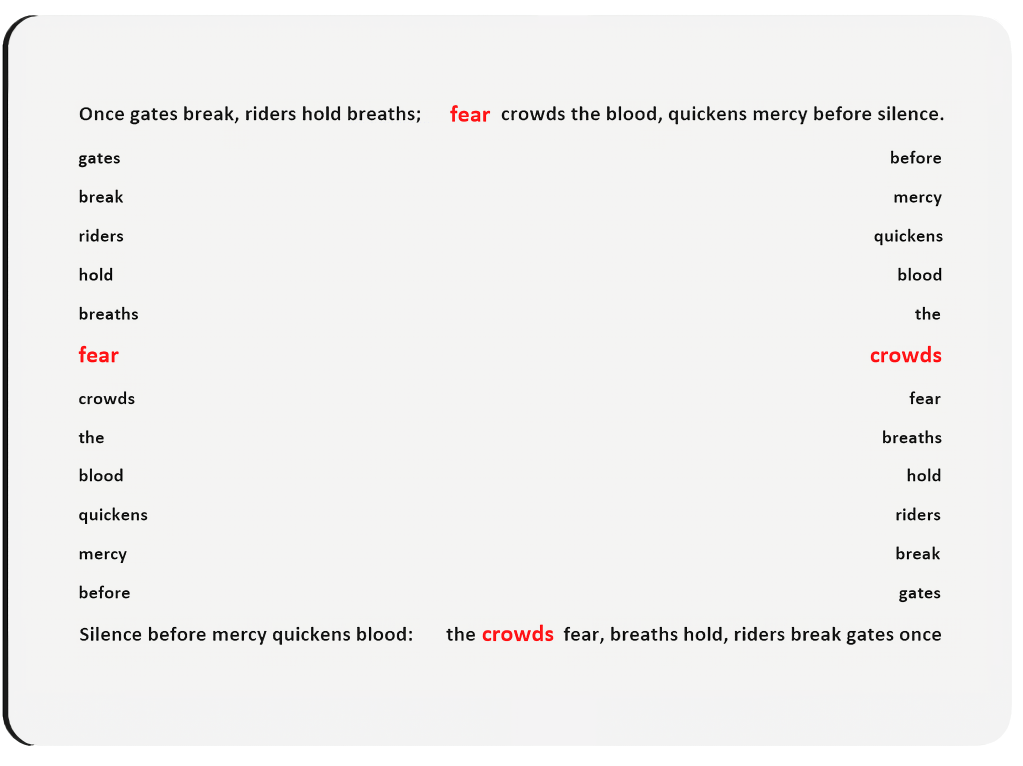
Within this enclosure emerges a rotational axis generated by hinge-words produced through the interaction of the spines. This axis is legible only once in straightforward sequence, while its vertical descent remains concealed within the poem’s internal Shakespearean rhyme structure.
BUILDING THE ROTATIONAL AXIS
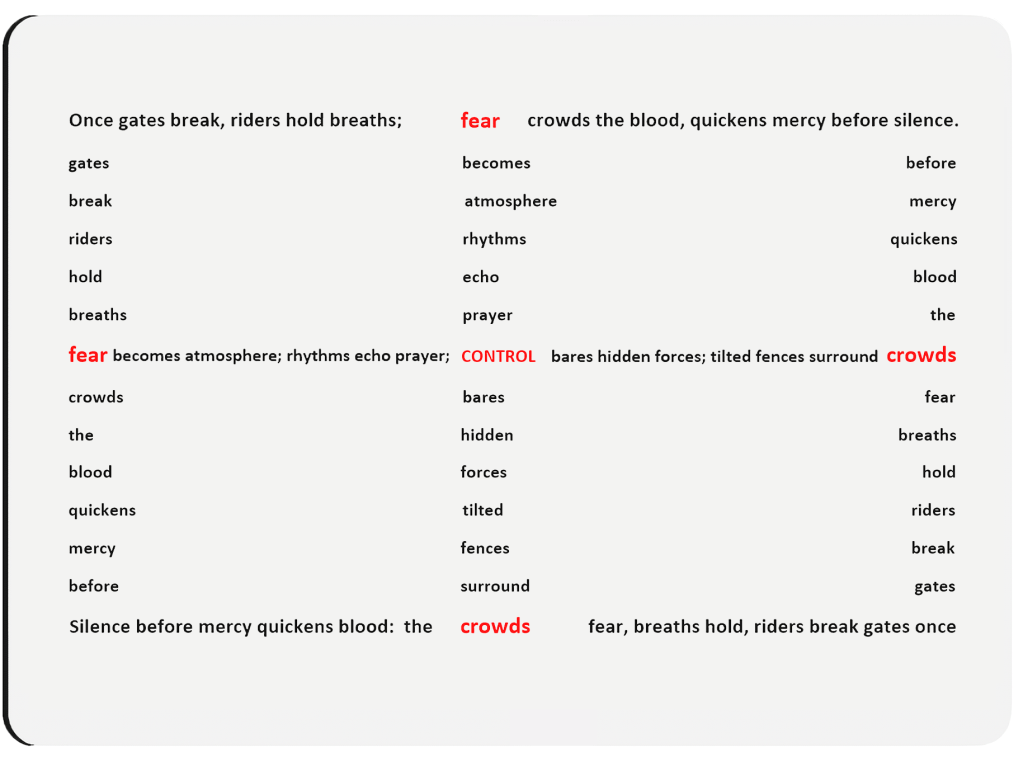
The quadrants formed by the intersecting axes distribute thematic pressure across four experiential domains — psychic, social, spiritual, and physical — allowing the poem’s development to occur cumulatively rather than through a single overt turn. The structure therefore behaves less like an argumentative sonnet and more like a ritual passage in which meaning accrues through spatial progression.
BUILDING THE QUADRANTS
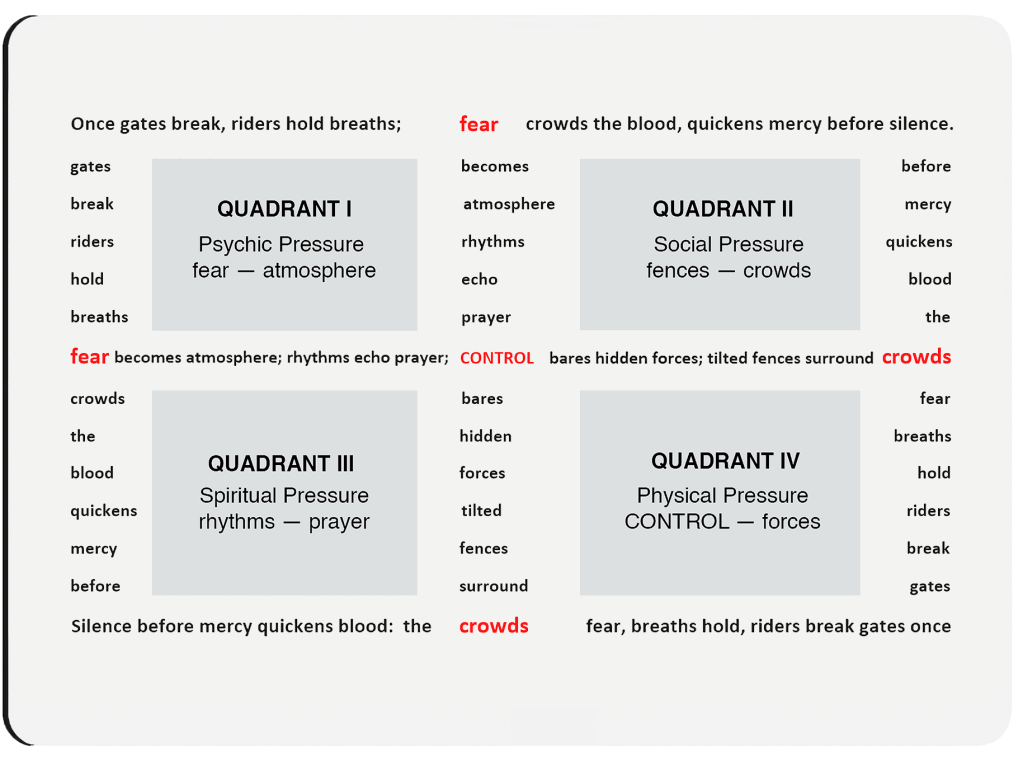
In Eight Seconds in Nowata, the form’s spatial grammar becomes directly tied to the choreography of a bull ride. The poem maps the rider’s passage through the arena as a Z-shaped trajectory moving across successive pressure fields. The opening quadrant establishes psychic anticipation at the chute, where fear is internalized as atmosphere and rhythm. As the ride begins, this inward tension is externalized within the second quadrant as spectacle before the crowd, introducing social pressure alongside mechanical violence. The third quadrant intensifies the struggle through rotational instability, mirroring the oscillation between displacement and recovery that characterizes the rider’s attempt to maintain equilibrium along the bull’s spine. Finally, the fourth quadrant resolves into physical reckoning, where the cumulative pressures of torque, exhaustion, and temporal threshold converge. The governing axial word — control — functions as both thematic fulcrum and structural necessity, binding these transitions into a recursive loop. Regardless of whether the rider succeeds or is thrown, the system resets: the bull returns to the gate, another rider steps forward, and the pattern recommences.
Eight Seconds in Nowata
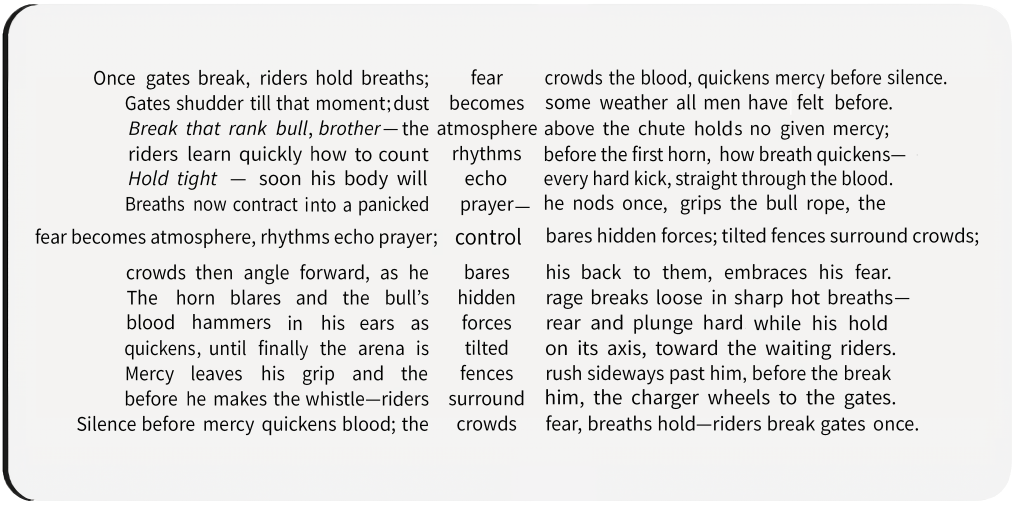
As discussed on the research page, these quadrants function much like the subliminal Shakespearean spine: they operate beneath the reader’s conscious awareness, and I am not suggesting that they must stand as independent lyric units. However, for those who feel compelled to distill them into provisional mini-poems, the earlier lineated version provides a useful point of departure. The lineation itself is not ornamental but mimetic. Its rectangular disposition deliberately echoes the physical layout of the rodeo grounds — rails, gates, chute, and open dirt ring translated into a field of staggered verbal movement. To alter that visual architecture is to weaken the poem’s governing premise, since in this form spatial arrangement is not merely presentation but meaning.
The derivation of these quadrant-verses is therefore not mechanically fixed, but neither is it arbitrary. At times I draw directly from the axiomatic vocabulary of the rotational spine; at other moments I suspend those terms in order to preserve local clarity or tonal continuity within a given pressure zone. This latitude is governed by structural obligation rather than preference. If an axial word is deferred in one quadrant, it must be recovered elsewhere. In this sense, lexical force behaves like the rider’s balance: it shifts, compensates, and redistributes, but it cannot simply vanish. The poem’s lineation records this continual negotiation, allowing the reader to perceive movement across the page as an analogue to movement across the arena.
It is also important to emphasize that this procedure is diagnostic rather than essential. The quadrants are not presented as autonomous poems but remain largely latent within the finished architecture, much as the geometry of the arena recedes once the ride begins. Their function is to help the poet test whether the lattice can sustain multiple trajectories of meaning without compromising its internal logic. In all lineated poetry — and especially in forms such as this — structure is not a neutral container for content. The structure is the content’s kinetic expression. Preserving the prescribed format therefore preserves the poem’s conceptual integrity, ensuring that the reader encounters not only a narrative of pressure but the visible mechanics through which that pressure is organized and endured.
Quadrant I
Once gates break, riders hold breaths;
Gates shudder till that moment.
Break that rank bull, brother—
riders learn quickly how to count rhythms.
Hold tight now— soon his body will echo
breaths, now contract into a panicked prayer;
fear becomes atmosphere, rhythms echo prayer.

Quadrant II
Fear crowds the blood, quickens mercy before silence—
dust becomes some weather all men have felt before:
the atmosphere above the chute holds no given mercy.
Before the horn, how breath quickens—
every hard kick, straight through the blood.
He nods once, grips the bull rope.
Control bares hidden forces; tilted fences surround crowds.

Quadrant III
Fear becomes atmosphere, rhythms echo prayer;
crowds then angle forward,
the horn blares and the bull’s
blood hammers in his ears,
quickens—until finally the arena is tilted.
Mercy leaves his grip
before he can make the whistle—
silence before mercy quickens blood

Quadrant IV
He bares his back to them, embraces his fear.
The bull’s hidden rage breaks loose in sharp hot breaths—
forces rear and plunge hard, while his hold
is tilted on its axis, toward the waiting riders,
the fences rush sideways past him, before the break
riders surround him, the charger wheels to the gates.
The crowds fear, breaths hold—riders break gates once.
The Sator Square Sonnet did not begin as an abstract formal proposal so much as a delayed recognition of pattern within lived experience. As a child I attended rodeos in rural Kansas — evenings that were equal parts spectacle, danger, dust, and exhilaration. People went to be entertained, to cheer, to test their nerve against something larger than themselves. Yet beneath the laughter and concession-stand glow, the event was governed by strict limits of time and space. A bull ride lasted eight seconds. The action unfolded within the rails and gates of a rectangular arena. Even then, it felt less like chaos than like a performance staged inside an invisible system of pressure.
Only years later did this memory resolve into formal insight. The ride behaved like a sonnet in motion: it possessed a discernible beginning, escalation, and provisional ending, while remaining fundamentally cyclical. One rider dismounted or was thrown, the bull returned to the gate, and the sequence began again. At the same time, a long-standing fascination with recursive linguistic systems — particularly the Sator Square — offered a conceptual model for translating this kinetic spectacle into poetic architecture. Attempts to construct a fully palindromic poetic structure had repeatedly stalled; extended syntax resists perfect reversal. The solution was therefore analogical rather than literal. By adapting the square’s logic of bidirectional containment and intersecting axes, it became possible to design a form capable of sustaining rotation, recurrence, and thematic inevitability without requiring strict palindrome at every level of language.
DEEPER STRUCTURE
STRUCTURAL ENTRY — Containment Activated
Lines 1–2 establish engineered pressure.
Gates, rails, and breath create a procedural environment
in which catastrophe is already scheduled.
The arena functions as architectural fate rather than setting.

RITUAL INSTRUCTION — Apprenticeship in Violence
Lines 3–4 introduce learned behavior.
Imperative speech (“Break,” “Hold”) frames the ride
as transmitted knowledge rather than spontaneous action.
Time becomes measurable through rhythm and counting.

ATMOSPHERIC TRANSFERENCE — Interior Fear Externalized
Lines 5–6 convert psychic tension into environment.
Dust, weather, and breath collapse bodily sensation
into shared atmospheric condition.
Private fear begins to circulate socially.

AXIAL CONTACT — System Engages the Body
Line 7 introduces the governing hinge: control.
Hidden forces emerge as structural reality.
The rider’s grip becomes the poem’s mechanical fulcrum.

ROTATIONAL ESCALATION — Torque and Disorientation
Lines 8–10 enact directional instability.
Tilt, plunge, and recoil generate the poem’s kinetic grammar.
Language begins to echo itself,
signaling recursive motion within the containment field.

THRESHOLD APPROACH — Temporal Limit Tightens
Lines 11–12 compress duration toward crisis.
Mercy and silence exchange structural positions,
marking the nearing of the eight-second boundary.
Spatial perception fractures under accumulated force.

RECURSIVE SEAL — System Resets
Lines 13–14 complete the semantic circuit.
The rider’s ordeal resolves not into victory or defeat
but into patterned return.
Crowd, gate, breath, and fear realign,
restoring the arena’s ritual sequence for the next descent.
At its most visible level, the Sator Square Sonnet establishes a rectangular field defined by two reciprocal envelope spines. These semantic palindromes function as the poem’s structural borders, appearing in multiple directional states: horizontally across the opening and closing lines, vertically through columns of initial or terminal words, and in reverse orientation recovered through upward reading sequences. Through these reiterations, the poem becomes a fully enclosed linguistic container. Motion cannot escape the lattice; it must circulate within it. Within this enclosure emerges a rotational axis generated by hinge-words produced through the interaction of the spines. This axis is legible only once in straightforward sequence, while its vertical descent remains concealed within the poem’s internal Shakespearean rhyme structure. The quadrants formed by the intersecting axes distribute thematic pressure across four experiential domains — psychic, social, spiritual, and physical — allowing the poem’s development to occur cumulatively rather than through a single overt turn. The structure therefore behaves less like an argumentative sonnet and more like a ritual passage in which meaning accrues through spatial progression.
The Sator Square Sonnet is particularly well suited to narratives defined by bounded space, ritual repetition, and escalating pressure. Stories involving rites of passage, endurance contests, initiatory ordeals, or moral trials naturally align with its architectonic demands. Such subjects benefit from a structure capable of rendering simultaneity — the coexistence of internal fear, public scrutiny, spiritual invocation, and bodily exertion — while maintaining a disciplined sense of progression toward a decisive threshold.
More broadly, the form favors narratives in which movement appears linear but is revealed to be cyclical upon closer inspection. Experiences that recur across generations, professions, or cultural rituals can be effectively shaped within its recursive lattice. Because the structure requires both containment and rotation, it thrives on material possessing inherent structural gravity: events measured against time limits, spatial constraints, or irreversible consequences. Wherever human action unfolds within a system that both compels forward motion and guarantees return, the Sator Square Sonnet offers a rigorous means of transforming experience into formal inevitability.
CANONICAL PATTERN POEM
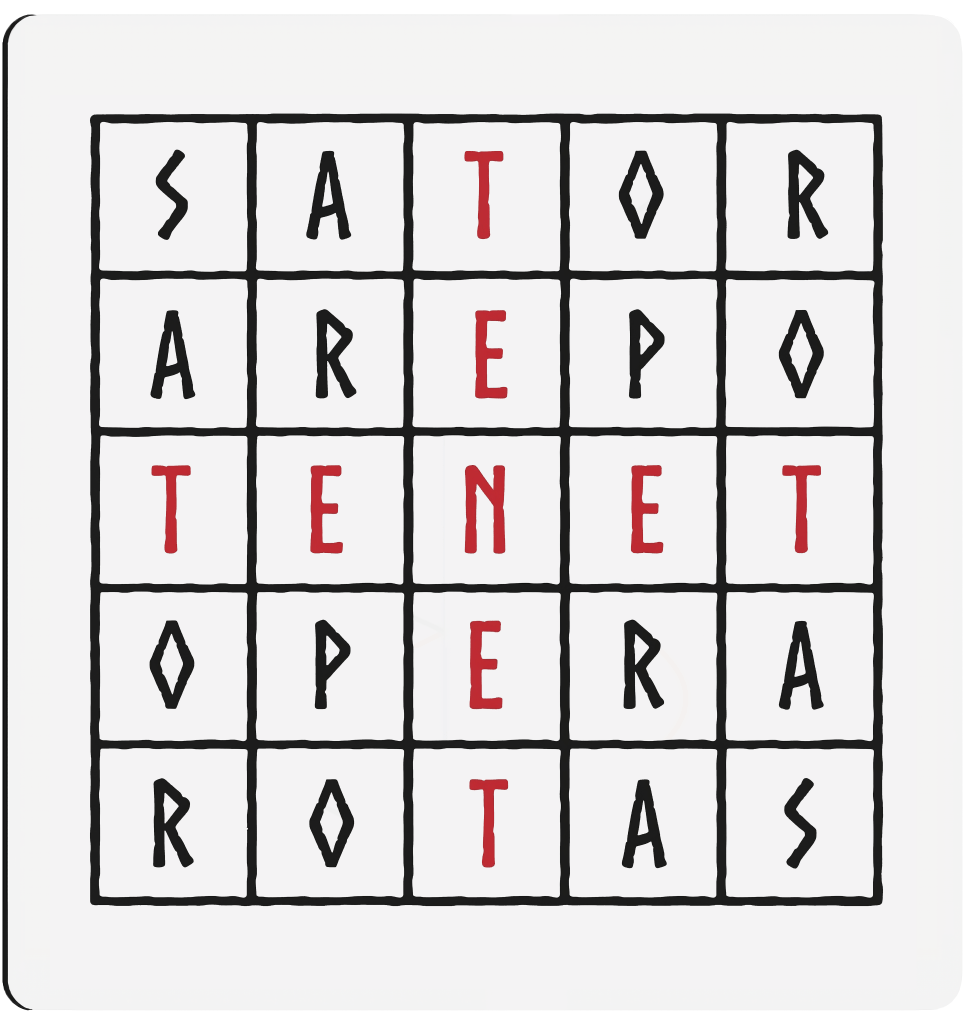
The Sator Square is a five-word Latin word square whose sequence may be read in multiple directions while remaining structurally intact, making it one of the most enduring examples of recursive linguistic design. Its significance lies not only in its reversibility but in its architectonic logic: language is fixed within a grid that simultaneously contains movement and generates it. For that reason, the square serves less as a mere palindrome than as a model of formal inevitability, in which repetition, crossing, and return are built into the structure itself.
First attested in the archaeological record of the early Roman Empire — most famously in the graffiti preserved at Pompeii — the square appears to have circulated widely across late antiquity and the medieval world, acquiring devotional, magical, and symbolic interpretations. Its durability is striking: unlike many textual artifacts that depend upon semantic clarity or narrative content, the Sator Square persists because its power is fundamentally structural. The reader encounters not simply a statement but a system — a self-contained linguistic mechanism that compels recognition through pattern rather than persuasion.
Over time, scholars and readers have repeatedly extracted secondary geometries from the square’s lattice. The most famous of these is the hidden PATER NOSTER cross configuration, in which the letters of the grid reorganize themselves into intersecting vertical and horizontal sequences centered upon the word TENET. Such reinterpretations reveal that the square operates not as a single linear text but as a field of latent pathways. Meaning emerges through traversal, recombination, and return. In this sense, the Sator Square anticipates later architectonic poetics by demonstrating that language can be engineered to behave like spatial structure — capable of rotation, inversion, and recursive closure within a finite frame.
LINEAGE OF THE SATOR SQUARE SONNET: PATTERN POEMS AND RECURSIVE LATTICES
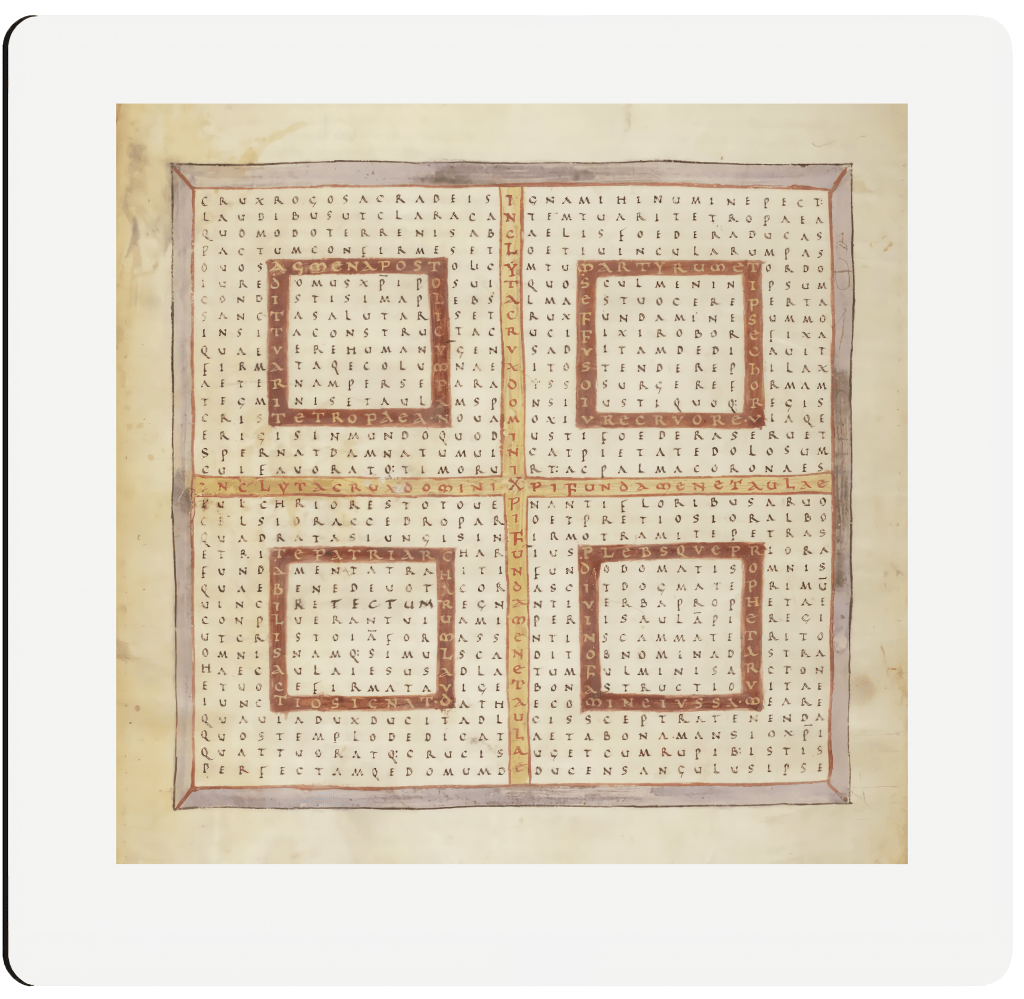
Pattern poetry — sometimes called shaped verse, visual poetry, or technopaegnia — represents one of the oldest impulses in literary design: the desire to make language inhabit space. Long before modern experiments in visual poetics, writers and scribes were arranging words into grids, spirals, crosses, and other architectonic configurations that required the reader not merely to follow a line of syntax but to traverse a constructed field. These works demonstrate that poetic meaning can emerge not only from diction and rhythm but from spatial disposition itself. The poem becomes both text and diagram — an event unfolding across a surface rather than solely across time.
Early precedents for such thinking may be found in ancient inscribed artifacts like the Phaistos Disc, whose circular sequencing of stamped symbols suggests a ritualized or recursive reading practice. Although its exact linguistic status remains debated, the disc nonetheless exemplifies the principle that language can be organized according to geometric logic. Classical Greek technopaegnia — including altar-shaped or wing-shaped poems — further developed this spatial consciousness by aligning semantic content with visual form. In these works, pattern does not merely decorate meaning; it conditions how meaning is encountered.
By the early medieval period, pattern poetry achieved extraordinary sophistication in the De laudibus sanctae crucis. of Rabanus Maurus, particularly in the cycle De laudibus sanctae crucis (see image above), which is identical in structure to my own framework for Eight Seconds in Nowata. Here the page becomes a densely structured lattice in which letters function simultaneously as linear text and as components of a larger geometric image. Crosses, grids, and nested shapes generate multiple reading pathways, encouraging the reader to perceive the poem as an integrated visual-theological system. Such works demonstrate that recursive patterning can operate across several scales at once — lexical, graphic, symbolic — anticipating later experiments in architectonic poetics.
Modern and contemporary poets continue to explore these principles in diverse ways, from the typographic constellations of concrete poetry to digital and algorithmic compositions that foreground recursion, permutation, and spatial constraint. What unites these traditions is the recognition that poetic form can function as an operational structure — a set of pressures and possibilities rather than a static container. The Sator Square Sonnet participates in this lineage by translating the logic of patterned lattices into a kinetic narrative framework. It treats the poem not as a linear utterance but as a navigable system in which containment, rotation, and return generate meaning through movement.
INVENTED SESTINA FORMS
Because the sestina is governed less by meter or stanzaic proportion than by a fixed rotational sequence of terminal words, it admits fewer convincing variants than the sonnet. Poets may alter line length, tonal register, or the handling of the envoi while preserving the form’s recognizability, but more substantial modifications often require intervening at the level of recurrence itself. As a result, sestina innovation tends to be structurally consequential rather than cosmetic. Where sonnet variants frequently reshape rhetorical pacing or stanzaic balance, sestina variants test the durability of the rotational engine that produces semantic drift, delayed recognition, and recursive pressure. In many cases such experiments remain clearly within the form; in others they generate new recurrence-based architectures that derive from, rather than simply modify, sestinal logic. For these reasons, my own variations within the form are intentionally limited to the Mirrored Sestina and the Sestonnet, the latter adapting sestinal recurrence within the adjudicative framework of the sonnet.
THE MIRRORED SESTINA
The mirrored sestina is a six-stanza structure that preserves the classical rotational pattern of terminal words while introducing a hinge at the fourth sixain that inverts interpretive authority. It does not merely repeat; it reclassifies. The first three sixains establish a governing premise; the fourth initiates reversal; the final two complete that inversion without altering the lexical sequence. The result is a recursive design in which progression occurs through structural reorientation rather than expansion.
The form emerged not from abstraction but from sustained engagement with recursive systems. While immersed in a long sonnet cycle and in Roman historiography—Caesar, Suetonius, Plutarch—I found the sestina’s rotational logic congenial to Greco-Roman material. Yet simple rotation proved insufficient. Influences as varied as Bach’s canonic structures, Escher’s visual paradoxes, Lewis Carroll’s mirror logic, and Hofstadter’s analysis of self-referential systems in Gödel, Escher, Bach clarified the deeper aim: a design that advances while encoding its own reversal. The objective was not ornament but engineered return.
Musical analogues sharpened this intuition. In Britten’s Passacaglia from Peter Grimes, a fixed ground bass supports escalating psychological tension; the pattern remains constant while affect intensifies. Górecki’s Symphony No. 3 achieves similar force through austere repetition and incremental variation. In both cases, recurrence generates deepening rather than release. The mirrored sestina seeks comparable conditions in language: intensification without lexical proliferation. For that reason, it cannot accommodate an envoi. The traditional sestina gathers its terminal words into final compression; the mirrored structure must refuse that seal. Closure would interrupt symmetry. Instead, the poem reaches a pivot sixain and proceeds under reversed authority, preserving rotation while altering semantic charge. Meaning is not replaced but recontextualized.
In Filum Sicarii, the myth of Theseus and the Minotaur required precisely such a design. The poem needed to behave like a labyrinth rather than a linear narrative: a path that appears to move outward while folding back toward origin. The thread ceases to guarantee escape; the sword ceases to confer moral clarity. By formalizing inversion within rotation, the mirrored sestina renders myth as recursive mechanism. What follows outlines that schema before presenting the poem itself, demonstrating how the design performs the narrative rather than merely recounting it.
FORMAL STRUCTURE
Mapped to: Filum Sicarii (Canonized)
Duration: 36 lines
Architecture:
Six Sixains (I–III Establishment / IV Mirror Pivot / V–VI Inversion) — No Envoi
Meter: Predominantly Iambic Pentameter (with substitutions)
Terminal Word Order:
1 2 3 4 5 6 (strict rotational permutation across six stanzas)

1(sword)   2(cave)   3(beast)  4(shadow)  5(thread)  6(weaves)
                         }  STANZA 1 (Sixain 1)
                         }  Exposition / Initial State
                         }  Mythic Field Established (Labyrinth / Pasiphaë)
                         }  Catalytic Condition Introduced

6(weaves)  1(sword)   5(thread) 2(cave)   4(shadow)  3(beast)
                         }  STANZA 2 (Sixain 2)
                         }  Rising Action
                         }  Thread and Sword Enter Active Motion
                         }  Pinch Point 1 (Pressure Reinforced)

3(beast)   6(weaves)  4(shadow) 1(sword)  2(cave)    5(thread)
                         }  STANZA 3 (Sixain 3)
                         }  Development
                         }  Identity Begins to Blur (Theseus / Beast)
                         }  Semantic Drift Through Repetition
                         }  Stakes Deepen

5(thread)  3(beast)   2(cave)   6(weaves) 1(sword)   4(shadow)
                         }  STANZA 4 (Sixain 4) — The Pivot Sixain
                         }  Midpoint / Reversal Zone
                         }  Convergence of Hero and Monster
                         }  Possible Volta
                         }  Structural Tension Intensifies

4(shadow)  5(thread)  1(sword)  3(beast)  6(weaves)  2(cave)
                         }  STANZA 5 (Sixain 5)
                         }  Escalation / Pinch Point 2
                         }  Fate and Violence Intertwine
                         }  Pressure Reinforced at Maximum Weight

2(cave)    4(shadow)  6(weaves) 5(thread) 3(beast)   1(sword)
                         }  STANZA 6 (Sixain 6)
                         }  Pre-Climax / Compression
                         }  Full Circuit Completed
                         }  Inevitability Revealed
The mirror pivot sixain—the fourth stanza in a mirrored sestina—functions as the structural hinge at which the poem’s governing assumptions begin to reverse. In a classical sestina, Sixain IV often marks a midpoint or tonal shift. In the mirrored variant, it initiates formal inversion: the lexical rotation remains intact, but the authority behind it changes.
In a traditional sestina, the envoi gathers the six terminal words into a final compression—offering summation, adjudication, and closure. In a mirrored sestina, that kind of closure would undermine the governing principle. The mirror pivot already initiates reversal, and Sixains V and VI complete the inversion structurally. An envoi would reassert authorial control, impose epigrammatic judgment, and artificially seal what the architecture has deliberately unsettled. Instead, the poem ends on structural inevitability: the final sixain completes the rotational circuit and leaves the reader inside the inversion. The adjudication is embedded in the design itself. The classical sestina gathers its words; the mirrored sestina exposes them. The absence of an envoi is not omission—it is intention.
Filum Sicarii


Queen Pasiphaë is redeemed by the sword
when she hears her child’s echo in the cave—
not unlike her shrieks in the wooden beast
when she braced under the white bull’s shadow.
Now, justly induced by her daughter’s thread
and hand, her bastard son’s assassin weaves

in and out of the labyrinth, he weaves
more deftly than a needle with his sword,
piercing the darkness at each turn, the thread
leading his hands to the mouth of the cave—
soon Theseus will emerge, his shadow
reconfigured in the light, and the beast

now a story upon his lips, the beast
reduced to a tapestry that he weaves
from the edge of his unraveling shadow.
Yet still its blood is hot upon his sword
as he is running blindly through the cave,
his left palm scorched by Ariadne’s thread.

         ———————————————

His left palm burns from Ariadne’s thread
as he is running blindly through the cave
to draw its blood, hot upon his sword,
and join the remnants of his own shadow.
Reduced to a tapestry he later weaves,
a story brimming on his lips, the beast

is reconfigured in his mind: the beast
and Theseus will converge, their shadows
reeling back and forth within the cave,
facing darkness at each turn, the thread
then deftly wending under hoof and sword
along the labyrinth’s edge. He weaves

through night, the bastard son’s assassin weaves
fatefully led by Ariadne’s thread,
he lunges under the minotaur’s shadow
as Pasiphaë once braced under Daedalus’ beast.
She hears her child’s echo in the cave:
Queen Pasiphaë is redeemed by the sword.
— Filum Sicarii, Mythos (Hallucinations)
This narrative structure is unusual because it fuses mythic storytelling with strict architectural recursion. Classical models—Freytag, the three-act paradigm, the hero’s journey—move forward through escalation toward resolution. Even the traditional sestina, though recursive, culminates in envoi and compression. The mirrored sestina operates differently: it advances while reversing its authority. The midpoint does not merely intensify tension; it inverts the moral frame, and the final sixains complete that inversion structurally rather than rhetorically. Meaning is not argued—it is disclosed through rotation. The narrative behaves less like a line than a labyrinth, where progression and return are inseparable.
Form and myth cohere because the myth itself is recursive. Greek cosmology repeatedly stages generation through transgression, order born of violation, lineage folding back upon itself. The labyrinth is not only architecture but metaphysics: a spatial emblem of fate. In vase painting and frieze, figures move across a surface governed by pattern; motion is contained within design. The mirrored sestina subjects Theseus to the same rotational law that governs Pasiphaë and the Minotaur. Sword, thread, and cave are not episodic devices but structural constants. By preserving the lexicon while inverting its authority, the poem mirrors moira—destiny as system rather than event. The hero does not escape the maze; he fulfills it (Jean-Pierre Vernant, Myth and Tragedy in Ancient Greece).
DEEPER STRUCTURE
SIXAIN I — Establishment (Authority A)
Film: Exposition / Engine Primed
Poetry: Terminal lexicon established; mythic field set
The poem establishes the labyrinth as a governed space:
sword, cave, beast, shadow, thread, weaves.
Authority is stable: the myth reads as hero-work.
The thread functions as promise of exit;
the sword functions as moral permission.

SIXAIN II — Entry (Pressure Reinforced)
Film: Rising Action / Pinch Point 1
Poetry: Recurrence begins; motion commits
Rotation begins to bind the speaker to the lexicon.
Thread and sword enter active use; shadow thickens;
cave becomes more than location—an ontological interior.
The poem’s pressure comes from recurrence:
the same six words, returning, refuse relief.

SIXAIN III — Blur (Semantic Drift)
Film: Development / Identity Destabilized
Poetry: Hero and monster begin to contaminate one another
By the third sixain, the lexicon stops behaving like labels
and begins behaving like a system.
Beast and Theseus start to converge.
Shadow becomes inheritance rather than atmosphere.
Weaves becomes confession rather than craft.
The myth remains intact, but its authority begins to wobble.

SIXAIN IV — Mirror Pivot (Authority Inversion Begins)
Film: Midpoint / Reversal Zone
Poetry: Pivot sixain; ontological assumptions flip
This is the hinge: the poem begins to reverse
the moral direction without breaking the rotation.
Hero’s narrative collapses into the monster’s narrative.
The thread stops promising escape and becomes a binding.
The sword stops redeeming and becomes
the instrument that repeats the crime.

SIXAIN V — Inversion (Authority B)
Film: Escalation / Pinch Point 2
Poetry: Reclassification completes; violence becomes cyclical
Now the second semantic hemisphere asserts itself:
the same words reappear, but their authority is reversed.
The labyrinth feels engineered, not conquered.
Pasiphaë and the “wooden beast” rise
as the poem’s true origin engine.
What we thought was a rescue reads as recurrence.

SIXAIN VI — Closure Without Exit
Film: Pre-Climax / Compression
Poetry: Full circuit completes; inevitability revealed
The final sixain completes the rotational circuit.
The poem ends where the structure demands,
not where narrative “resolves.”
The adjudication is embedded: the myth closes as a loop—
hero and monster locked in the same machinery.

Why There Is No Envoi
A classical sestina gathers its six words
into a final compression (envoi) — a seal of authorial closure.
The mirrored sestina refuses that seal.
The mirror pivot already initiates reversal;
the final sixains complete it structurally.
An envoi would reassert mastery, break the governing principle.
The poem ends on the completed circuit:
closure without consolation, design without exit.
The mirrored sestina is not limited to mythic material; it is particularly suited to narratives in which authority fractures and reverses under scrutiny. Any story structured around contested origins, cyclical violence, or epistemic instability could inhabit this architecture. Founding myths that conceal their own brutality, martyrdom narratives that invert sanctity and sacrifice, political revolutions that reproduce the regimes they overthrow—each depends upon a hinge at which moral direction reclassifies itself.
The form is equally apt for cosmological tales grounded in return: Persephone’s descent and seasonal recurrence, Oedipal inheritance as structural inevitability, or even modern narratives of technological recursion in which invention generates its own catastrophe. Because the mirrored sestina preserves lexical constancy while reversing semantic authority, it privileges stories in which the terms never change but their meaning does. It is, fundamentally, a form for dramatizing systems that appear linear yet are architecturally circular.
LINEAGE OF THE MIRRORED SESTINA
Recognition (Anagnorisis)

Oedipus:
“I, Oedipus, whom all men call the Great.”

Oedipus:
“O God — all come true, all burst to light!
I stand revealed…”
— Sophocles, Recognition (Anagnorisis), Oedipus Rex
Between these declarations lies the tragic hinge. Nothing new is introduced; the name remains the same. What shifts is jurisdiction. Authority collapses inward. Greek recognition (anagnorisis) is not additive revelation but structural reclassification: speech that once asserted sovereignty returns as indictment. The reversal does not alter vocabulary; it alters standing.
The mirrored sestina formalizes this mechanism. Sixains I–III establish authority within a fixed lexical rotation. Sixain IV initiates inversion. Sixains V–VI complete it without modifying the terminal sequence. The words do not change; their charge does. Like tragedy, the form turns within its own field and refuses consolatory compression. The circuit closes. Authority has shifted.
Chiasm as Structural Precedent

“The sabbath was made for man,
and not man for the sabbath.”
— Mark 2:27

“But God remembered Noah.”
— Genesis 8:1
— Mark 2:27, The New Testament, King James Bible (1611)
— Genesis 8:1, Old Testament, King James Bible (1611)
A chiasm—named for the Greek letter chi (Χ)—arranges elements forward and then in reverse (A–B / B–A). Vocabulary remains constant; hierarchy inverts. Meaning is not accumulated but reordered. In Mark 2:27, Christ’s formulation performs a compact example: sabbath / man → man / sabbath. The terms remain fixed, but their relation is reversed, overturning a legal hierarchy without introducing new doctrine. The force of the statement lies not in expansion but in reclassification—law becomes servant rather than master (Nils Lund, Chiasmus in the New Testament).
A more extended and architecturally consequential example appears in the Flood narrative (Genesis 6–9), widely recognized as a large-scale chiastic structure. The narrative advances toward a precise midpoint—“But God remembered Noah” (Genesis 8:1)—and then unwinds in reverse sequence. Waters rise; waters recede. Entry into the ark is mirrored by exit. Destruction is balanced by covenant; judgment yields to preservation (Gordon Wenham, “The Coherence of the Flood Narrative”; Mary Douglas, Thinking in Circles). Crucially, the hinge does not negate what precedes it. The Flood is not undone; death is not erased. Instead, memory reorders meaning. What appeared annihilative becomes preservative. What read as abandonment is reframed as custodial delay. Chiasm thus operates not as contradiction but as retroactive clarification: the first movement becomes fully legible only after inversion reveals what governed it all along. Its power lies in ethical and ontological recalibration rather than narrative surprise—understanding emerges at the point of crossing, not at the endpoint.
The mirrored sestina operates under a stricter discipline. Its six terminal words rotate traditionally; at the pivot sixain, interpretive authority flips while the lexicon remains intact. Like chiasm, it mirrors. Like tragedy, it exposes. But unlike both, it refuses final compression. There is no envoi to seal the turn. The structure completes its circuit and leaves the reader inside the inversion.
 jaznoblog