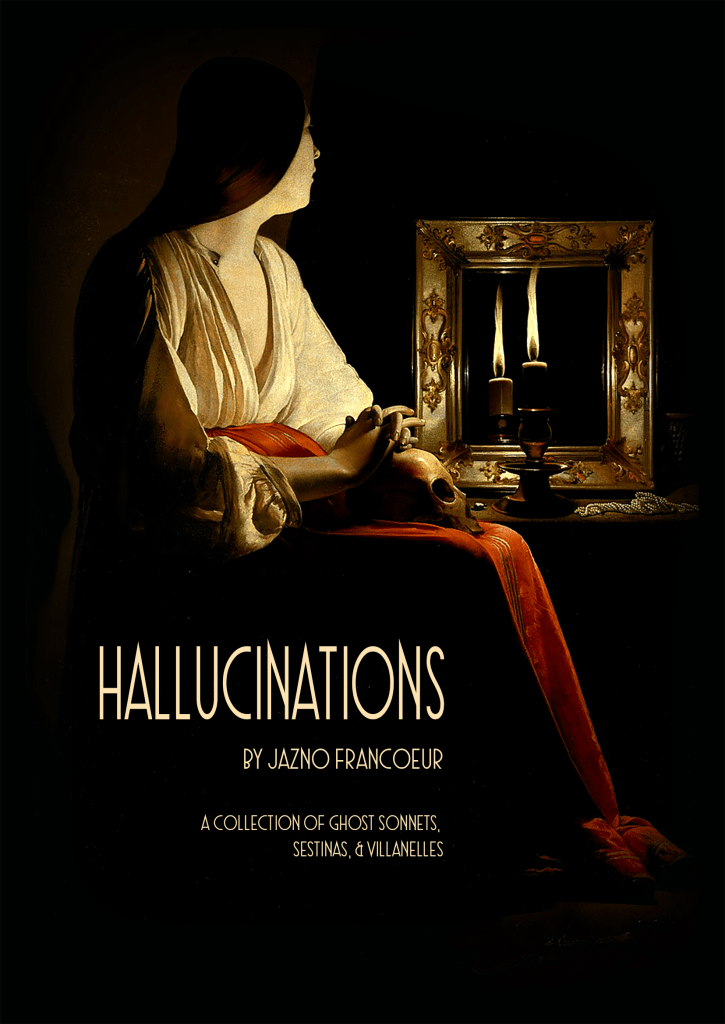
Author: Yadis Tractatus
Prologue
There is too much truth in this; any hand should hesitate to dilute it. The question is what do you do with such a well-crafted hatchet? … Secrets create unexpected worlds. Wrap it in a T-shirt, tie it to your leg and cover it with your trouser; pretend it isn’t there. Only you know the use of the holy paraphernalia.
— Robert Lee Francoeur
The Magic Blanket of Laura Vicuña
As a child, my blanket shielded me
from dangerous men, or so I thought.
When Señor Mora caressed my feet
I made a prayer to that tattered cloth
to make him leave my room, and he did.
When rebel bandits burst through our door
to threaten my family, I hid
under its soft skin with my sister
until they left the estancia.
On the day the Chimehuin River
flooded its banks, my blanket vanished—
later that night, I would discover
mother whispering by the fireplace,
Señor Mora caressing her face.
Day of the Dead
The skeleton with a tan sombrero
copulates with a swollen woman.
There are five houses with broken windows,
behind them a rainbow fence, two mountains.
This is a portrait of you together,
the empty houses you have left behind,
the fence between you and the deep river,
the black mountains you escaped to at night.
I still remember you, señor, fondly,
the moribund thief from a shanty town
stalking my family in the dry streets—
who shook the shards of my banjo down
from the red oak tree, as I stood there dazed
behind the house— while at dusk, drunk gringos
licked their lips and mariachis played
double-time around the corner, cantando:
O La Pistola y El Corazón
O La Pistola y El Corazón.
Fall River at Midnight
Fireflies brighten the grass by the shore
as you pass under the low-hanging trees
in your father’s green aluminum boat
above the submerged farms and rock quarries;
setting the lines on the branches, the leaves
just skimming the surface, you navigate
through an alcove, then settle in between
the bait cooler and the motor to wait.
At times, you see a faint light reflected
from the lamp on a small school of minnows
like silver coins flipping end over end,
disappearing in the darkness below,
while your father gathers a large white net
and casts it out, as if making a bed.
Driving through Salina
I counted the telephone poles as fast
as the horizon could generate them.
Anything to ease the boredom: a vast
row of crosses passing along the edge
of the Kansas interstate—Spartacus
and his defeated men decorating
the Via Appia. There was a verse
my father wrote in the military:
six million miniature Jesuses
marching into the distance. As a boy,
I would sit on his lap to Angelus
as he read from Zen Flesh, Zen Bones. The void
is the hitch between those boxcars, he said,
connecting one brief moment to the next.
Burns, Kansas
Oil pumps rock steadily on the long ridge
like mosquitoes on a sleeping man’s arm
while behind the power plant, frogs emerge
from the black pond. Near a neighboring farm,
an antique radio phases between
“Mr. Sandman” and a faint foreign voice,
occasionally crackling into brief
periods of silence. The older boys
smoke cigarettes underneath a streetlight,
their shadows splayed across the white silos
in the feed lot. Every few hours, headlights
burst over the hill like a flare, a gold
penumbra on the horizon that fades
to a narrow beam above the highway.
Cherryvale
I place my ear against the glass,
cicadas chirr in sorghum rows—
a sidewind moves the brittle grass,
a dust cloud lifts above the road
until the headlights burn it thin.
An engine labors up the grade,
gravel snaps the chassis skin—
axles creak, then comes the frame,
then wheels align outside the yard.
A hinge resists, a door gives way.
A strip of yellow splits the dark;
the porch receives a stranger’s face
becoming mother with each step:
I fold into her long blue dress
Baptism
My uncle watched that tree all winter long—its patient bark,
the rope-scars catching dusk like half-closed eyes;
his boyhood ended there—a narrow pasture marked
by hooves and harm, where lashing is a sign.
He drove us out where ice replaced the shore,
a mirror set against the world’s return;
my brother paled—hands frozen to the door,
the windows starred with snow; the cedars blurred.
We shed our clothes, the snow received our weight,
then wiped our footprints clean as if we’d never come.
John cut a path the storm could not erase
and led us to the shoulder of the pond.
He walked the ice and summoned me alone,
his hammer fixed above the winter skin—
the wind returned; the cattails bent in rows,
my brother watching from the snowbank’s rim.
I held my place; the heavens offered no reprieve—
A boy consents. The ice proceeds.
Ice Breaking
Across the wires, white hairs rest,
caught in red on the barbs.
Her scent lingers near the fence,
worked through stake and spars.
I lift the axe to the moon,
a circle rests in the blade,
hangs there like a pale rune
before the stroke is made.
She stares behind a tree,
snow gives beneath her weight:
she sees the ice break free,
beneath the moonless blade.
Her hips shift; she glides down
across the frozen ground.
 jaznoblog