Honeymoon


HONEYMOONa.jpg

I.

When Christ had driven the money-changers

out of the temple, he couldn’t foresee

the irony— two thousand years later,

I’m outside of the Vatican City

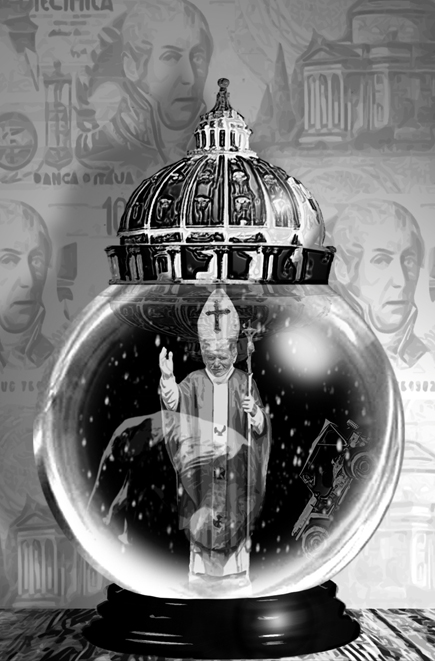
haggling over a Pope in a snow dome

as my wife digs for Lire in her purse.

There is a perverse energy to Rome,

especially inside St. Peter’s Church

where saints and martyrs vie for attention

in the tapestries, frescoes, and friezes—

even the Pieta near the entrance

eroticizes Mary and Jesus,

with their smooth bodies in blissful repose

like lovers having a post-coital smoke.

II.

Joah points to a handsome youth and swoons:

“I could see him in an underwear ad.”

For the remainder of the afternoon

I imagine the slight Italian man

in boxer briefs, tensing for a camera.

In the evening, we take our gracious hosts

to watch “Wozzeck,” a German opera,

then make our way backstage after the show

by posing as American pop stars.

Zubin Mehta fields reporter’s questions

while the lead actor drinks bottled water

and blots his armpits with a wet napkin.

“Do you speak English?” I ask in German.

“Bloody well should.” he quips. “I’m from England.”

III.

On the train back to Florence, my wife rests

as the cypress trees outside the window

gradually recede into the mist

then fade altogether in the shadows.

I stare into the distance, eyes half-closed,

and remember the previous morning:

the frantic mothers running toward the Pope

when he entered the square in a white Jeep,

comically ascending the marble steps

like Ernest Hemingway on safari,

his arms shaking as he reached out to bless

the frightened children. Then I fall asleep

and dream of a woman in the desert

wandering in the sand with a hair shirt.

IV.

I’m jostled awake in the train station,

and immediately look for a pen

to commit the images to paper.

I dreamt of the Penitent Magdalene,

Donatello’s apocryphal figure

in the museum behind the Duomo

which I had visited the week before.

In every doorway, a guard was posted

reminding the tourists: “Please do not touch.”

Their words now took the shape of a poem—

a reference to Mary being rebuffed

after Jesus Christ crawled out of his tomb

and said to her “Noli Me Tangere”

when she threw herself at his wounded feet.

V.

I was uprooted by Donatello—

my trunk carved into a woman’s body,

bent in an eternal contrapposto,

and christened the Apocryphal Mary,

Thus my creator was finished with me

and placed me in a room with large sculptures

where I stood unmolested many years—

when at last, a great flood broke through the doors,

spilling high above the window ledges.

I floated quickly past the Bargello

and saw the bottoms of the old bridges

as I traveled down the turbid Arno

behind Cimabue’s yellow Jesus

and Ghiberti’s gold Gates of Paradise.
St. Catherine’s Head


San Domenico is my reliquary,
a temenos of bronze and marble—
the friars removed my head from my body
to suspend it like a thought in the altar.
I hear them chanting as they don their vestments
in the sacristy before evening Mass
and watch them in procession swinging incense,
bearing the Holy Eucharist as they pass.
Yet there is a secret I hold most dear:
no martyr died with grace or dignity,
for still my fellow prisoners peer
from the frescoes and the tapestries
with a passivity that mocks their pain;
each portrait a lie, the immurement of faith.

Surrender

Spilled wine spreads to the edge of my napkin

over the course of dinner. I confess

my wife has thirteen ribs—then I open

a third bottle as we compare traumas.

The gay waiter interposes his tray

with the indifference of a Greek chorus:

“Our most popular sin is the soufflé.”

An hour later, my red napkin could pass

for a thin sheet of venison tartare.

The waiter pours two flutes of Kir Royal,

palms the bill, then impatiently stacks chairs

behind us. You lean back from the table

as if you were Isaac baring his chest

braced for a father’s judgment.


September Villanelle


SEASONSa.jpg

On the edge of a hill, on a warm day

I asked you to marry me, and you said:

“There is nothing, not one thing that remains

for me to consider.” The wedding came

and went, we settled into a long bed

on the edge of a hill, on a warm day.

In September, we tirelessly made

new friends, then lovers, who’d come to forget

there is nothing, not one thing that remains

constant in this life. We lost them in May,

and then became bitter, filled with contempt

on the edge of a hill, on a warm day.

“I love you” we said each night through the pain,

like a rote incantation to the dead.

There is nothing, not one thing that remains

sacred, I thought. By June, you moved away,

the house empty, our money divided.

On the edge of a hill, on a warm day

there is nothing, not one thing that remains.

The Ascetic


Why was I so compelled, that speaking those
words, I felt a shift—some tacit wheel
turning in the current of our lives?
I’m no mystic. Such visions do not heal.
I’m secretly bourgeois. Do I love you?
I want to be an ascetic—slip the rope,
step from the ledger of desire and rue,
leave little but a name, a fact, a hope.
From Siddhartha to Schopenhauer, all
nihilism keeps its counsel in the dharma:
Desire is the root of suffering—the small
and local truth behind this mantra:
Why was I so compelled, those words released?
A current broke. Something reversed. Or ceased.


The Romantic


I tell myself the house is only wood,
old nails, a roof that leaks when God feels bored.
But every dusk it tilts—a confessional door
ajar—inviting and accusing. You stood
at the kitchen counter, haloed the way
cheap bulbs sanctify a lover leaving.
I watched the terrazzo patterns weave
our shadows, even as they pulled away.
Forgive me—though I never learned for what.
My tongue still tastes of penny metals, sin’s
small currency. “We’re fine,” I said, the thin
lie cracked like plaster in a too-cold spot.
And just like that, the evening filled the room,
light receding from a familiar wound.

I write this with the sun behind my back,
flat on a chipped green table—rough Formica
cold as a hospital tray. I stalled, the brightest
flecks reflecting light like sins I can’t retract.
“Can you be saved?” you asked. Christ—your knack
for dissecting me—and my maniacal
habit of drafting grief into a mythical
shape—left me split between attack
and retreat. What’s needed, I suppose,
is not revision—just the truth: how women
draw us in with that unguarded pose,
the grace note just before the guillotine. Again
I tried to mend the poem, stitch its prose—
but what won’t live won’t rise. Amen. Amen.

Possibilities


POSSIBILITIESa.jpg

“Never say that marriage has more of joy than pain.”

-Euripedes


I. The Estranged Wife


A poem needs rooms, it needs the conceit

of a history. Seal this history

in an envelope, push it underneath

a lonely woman’s door. Make it evening.

Give her things she can use: a living room,

a fireplace, a small lamp on a table,

a telephone, a window, the moon,

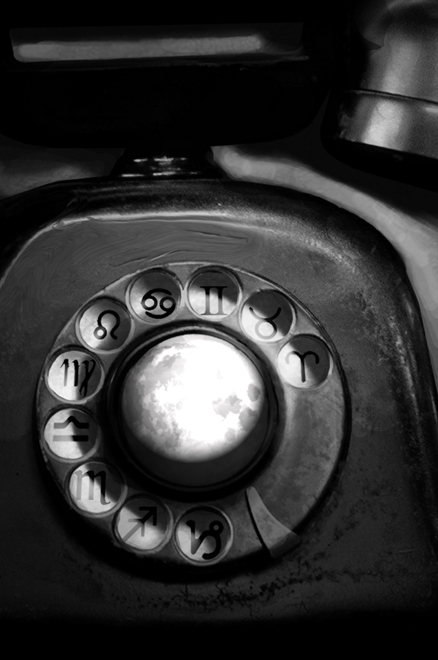
a row of photographs on the mantel.

Sometime after midnight, the telephone

will ring. When she answers, she may study

the pictures, then come to a conclusion.

Her left ear is warm. She is listening.

Every picture is a discrete moment

which has indiscreetly lost its moment.

II. Twilight of the Idols


The day passes, the autumn light slanting

through the blinds and onto the window ledge

as the sun tangents the tips of the trees.

Our two black cats hide underneath the bed

when an airplane passes in the distance,

its low rumble lingering in the sky

then tapering slowly into silence

along with the last vestiges of light.

The neighborhood dogs bark in unison

at some indiscernible animal

and the blue glow of the television

casts cobalt shadows on the bedroom wall.

I pull you toward me to kiss your neck,

your cold back pressing against my stomach.

III. The Lucid Husband


The moon crystallized to sugar last night,

Ants crawled over its surface, gathering

in craters, visible to naked eyes.

It was shaping into a strange morning:

the paper was delivered an hour late,

our cat menaced a bag in the corner—

outside the front window, a meter maid

wrote tickets without pausing her scooter,

like Lao Tzu scribbling the Tao Te Ching

on horseback. Even more peculiar:

the furniture was gone—the house empty,

save for a small radio on the floor,

Patsy Cline’s sweet tremolo now drifting

from the living room into the kitchen.

IV. Lover’s Leap


A phone is ringing in the upstairs room.

You answer it politely in your mind—

perhaps your future ghost is calling you,

to tell you now to look beneath the blinds,

carefully pull upon the vinyl string

and bare the pages of a tattered will

purposely lodged between the frosted teeth

of a splintered pane and the window sill,

a checklist for the hopeful suicide

to review before some Brechtian leap—

just a cursory glance may well suffice

to nudge you further from the edge of sleep.

Feed the cat. Return your physician’s call.

Make sure you clear the hedges when you fall.

The Empty House

I.

Be as an empty house. Send your guests away

and let the halls go dim. Block out your children.

Lower the blinds. Let the muted gray

settle into the shape your quiet has taken.

Assign each pain its room—unfurnished, plain—

a presence you know by outline alone.

Enter when you must. Leave when you regain

the small composure absence makes its own.

The ascetic is a vessel, narrow and exact,

a conduit pared to what he will endure.

He divines the little he can of the house intact

and lets the unsolved chambers remain obscure.

There is no time for solace or display.

Only the discipline of turning things away.

II.

The romance of leaving. The romance of staying.

Two bodies in the same unlit corridor,

each testing the frame, each quietly weighing

what is kept, what loosens, what presses for more.

You built the inner rooms again—unadorned,

its thresholds cleared, the echoes unbidden.

You crossed it lightly, believing you had mourned

what needed release, your solitude thinned

to something almost bearable. Yet she arrived

without design, and took a room untouched—

a chamber neither grief nor will supplied,

though both had held the others just enough.

Whatever emptiness promised to allay,

she is the one you must never turn away.

Far From the Edges of a Conceit

There is the image that is removed
from the source: the room unmaking space
around a candle—the light denuded,
a breath withdrawing from its place.
Or the space around that breath—where we
hold our bodies in the mirror’s frame,
repeating some inherited degree
of mother, father—gestures without name.
To be inside and outside the room,
to be inside and outside our bodies—
the light does not distinguish. Assume
the eye returns to where it used to be,
and thought, unlit, divides what we are taught:
two bodies bending toward one thought.


Severance

The art of the second was born of need:
to sever the head—let it descend
to the retainer’s lap with proper speed
still hitched to the flesh it must transcend,
a newborn’s tether, pale and stubborn, caught
between what leaves and what refuses still.
Mercy and taste: the blade that answers thought,
the practiced hand that sanctifies the skill.
One final stroke to staunch a benediction
or to close the mouth before it speaks in vain—
and spare the watchers any fleck of sin;
the blood directed to a higher plane.
The breath revoked, the body’s work undone—
the tether breaks. There is no resurrection.