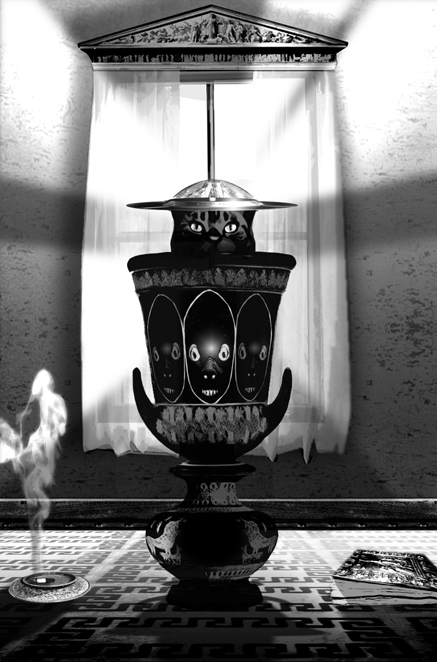
Leadville

I choose a corner where the rafters lean,

so near they press the night against my skull;

the joists resist—the timber, tight and mean—

and walls grow thin enough to hear your pulse.

The mountain’s dust has settled in your chest;

you vanish downward—wordless, slow, and deep—

the earth receiving you like stolen breath.

No ladder down. No light to mark the slope.

You disappear the way a door goes dark.

You said: The fire’s near—move from the tribe;

strike flint to keep our worlds apart.

Don’t stay too long in Leadville’s starless night.

Repeat the tale: this town is not your home;

the blood that stains its rocks is yours alone.

Kettenbiel

We moved from town to town, no place to rest,
old griefs receding in the mirror’s black;
the next one waking somewhere in the west,
with Kettenbiel descending at our back.
Our heads were thick with troubled dreams—
a slanted flight that shifts the summer grass;
our mother’s lover tracking us, a pulse of green
through broken stalks, their edges sharp as glass.
The engine failed and left us where it died,
the road a scar where counties split in half;
a water tower rising past the power lines,
where nameless byways narrow into chaff—
we slept inside the car that night, alone;
at dawn we rose and called the town our home.

The mornings gave no rest—just fear again;
we slept, we rose, with eyes still on the road;
no mercy there, just nights that clung like skin,
a faceless time that passed beyond the oaks.
Next winter brought a package to our fence:
a frozen keepsake, some inverted ark
from Kettenbiel, our mother knew at once—
that thing that settled there against the dark.
She counted every car that didn’t turn,
each flickered headlight splintered through the slats
as if a secret lifted miles from her,
the box already open in her hands.
It knew the door. It knew the shape of us.
A red pulse beat, and silence did the rest.

The Embrace

for Troy Gustafson

If you’re standing within swinging distance,

you’re standing too close, you’d say, shoulders squared.

But you were all bluster. In Nebraska parlance,

it really meant I want to embrace you as a brother.

You knew the same back roads I traveled and forgot,

those gravel barrens leading mostly nowhere,

to overgrown cul-de-sacs or abandoned feed lots,

the kind urbane folk rightfully fear.

To say we held debates would be a slander.

You would only offer: Speak plain. You’d say:

With your words, you could bring many over

to Christ. I was too arrogant in those days

to parse my pain from my avarice,

too cocksure to accept what was

the deepest embrace: the promise beyond

brotherhood—of stewardship and sacrifice.

Your death has only hardened what was wrong

when I left my church in that corner of Kansas

too afraid to claim myself, too young

and unwilling to forgive my family

for their imperfections. One by one,

they are crossing over; any lingering grief—

any doubt their corporeal bodies

resurrect to light in paradise—

could now only be construed as mocking

the dead, or a disregard for the righteous—

or worse yet, a violation of the faith

you put in me with your embrace.

Highway 84

Outside of Boise, four black horses bolt
quickly past my window, slow to a trot,
then pull away, their obsidian coats
shimmering like sunlight on the blacktop.
I am barely awake. The night before,
in the panhandle of Oklahoma,
I fixed a flat tire in a lightning storm,
watching the dense nerves of light branch over
the blue nimbus clouds in the northern sky.
There was no sound, other than the engine.
On such a night, Saul may have held his knife
closer to his chest—by morning, the sun
nothing more than a warm breath on his cheek,
his horse leading him into the city.

I will arrive in Seattle tonight

to visit the bed of an old lover.

What do I tell her—Do I fill her head

with secrets, or brush the truth like dander

from my hair? There is no balm in Gilead,

this is not manna, nor gossamer flakes

from desiccated saints whose frozen ash

melts on my tongue– it is the Cascade’s

autumn wind blowing through Snoqualmie pass,

shaking the white crowns from the evergreen.

On the outskirts of Moses Lake, a crow

skims their broken tips– like an augur’s dream

scattered by daylight on the open road,

it wings irrespective of my vision,

angling lightly over Washington.

Fireweed

In spring, fireweed sprouts above Puget Sound,

rose-tipped cairns that lure a flock of seagulls

downward, winter-worn, to form a hill’s crown.

In the mouth of the bay, a tugboat’s hull

severs the slack water like black fabric,

the shape of the prop-wash an oil-green trail

that opens as a fan. The captain flicks

his cigarette butt against the ship’s wheel

and turns south to the beach, taking a fix

on the basalt cliffs at the shoreline’s rim,

the chalk-white shelves collapsed above the rocks.

He charts a constellation on his arm,

the face of a hill which blooms in a rash

the birds now spiraling upward like ash.

Lupa Noctus

At night, the shadow of a wolf descends

down the frozen shoulders of the forest

to settle by the window of this house–

I see her figure held within its frame

and she in turn watches me from the yard,

the shadow of a cross against her face

casting from my window upon her face–

but when the smoke above the roof descends

it drifts past every corner of the yard

and pools below the edges of the forest

and spills around the contours of her frame

to turn her from the light beyond this house

to turn her as a secret from my house.

Yet she returns to gaze upon my face

on smokeless nights, to grace my window frame

and bless the moonlit grass when night descends,

singing with her brothers in the forest

whose chorus echoes outward from the yard.

Beyond my bed, she beckons from the yard

her breath beneath the floorboards of this house

bearing winds that gather in the forest

now rising from my ankles to my face.

In dreams, the shadow of a wolf descends

slowly below my headboard to the frame

till I am frozen fast against the frame.

Her frozen breath vanishes in the yard,

her cobalt eyes recede, then she descends

the broken marble path behind the house

and leaps behind the fence’s northern face

to join her brothers deep in the forest

past the open shoulders of the forest.

I wake to see her near the window frame,

who peers from shadows cast across her face,

who warms her winter body in the yard

and leaves her restless spirit in my house.

I praise her every night when she descends,

when her shadow turns to face the forest

and smoke descends below this window frame

to fill the yard, turning her from my house.

Figurina Spiritinata


(A Portrait)


Your breath, a white net, a gossamer veil

falling into the dark waters beside

your hand. Your hand, a coral branch, a gray

comb, now parting the curtains from your eyes.

Your eyes, two halos, fire-ringed coronas

beaming bright as moons against the blue skin

of your face. Your face, a cobalt opal,

a smooth luminescent stone balancing

upon your shoulders. Your shoulders, a wood

frame, a cross buried in the sand, pressing

into your spine. Your spine, a marble road,

a long porcelain serpent constricting

around your womb. Your womb, a burning house,

a violet light pluming into your mouth.

Strangers in the Pyrenees

Entranced by the ersatz girl, an old man’s heart
wells upward into ecstasy. He stands—
a mast in unseen currents—a world apart,
blanched below the chalky night’s commands.
He floats below wisterias and willows,
their moonlit drapery pulling him along
toward her curious gaze. Her posture follows:
she bares her chest as if the wind were strong—
a child, a sacrifice of blind abandon,
she calls to him: the rocks are not your end.
The hillside, mute and stony, makes its summons
over the ones who falter, break, and bend.
He nears the edge; the dark would take him in.
She calls again—the rocks are a benediction.


Monday Morning

or Ode to Countess Motorboat and Alexis (after Wallace Stevens)

MONDAY MORNINGa.jpg

I.

She pushes her cat like a sacrifice

over the soft edge of the water bed

to mingle on the rug in the sunlight

with paperbacks annotated in red

and crushed cigarette butts in coffee tins.

In the window, elongated figures

are frozen behind her saffron curtains,

like relics in primordial amber

or Greeks adorning a black-figure vase—

a primitive diorama where light

throws canted shadows over the bookcase

past the kitchen wall—while her sleeping mind

quietly imposes an obverse world

behind her eyes, the shades of Grecian girls.

II.

Like the Ergastines in procession

passing half-dazed through a marble city,

she marvels at her unbidden passions

preserved for antiquity, in a frieze

forever fixed within the pediment

above her, mounted on her bedroom wall.

Then her sable cat pounces on the bed—

she wakes, stares at the alabaster vault:

What is divinity if it can come

only in dreams, after reading a book?

She looks over to the glowing curtains,

to the strange figures with extended necks

floating, Giacometti-like, in the sun,

who, voice by voice, seem almost alien.

III.

The tyrant god invented his own birth,

invisible spirits strewn about him,

and he moved among us, composing worlds

and the stubborn leavings of his system—

with neither allegiance to earthly souls

nor fear of a god more omnipotent

to move or mitigate such requital,

to desire something other than himself.

And from his nebulous perch, divided

man in twain, giving him body thetans

to antagonize his vulnerable side

like the vultures pecking at Tityus.

The muttering king, listless in the clouds,

thus filled the world with a peculiar doubt.

IV.

She says: “I’m gladdened when my Bombay cat

returns to me—bounding from the rug.”

She floats on her wide bed, her noontide raft,

and navigates the emptiness above,

the splintered beams where every lucid thought

must interpose: “Where, then, is paradise?”

As if watching martyrs chained to a rock,

she places her hands over her eyes

to avert that ancient catastrophe,

the slow encroachment of the years

now shuffling like a chorus at her feet,

long after the sunlight has disappeared—

further into the water bed, she sinks

as it undulates on suspended dreams.